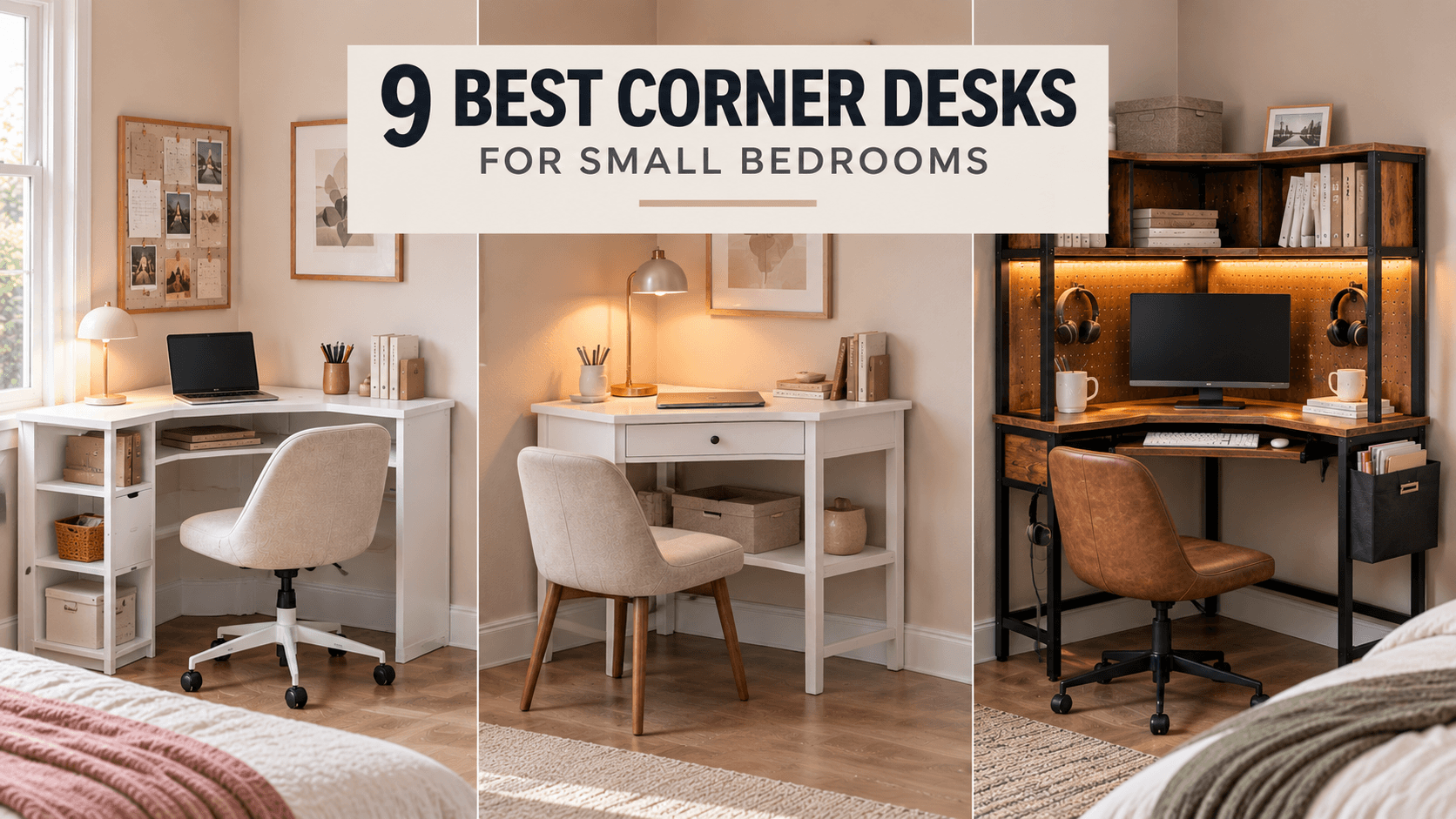
9 Best Corner Desks for Small Spaces and Bedrooms
Disclosure
This post may contain affiliate links. If you purchase through these links, I may earn a small commission at no extra cost to you. As an Amazon Associate I earn from qualifying purchases.
Finding a desk for a small bedroom sounds simple until you start looking at the measurements. Many so-called “corner desks” stretch 40 to 50 inches along both walls and swallow half the room.
That’s why I narrowed this guide to corner desks that genuinely make sense in small bedrooms and apartments. Every pick is designed around a 90-degree corner instead of simply being a smaller L-shaped office desk.
But footprint wasn’t the only thing I compared.
Some desks save space with keyboard trays. Others hide clutter inside drawers. Some use vertical space with shelves or hutches instead of taking over more floor area. And a few are worth considering only if your corner needs to function as a full workstation.
Rather than picking the desk with the longest feature list, I looked at which features actually earn the space they occupy.
The Best Corner Desks for Small Spaces at a Glance
| Product | Best For | Approx. Footprint | Storage | Standout Feature |
|---|---|---|---|---|
| Armocity Corner Desk | Best Overall for Tiny Bedrooms | 26.8″ × 26.8″ | Lower shelf | Built-in power and USB |
| ODK 28.3″ Corner Desk | Best Small Corner Desk With a Keyboard Tray | 28.3″ × 28.3″ | Lower shelving | Pull-out keyboard tray |
| Sedeta Corner Desk | Best Corner Desk With Drawers | 31.5″ × 31.5″* | Drawer + lower storage | Concealed storage |
| Tangkula Corner Desk | Best Small Corner Desk With Storage | 34″ × 34″ | Adjustable shelving | Flexible storage layout |
| Uniheim Corner Desk | Best Corner Gaming Desk With a Monitor Stand | 28.1″ × 28.9″ | Monitor stand + shelves | Compact gaming setup |
| Vecelo Corner Computer Desk | Best for More Desktop Space | 41″W × 29.5″D | Lower shelves | Larger work surface |
| Lvifur Corner Desk | Best Corner Desk With Bookshelf Storage | 35″ × 35″ | Tall shelves/hutch | 63″ vertical design |
| Sedeta Corner Desk with Hutch | Best Corner Desk With a Hutch | 38.9″ × 38.9″ | Hutch + accessories | Larger workstation |
| Pamray L-Shaped Computer Desk | Best L-Shaped | 39.3″ × 27.5″ | 2 open adjustable shelves | Reversible L-shaped workspace |
1. Armocity Corner Desk With Outlets — Best Overall for Tiny Bedrooms
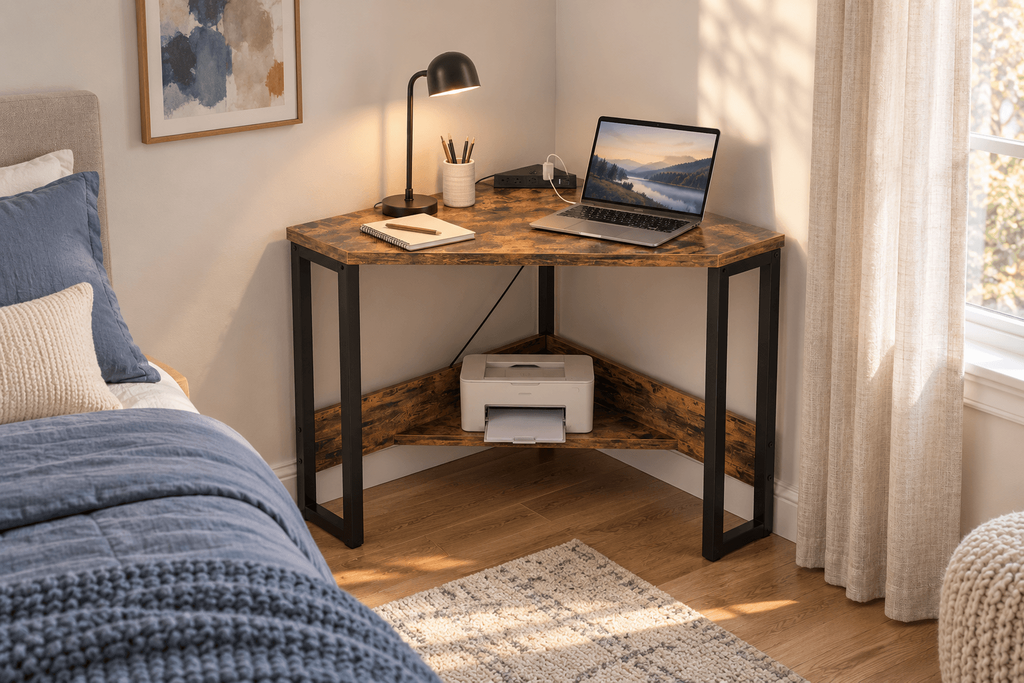
The Armocity is the desk I would start with if the main problem is simply finding enough room for a proper workstation in a tiny bedroom.
It doesn’t try to turn one corner into an entire office. Instead, it combines a very compact triangular desktop with basic storage and built-in power while keeping the structure relatively open.
Key Specs
- Dimensions: Approx. 26.8″ × 26.8″ × 29.6″
- Storage: Lower triangular shelf
- Power: 2 AC outlets + 3 USB ports
- Frame: Metal
- Desktop: Engineered wood
Why We Chose It
The strongest argument for the Armocity is its footprint.
At roughly 26.8 inches along each wall, it requires materially less room than the 34-, 35-, and 39-inch desks later in this guide. That difference matters when your “office” has to fit between a wardrobe and a window or into the one corner that isn’t already occupied by the bed.
The integrated charging also makes more sense here than it might on a large desk. When the desktop itself is small, adding a separate power strip, charging hub, and multiple adapters can quickly eat into the space you’re trying to preserve.
The lower shelf gives you somewhere to move a few books, supplies, or a small basket without turning the desk into a tall storage unit.
There are desks below with more storage and larger work surfaces. But for a genuinely tight bedroom, the Armocity has the best balance of small footprint, everyday functionality, and relatively low visual weight.
Pros
- Fits corners that are too short for most conventional desks
- Leaves more surrounding floor and wall space available for other bedroom furniture
- Built-in charging makes it easier to keep adapters off the desktop
- Open frame feels less bulky than cabinet-style corner desks
- Lower shelf provides useful overflow storage without adding a hutch
- Particularly practical for laptop work and modest single-monitor setups
Cons
- Work surface will feel restrictive if you regularly spread out papers or equipment
- No drawer for hiding smaller office supplies
- Open lower storage remains visible
- Not a realistic choice for a large multi-monitor workstation
- Available evidence supports its configuration and compactness more strongly than long-term durability claims
Small-Space Verdict
Best for: Very small bedrooms, laptop users, and compact single-monitor setups.
Choose the Armocity when preserving room around the desk matters more than maximizing the desk itself.
If your keyboard permanently occupies too much of a small desktop, however, the ODK gives up only a little more corner space while moving the keyboard onto a separate tray.
Check Price of the Armocity Corner Desk on Amazon
2. ODK Corner Desk — Best Small Corner Desk With a Keyboard Tray
The ODK solves one of the most annoying problems with a tiny computer desk: the keyboard can take up a disproportionate amount of the available surface.
Instead of making the entire desk larger, ODK adds a pull-out keyboard tray underneath it.
Key Specs
- Dimensions: Approx. 28.3″ × 28.3″ × 29.9″
- Keyboard Tray: Pull-out
- Storage: Open lower shelving
- Frame: Metal
- Desktop: Engineered wood
Why We Chose It
The ODK is only slightly larger along the walls than the Armocity, yet its configuration is better suited to someone using an external monitor and keyboard every day.
That is the key difference.
A keyboard tray doesn’t technically increase the size of the desktop, but it changes how much of that surface remains available. Your monitor can stay above while the keyboard slides underneath, leaving more room for a mouse, notebook, or whatever you’re actively working on.
The lower shelving handles supplies that would otherwise compete for the same small work surface.
There are larger desks in this guide that also include keyboard trays. The ODK wins this category because you get that functionality without first turning the desk into a 39- or 41-inch workstation.
Pros
- Makes better use of a small desktop when you use a separate keyboard
- Requires less than 30 inches along each wall
- Lower shelving reduces the need for a separate office storage unit
- More computer-friendly than a basic triangular writing table
- Keeps the main surface clearer during everyday work
- Compact enough to remain realistic for many small bedrooms
Cons
- Pull-out tray adds another component that needs to be assembled and aligned properly
- Oversized keyboards and gaming peripherals may feel cramped on the tray
- Open shelves do little to hide visual clutter
- Still too small for people who need a broad surface for paperwork or multiple screens
- No integrated power like the Armocity
Small-Space Verdict
Best for: Small bedroom workstations with a monitor and external keyboard.
Choose the ODK over the Armocity when desktop organization matters more than saving the final inch or two of wall space. If you mainly use a laptop, the keyboard tray is less valuable. In that case, the Armocity’s built-in charging may be the more useful feature.
Check Price of the ODK Corner Desk on Amazon
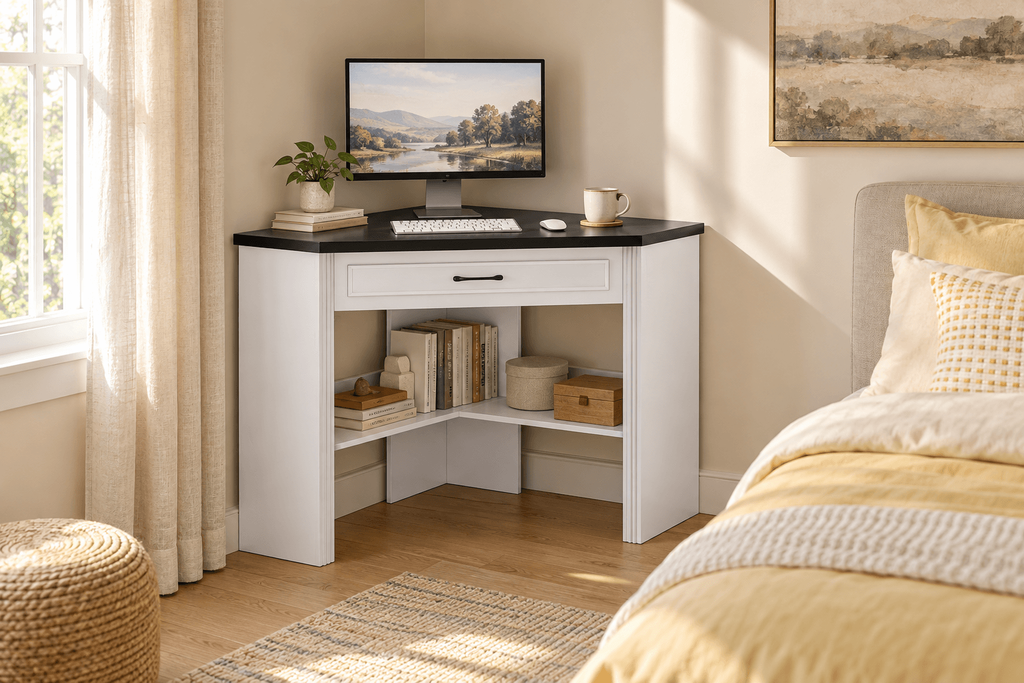
3. Sedeta Corner Desk — Best Corner Desk With Drawers
Open shelves are useful, but they don’t solve every storage problem.
Chargers, pens, paperwork, and all the little things that accumulate around a desk can still make a small bedroom look cluttered even when they’re technically “organized.”
The Sedeta desk gives those items somewhere to disappear.
Key Specs
- Dimensions: Approx. 31.5″ × 31.5″ × 31.5″
- Storage: Drawer + lower open storage
- Material: Engineered wood
- Weight: Approx. 43.5 lb
Why We Chose It
This Sedeta is the most convincing option in the group if you want a corner desk with drawers rather than another open metal-frame workstation.
The drawer isn’t just an extra feature. Concealed storage is particularly valuable in a bedroom because the desk remains part of the room when you’re not working. Putting stationery, charging cables, and other small items away helps the corner visually settle back into the bedroom instead of permanently looking like an office.
The lower storage then handles larger items that don’t need to occupy the desktop.
Its furniture-style appearance is another advantage in this setting. Compared with a gaming desk or exposed steel frame, it can integrate more naturally with a dresser, nightstand, and other bedroom furniture.
The tradeoff is that it isn’t as tiny or visually light as the first two recommendations.
There’s also a genuine specification issue worth knowing about. The most consistent measurements put the desk at approximately 31.5 inches along each wall, but some product data has also shown a conflicting 44.5-inch measurement. I would use the manufacturer’s current dimension diagram not an isolated marketplace specification field before deciding whether it fits your corner.
Pros
- Concealed drawer keeps small everyday clutter out of sight
- More bedroom-friendly appearance than many computer-style corner desks
- Combines hidden and open storage instead of relying entirely on shelves
- Can reduce the number of desktop organizers you need
- Moderate footprint provides more storage without moving into full-hutch territory
- Good option for a desk that will remain highly visible from the bed
Cons
- Requires more room than the Armocity and ODK
- Assembly is a more significant part of the setup than with a simple open-frame desk
- Solid furniture-style construction looks heavier in a very tight room
- Drawer and storage structure reduce some of the openness underneath
- Conflicting published dimensions mean measuring from the current product diagram is especially important
Small-Space Verdict
Best for: Bedrooms where you want the workspace to look tidy when you’re not using it.
The Sedeta makes sense when you would otherwise buy a compact desk and then cover it with organizers because there’s nowhere to put anything. If you prefer flexible shelf storage to a drawer, the Tangkula below gives you more freedom to configure the lower section around what you actually own.
Check Price of the Sedeta Corner Desk on Amazon
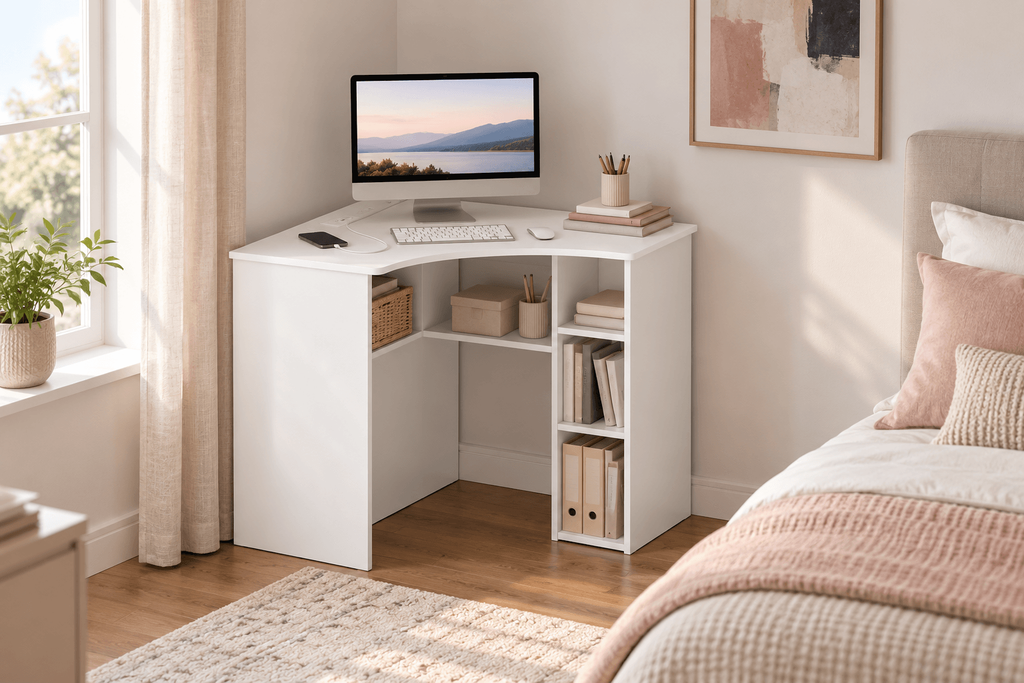
4. Tangkula Corner Desk — Best Small Corner Desk With Storage
The Tangkula takes a different approach to storage.
Instead of giving you one drawer or a tall fixed hutch, it uses the area beneath the desktop for adjustable open shelving.
That makes it one of the more adaptable options if your desk needs to store more than a laptop and a few pens.
Key Specs
- Dimensions: Approx. 34″ × 34″ × 30.5″
- Storage: Two lower shelving sections
- Shelves: Adjustable
- Desktop Capacity: Up to approx. 200 lb, manufacturer-listed
- Shelf Capacity: Approx. 22 lb each, manufacturer-listed
Why We Chose It
A desk with storage only saves space when the storage is useful enough to replace something else.
That is the exact mark this Tangkula model hits.
The adjustable lower shelving lets you change the spacing around books, baskets, office supplies, or taller items instead of being stuck with fixed cubbies that may not suit what you own.
At around 34 inches along each wall, it is noticeably larger than our most compact picks. But the extra footprint is easier to justify if those shelves mean you don’t also need a small bookcase, rolling drawer unit, or another storage piece beside the desk.
It also keeps all of that storage below desktop level. For a small bedroom, that can feel less imposing than a 60-inch-plus hutch rising above the workspace.
Pros
- Adjustable shelving accommodates different storage needs better than fixed cubbies
- Can combine workspace and office storage within one corner
- Keeps frequently used supplies within easy reach
- Lower storage doesn’t dominate the wall the way a tall hutch can
- Useful for baskets if you want some of the open storage visually concealed
- Offers more capacity than minimalist corner desks without becoming a full workstation
Cons
- 34-inch wall runs are no longer exceptionally compact
- Open shelves need some restraint or they can make the room look busier
- No drawer for hiding small loose items
- Extra shelving is wasted floor-space investment if you don’t actually need the storage
- More components make assembly more involved than a basic triangular frame
Small-Space Verdict
Best for: Someone trying to fit both a workspace and useful storage into the same corner.
Choose the Tangkula when its shelves can replace another storage piece rather than simply giving you more places to accumulate things. If hidden storage is more important than capacity, the Sedeta desk is the better choice.
Check Price of Tangkula Corner Desk on Amazon
5. Uniheim Corner Desk — Best Corner Gaming Desk With a Monitor Stand
Gaming desks have a tendency to get enormous.
The Uniheim goes the other way. It combines a monitor stand, keyboard tray, shelves, and LED lighting in a footprint of roughly 29 inches.
That makes it one of the few gaming-oriented configurations here that still makes sense for a genuinely small bedroom.
Key Specs
- Dimensions: Approx. 28.1″W × 28.9″D
- Desk Height: Approx. 28.4″
- Monitor Stand: Yes
- Keyboard Tray: Yes
- Storage: Two shelves
- Lighting: LED
Why We Chose It
The monitor stand is the feature that earns this desk its place.
On a tiny desktop, a monitor base can consume a surprising amount of usable surface. Raising the monitor gives it a dedicated position while the keyboard tray creates another working level underneath.
The result is effectively a vertically layered workstation: monitor above, active desktop in the middle, keyboard below, and additional storage around it. That’s a more sensible small-space strategy than simply making the desktop wider.
Its gaming styling also answers a different need from the ODK. Both are compact and both have keyboard trays, but the ODK is the simpler computer desk. The Uniheim is for someone specifically looking for a small corner gaming desk with a monitor stand and related setup features.
Pros
- Raised monitor position leaves more of the main desktop available
- Packs several workstation zones into unusually short wall runs
- Keyboard tray separates another large peripheral from the work surface
- Shelves give gaming accessories and supplies dedicated locations
- More realistic for a small bedroom than most oversized gaming desks
- Useful if you want gaming features without committing an entire wall to the setup
Cons
- Compact footprint still limits the amount of gaming equipment you can realistically keep on it
- LED styling may look out of place in a softer or more traditional bedroom
- Multiple shelves and accessories can make the corner visually busy
- Evidence for long-term durability is more limited than for some of the more established products
- Published information does not document the complete assembled vertical dimensions as clearly as I would prefer
Small-Space Verdict
Best for: Compact single-monitor gaming setups.
The Uniheim makes sense when you want gaming functionality but don’t have room for the large L-shaped desks that dominate the category. For straightforward office work, I would still choose the ODK. For a larger gaming or multi-monitor setup, the 39-inch Sedeta later in this guide is more realistic.
Check Price for Uniheim Corner Desk on Amazon
6. Vecelo Corner Computer Desk — Best for More Desktop Space
Not everyone with a small bedroom needs the smallest desk that will physically fit.
Sometimes saving another five or ten inches creates a desk that’s technically space-efficient but frustrating to use every day.
The Vecelo is for the opposite situation: you have a little more corner space and want to spend it on a more comfortable work surface.
Key Specs
- Dimensions: Approx. 41″W × 29.5″D × 30″H
- Keyboard Tray: Pull-out
- Storage: Two lower shelves
- Frame: Metal
- Desktop: Engineered wood
Why We Chose It
The Vecelo is not our smallest recommendation, and that’s precisely why it’s here.
Its approximately 41-inch front gives you more room to work than the miniature triangular desks. A monitor doesn’t immediately dominate the entire surface, and there’s more flexibility for a notebook, mouse, paperwork, or other items you’re actively using.
The keyboard tray helps preserve that surface, while the lower shelves provide storage without adding a tall structure above the desk.
That makes it a useful step up from the ODK. Both accommodate a keyboard below the main surface, but the ODK prioritizes compactness while the Vecelo prioritizes working room.
Its dimensions are also better corroborated than several of the newer models considered for this guide.
Pros
- More comfortable surface for regular desk work than the smallest triangular models
- Better suited to using a monitor while keeping space available for other tasks
- Keyboard tray prevents peripherals from consuming the additional desktop area
- Lower shelves add accessible storage without creating a tall wall of furniture
- Good middle ground between a tiny corner desk and a large office workstation
- Makes sense when comfort matters more than squeezing out every possible inch
Cons
- Requires substantially more room than the Armocity, ODK, or Uniheim
- Larger front edge has more physical and visual presence in a bedroom
- Open storage leaves supplies visible
- Not the right choice for a genuinely tiny leftover corner
- The larger surface can become a clutter magnet if you don’t actually need the extra room
Small-Space Verdict
Best for: Small bedrooms with enough room for a more comfortable everyday workstation.
If the Vecelo fits without narrowing your walkway, interfering with a wardrobe, or crowding the bed, I wouldn’t automatically downsize to a 27-inch desk just because it’s smaller.
The best small-space furniture isn’t always the smallest furniture.It’s the one that fits without getting in your way.
Check Price for the Vecelo Corner Computer Desk on Amazon
7. Lvifur Corner Desk — Best Corner Desk With Bookshelf Storage
This piece goes beyond just fitting a small corner. It actively replaces other furniture to free up floor space.
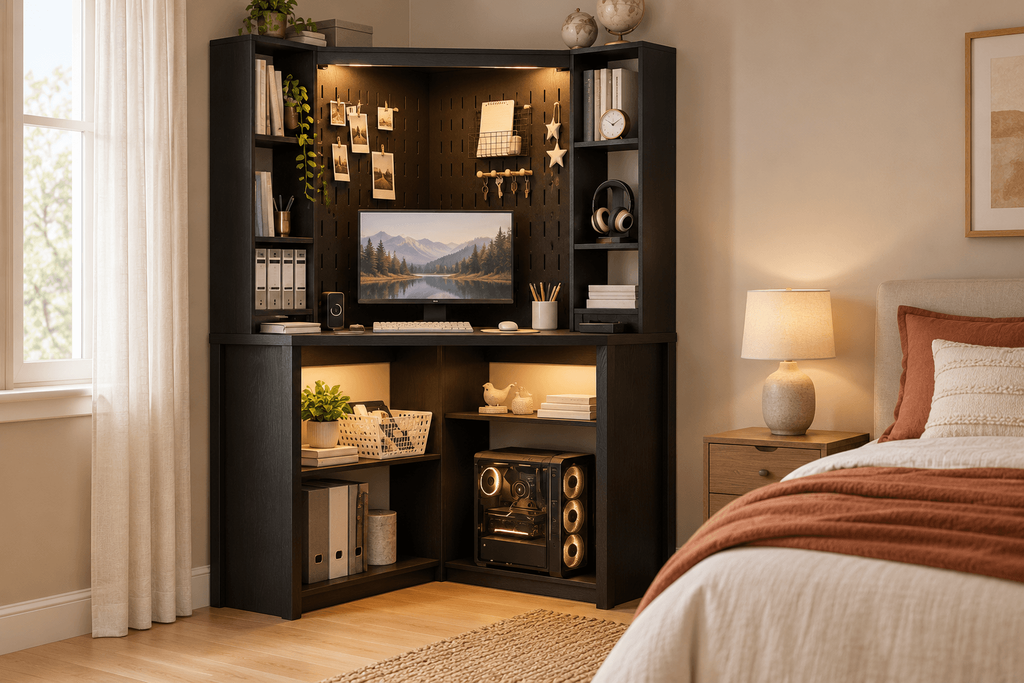
At approximately 63 inches high, this is not a visually minimal piece. But it combines a corner workstation with substantial vertical shelving, charging, and task lighting within roughly 35-inch wall runs.
Key Specs
- Dimensions: Approx. 35″ × 35″ × 63″
- Storage: Tall hutch/bookshelf + multiple shelves
- Power: Integrated charging station
- Lighting: Built-in reading/task lights
- Weight: Approx. 75.7 lb
Why We Chose It
The Lvifur only makes sense as a small-space recommendation if you look beyond the desk itself.
If you need a workstation and somewhere to keep books, supplies, and other items, using the wall above the desk can be more efficient than placing a separate bookshelf elsewhere in the bedroom.
That’s the job this desk does.
Its 63-inch height creates substantially more vertical storage without extending another piece of furniture across the floor. Integrated charging and task lighting can also reduce the number of separate accessories that need to sit around the workstation.
But there is a real tradeoff.
Vertical furniture saves floor space; it does not necessarily make a room look larger. The Lvifur will have much more visual presence than many of the desks on this list. In a very small bedroom, that difference can matter almost as much as the measurements.
Pros
- Can consolidate a desk and small bookshelf into one corner
- Uses vertical wall space that might otherwise go unused
- Keeps books and supplies away from the active desktop
- Built-in lighting can be useful in a dark bedroom corner
- Charging features reduce the need for separate desktop accessories
- Particularly useful when there isn’t another good location for shelving
Cons
- Tall structure makes the desk visually much heavier than low-profile alternatives
- 35-inch wall runs require significantly more room than the smallest picks
- Open shelves can amplify clutter if they are filled indiscriminately
- At roughly 75 pounds, this isn’t a piece you’ll want to move frequently
- Overkill if you only need somewhere to use a laptop
- Evidence for this model is thinner than for our strongest finalists, so I would not choose it based on unverified durability claims
Small-Space Verdict
Best for: Bedrooms where you need both a desk and substantial book or office storage.
The Lvifur earns its space when it allows you to remove another piece of furniture from the room. If you already have enough storage elsewhere, I would skip the hutch entirely and choose a lower desk. The Tangkula gives you useful shelving with far less vertical bulk.
Check Price of the Lvifur Corner Desk on Amazon
8. Sedeta Corner Desk With Hutch — Best Corner Desk With a Hutch
The largest desk in this guide is here for a reason.
Sometimes the challenge usually isn’t fitting a basic desk into a bedroom. It’s squeezing in a complete, functional setup without taking over an entire wall.
That’s where this Sedeta model fits.
Key Specs
- Desktop: Approx. 38.9″ × 38.9″
- Overall Height: Approx. 62″
- Storage: Hutch + additional storage accessories
- Keyboard Tray: Yes
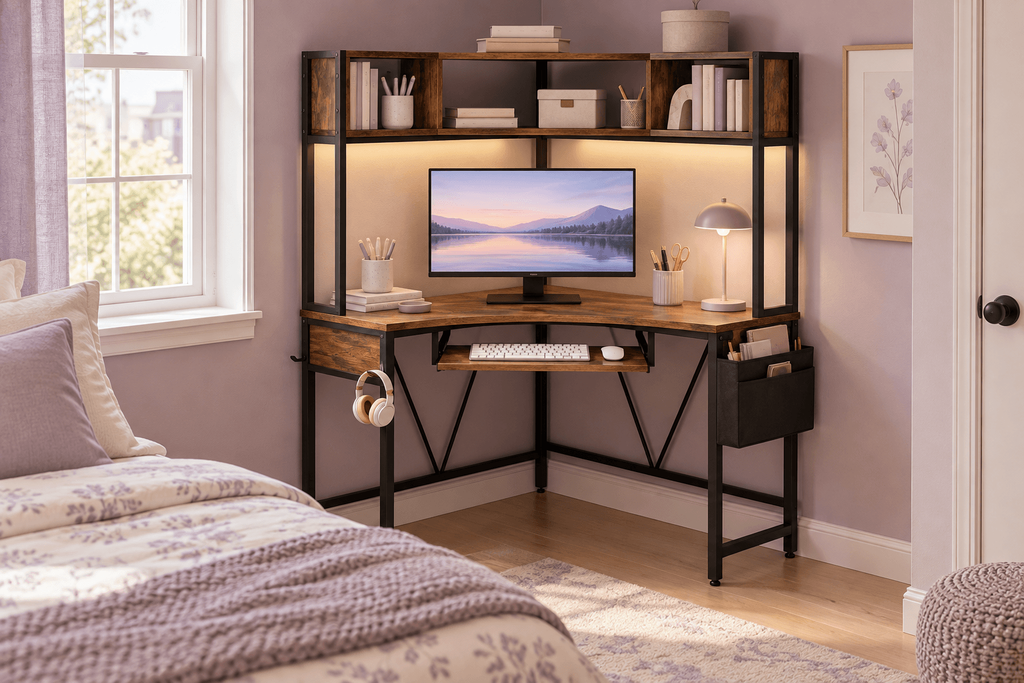
- Extras: Storage bag, headphone hook, and LED lighting
- Setup: Designed to accommodate a larger monitor configuration
Why We Chose It
This desk offers something the compact desks simply can’t: enough working area for a more substantial computer setup.
Its roughly 38.9-inch desktop is considerably larger than our tiny-bedroom picks, while the keyboard tray and hutch move peripherals and storage away from the main surface.
For someone who needs monitors, accessories, and storage, that can be a better use of one corner than buying a small desk and then surrounding it with extra furniture.
But I would not describe this as a tiny desk.
With almost 39 inches along both walls, an open-front span of roughly 55 inches, and a tall hutch, it needs real breathing room.
The word “corner” can make furniture sound inherently space-saving. It isn’t. This desk saves space only if its larger workstation and storage replace things you would otherwise need elsewhere.
Pros
- Provides enough surface area for a more demanding computer setup
- Hutch turns unused wall height into office storage
- Keyboard tray keeps a large peripheral off the primary work surface
- Dedicated accessory storage helps keep equipment from spreading around the room
- Can consolidate several workstation functions into one corner
- More realistic than the miniature desks if you genuinely need multiple monitors or substantial equipment
Cons
- Nearly 39-inch wall runs rule it out for many tiny bedrooms
- Tall hutch gives the workstation considerable visual weight
- Wide open front needs enough clear floor area for a chair and circulation
- More complicated to assemble and reposition than minimalist corner desks
- Easy to overbuy if your actual setup consists of a laptop and a few supplies
Small-Space Verdict
Best for: Small rooms that still need a substantial computer workstation.
Choose this option because you need the workspace, not because you assume a corner desk is automatically compact. If your equipment will comfortably fit on one of the smaller models, keep the extra floor and visual space instead.
Check Price of the Sedeta Corner Desk With Hutch on Amazon
9. Pamray 40-Inch L-Shaped Computer Desk — Best L-Shaped Corner Desk
Key Specs
- Approximately 39.3 inches wide × 27.5 inches deep × 29.2 inches high
- Reversible L-shaped configuration
- Two open storage shelves
- Adjustable shelf height
- Engineered-wood desktop
- Metal frame with X-shaped reinforcement
- Adjustable feet
Why We Chose It
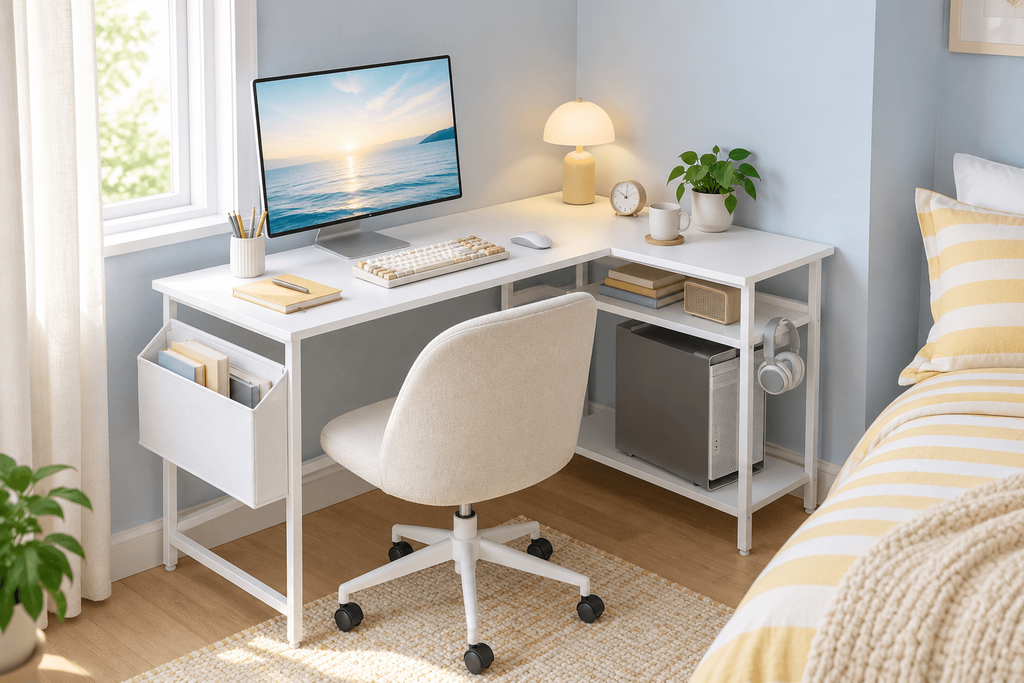
The Pamray earns the Best L-Shaped Corner Desk spot because it offers something genuinely different from the mostly triangular desks in this guide: more conventional working space without requiring the footprint of a full-size L-shaped office desk.
A triangular desk such as the Armocity makes excellent use of a very tight corner, but the shape inevitably limits how much uninterrupted desktop you get.
The Pamray extends the work surface along the adjoining walls instead. That gives you more room to separate a monitor or laptop from notebooks, a lamp and other everyday desk items rather than concentrating everything toward the center of a triangle.
At roughly 39 inches across its longest dimension, this is still a compact L-desk rather than one of the 50- to 60-inch workstations that can easily overwhelm a bedroom. But it isn’t the choice for the smallest available corner either. You are deliberately giving the desk more wall space in exchange for a more useful work surface.
The two open shelves help that tradeoff make more sense in a small bedroom. They provide space for books, baskets or computer equipment underneath the desk instead of requiring another storage unit beside it. The shelf section is also reversible, so it can be positioned on whichever side works better around a bed, window, closet or doorway.
That flexibility is particularly useful with an L-shaped desk because placement is otherwise one of the format’s biggest weaknesses. You still need to measure both walls carefully, but you are not locked into one orientation during assembly.
The evidence base is also better than it is for some of the newer private-label desks we considered. There is substantial marketplace feedback behind the design, with recurring positive comments around its fit in bedrooms and smaller rooms, straightforward assembly and usefulness for the price.
Pros
- Provides a broader and more conventional workspace than the compact triangular desks
- Compact by L-shaped desk standards
- Reversible configuration makes it easier to adapt to different bedroom layouts
- Under-desk shelving uses space that would otherwise contribute little to storage
- Adjustable shelving can accommodate items of different heights
- Gives you distinct areas of desktop for working, studying or computer equipment
- Open frame keeps the desk visually lighter than a large cabinet-style L-desk
- More established marketplace history than several of the newer corner desks in this guide
Cons
- Requires more wall length than the smallest triangular corner desks
- L-shaped footprint is less suitable for an extremely tight or awkward corner
- Open shelves leave stored items visible, which can look cluttered in a bedroom
- No drawers for concealing smaller office supplies
- Engineered-wood desktop is less substantial than a solid-wood work surface
- No keyboard tray, built-in charging or vertical hutch storage
Small-Space Verdict
Best for: Small bedrooms where you want more usable desktop space than a triangular corner desk provides
Choose the Pamray when workspace matters more than achieving the absolute smallest corner footprint. Its L-shaped design gives you more room to spread out than the triangular options while remaining considerably more manageable than a full-size L-desk.
If your available corner is extremely tight, the Armocity or ODK makes better use of limited wall space. But if you can accommodate roughly a 40-inch span and actually want a desk you can work at comfortably for longer periods, the Pamray’s larger, divided work surface is a worthwhile use of that extra space.
Check the Pamray L-Shaped Computer Desk on Amazon
What to Check Before Buying a Corner Desk for a Small Space
Measure Both Walls, Not Just the Listed Desk Width
Don’t start with the advertised “width.”
Corner desks are particularly confusing because manufacturers don’t always use width and depth consistently. One listing may measure the front edge while another measures the distance along the wall.
Instead, start in the corner where you want the desk and measure outward along both walls. Then mark those points with painter’s tape if necessary. This gives you a much more useful picture of whether a 27-, 34-, or 39-inch desk will actually fit.
Also check what’s occupying those walls. Baseboards, curtains, radiators, outlets, doors, and wardrobe doors can all change how much usable space you really have.
If you’re still deciding where the desk should go, Small Bedroom Layout With Desk and Storage Ideas covers ways to work a desk into the overall bedroom layout rather than treating it as a separate piece of furniture.
Don’t Forget the Chair
A desk can fit perfectly and still make the room unusable.
The product dimensions tell you how much room the desk occupies. They don’t include the chair pulled out in front of it or the space your body needs when you’re sitting there.
This is especially important with triangular corner desks because the chair projects diagonally into the room.
Before ordering, place a chair where the desk would go and check whether you can still:
- Walk comfortably between the desk and bed
- Open wardrobe or closet doors
- Reach drawers
- Open the bedroom door fully
- Get into and out of the chair without moving other furniture
If the chair blocks the room’s main circulation path, a smaller desk may be worth more than a larger work surface.
Decide Whether You Actually Need a Keyboard Tray
A small corner desk with a keyboard tray can be an excellent use of limited space.
Moving the keyboard below the desktop frees room for your monitor, mouse, notebook, and whatever you’re actively working on. That’s why the ODK works so well for a compact computer setup.
But don’t choose a keyboard tray simply because it sounds like an extra feature.
If you primarily work from a laptop, rarely use an external keyboard, or prefer your keyboard and mouse at the same height, the tray may add a component you don’t need.
For a small room, features should solve actual problems.
Match the Storage to What You Actually Own
“Storage” can mean completely different things from one corner desk to another. Think about what is currently cluttering your workspace before choosing between them.
A drawer works best for small items you want hidden: pens, chargers, cables, paperwork, and miscellaneous supplies.
Open shelves work better for books, baskets, and things you use frequently.
A monitor stand doesn’t store much in the traditional sense, but it frees valuable desktop area by creating another level.
A bookshelf or hutch is worth considering when you have enough items to justify replacing a separate storage unit.
This is also where people can accidentally make a small bedroom worse. Buying more furniture because it contains “more storage” doesn’t automatically reduce clutter.
If your desk already works but the surface keeps disappearing under accessories, you may not need a larger desk at all. 7 Space-Saving Products That Fixed My Small Desk Setup has ways to move frequently used items off a cramped desktop without replacing the entire desk.
Be Careful With Tall Hutches in Very Small Bedrooms
Using vertical space is one of the best ways to increase storage in a small bedroom. But there’s an important difference between saving floor space and making a room feel spacious.
A 63-inch hutch may occupy the same floor footprint as a lower desk, but visually it fills far more of the wall. That isn’t necessarily bad.
If the Lvifur replaces a separate bookshelf, for example, the room may end up with fewer furniture pieces overall. But if you buy a tall hutch and then keep the existing bookcase too, you’ve added visual bulk without solving the original problem.
Before choosing a desk with a hutch, decide what furniture or storage it will replace. If the answer is “nothing,” a lower desk may be the better small-space choice.
Check Monitor Depth, Not Just Monitor Width
A monitor can technically fit on a desktop without fitting comfortably. This matters with triangular desks because the work surface becomes shallower toward the back and sides.
Measure your monitor base, not just the screen. Then consider how much room remains for the keyboard and how far your eyes will be from the display.
A raised monitor stand can help organize the work surface, which is one reason the Uniheim works for a compact gaming setup. But a stand doesn’t magically create more viewing distance.
If your equipment requires a deeper or broader setup, the Vecelo or larger Sedeta may be a better decision than trying to force everything onto a 27-inch corner desk.
Think About Cable Management Before the Desk Arrives
Corners can be convenient for cables because equipment sits close to two walls, but they can also make outlets difficult to reach once the desk is installed.
Check where the nearest outlet is before ordering.
If the outlet will end up directly behind a shelf or hutch, think about how you’ll access it later.
Built-in power, like the outlets and USB ports on the Armocity, can simplify charging at desktop level. But the desk itself still needs to reach a wall outlet. Also consider where your monitor, computer, lamp, and other permanent equipment will plug in.
A little cable planning before assembly is much easier than pulling a fully loaded corner desk away from the wall later.
Don’t Assume “Gaming Desk” Means You Need a Large Desk
“Gaming desk” often seems to mean bigger desk. That doesn’t make sense when the bedroom itself is small.
Start with the equipment you actually use: monitor, keyboard, mouse, controller, speakers, and computer if applicable. Then find the smallest configuration that accommodates those items comfortably.
A monitor stand and keyboard tray can be more useful than simply adding another 20 inches of desktop because they create separate levels for different equipment.
That’s why the Uniheim makes this list.
But if you have two or three large monitors plus substantial peripherals, an ultra-compact gaming desk isn’t the answer. You genuinely need more workstation space, and the larger Sedeta becomes a more sensible choice.
Don’t Ignore Visual Weight
Two desks with similar footprints can feel completely different once they’re inside the bedroom.
An open metal frame allows you to see more floor and wall around it. A desk with drawers looks more substantial but hides clutter. A tall hutch occupies far more of your visual field even if its floor dimensions aren’t dramatically larger.
There isn’t one universally correct choice.
In a bedroom already filled with a bed, dresser, wardrobe, and other furniture, a low open desk may prevent the room from feeling overfurnished.
In a room where visible clutter is the bigger problem, a slightly heavier desk with concealed storage may actually look calmer.
The important thing is to evaluate both physical footprint and visual footprint.
Check the Current Product Diagram Before Ordering
This matters especially on marketplace listings.
One product page can contain several finishes, sizes, or related configurations, and specification fields don’t always update cleanly between them.
The Sedeta desk with drawers is a good example: published information contains conflicting dimensions, even though the approximately 31.5-inch wall-run measurement appears consistently enough to be useful.
Before buying any of these desks:
- Select the exact color or configuration you want.
- Open the current dimension diagram.
- Compare the wall-run measurements with your room.
- Check the height if the desk will sit below a window.
- Check shelf and hutch dimensions if you need them to hold specific equipment.
For small-space furniture, a few inches can be the difference between “fits perfectly” and “blocks the wardrobe.”