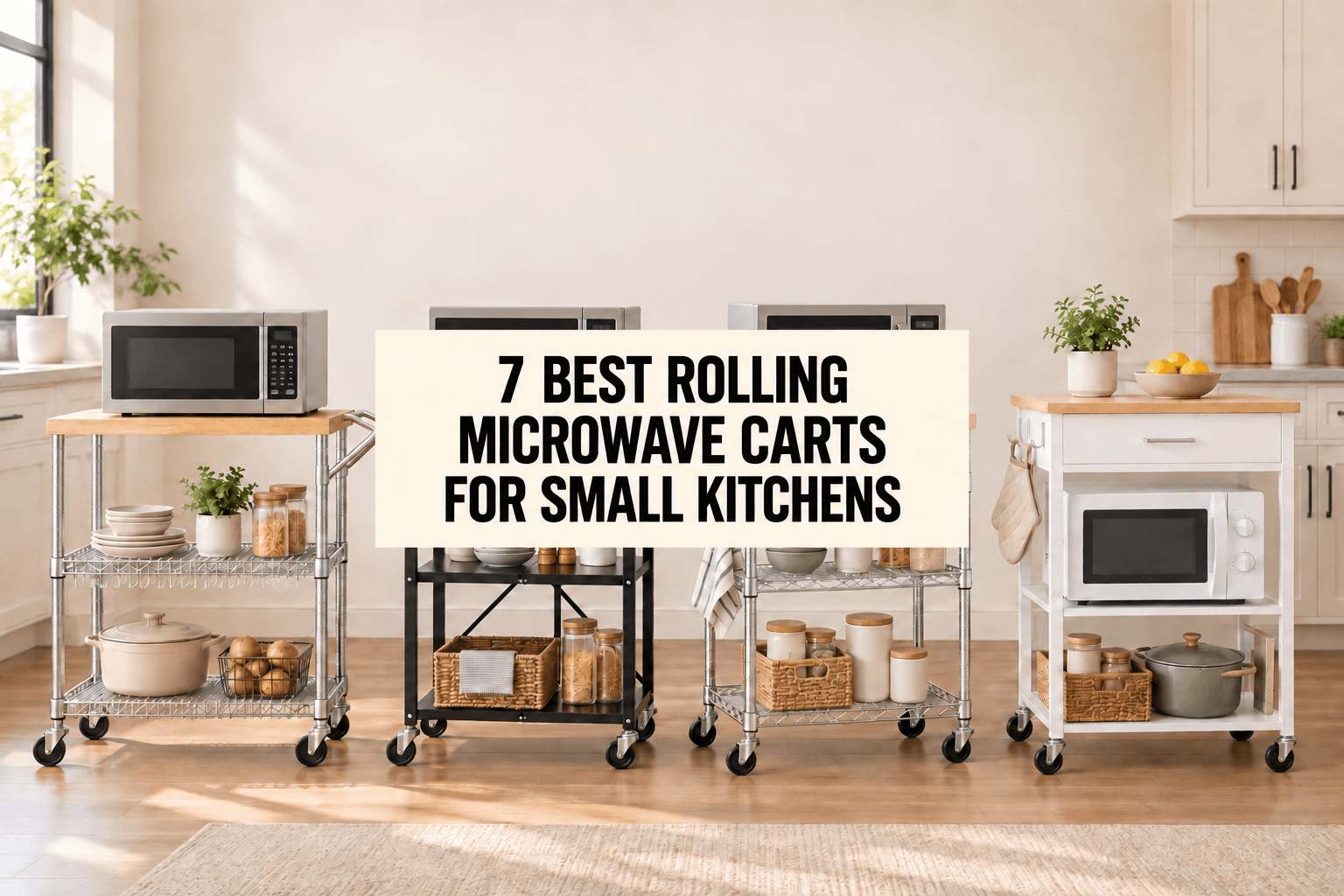
7 Best Rolling Microwave Carts for Small Kitchens
Disclosure
This post may contain affiliate links. If you purchase through these links, I may earn a small commission at no extra cost to you. As an Amazon Associate I earn from qualifying purchases.
A microwave can consume a frustrating amount of counter space in a small kitchen.
Moving it onto a rolling cart sounds like an obvious solution, but not every cart advertised as a microwave stand is suitable for the job. Some have worktops that are too shallow, weak shelves, unstable wheels or dimensions that take up more floor space than the appliance did on the counter.
The best rolling microwave carts provide a properly supported surface for the appliance while adding useful storage underneath. They should remain stable when the wheels are locked, position the microwave at a comfortable height and fit the room without narrowing an already restricted walkway.
For this guide, I compared the complete footprint of each cart, the usable microwave surface, listed weight capacities, shelf arrangement, materials, caster design and strength of the available product evidence.
The Best Rolling Microwave Carts at a Glance
| Product | Best For | Approximate Footprint | Storage | Standout Feature |
|---|---|---|---|---|
| Amazon Basics 3-Tier Microwave Cart | Best Overall | 21″W × 15″D | Wood top + two adjustable shelves | Compact purpose-designed microwave cart |
| ThreeHio 3-Tier Rolling Microwave Cart | Tight Kitchens | 20.47″W × 15.35″D | Three tiers | Narrow footprint with adjustable storage |
| Amazon Basics 3-Shelf Wire Cart | Heavy-Duty Utility Storage | 23.2″W × 13.4″D | Three adjustable wire shelves | Strong established shelving system |
| OGEMXU 4-Tier Microwave Cart | Four-Tier Storage | 23.62″W × 15.75″D | Four levels | More vertical organization on a compact base |
| Vasagle Rolling Kitchen Island | Furniture-Style Storage | 23.6″W × 17.7″D | Drawer + two lower shelves | Finished kitchen-island appearance |
| WDT 3-Tier Rolling Kitchen Cart | Large Microwaves | Approximately 35.4″W × 18.1″D | Large top + two lower shelves | Substantially larger appliance surface |
| Origami RBT Series Folding Kitchen Cart | Foldable Microwave Cart | 25.3″W × 19.8″D | Wooden top and two lower shelves | Folds to approximately 5.8 inches wide |
How I Chose These Rolling Microwave Carts
A realistically usable microwave surface
The overall dimensions of a cart do not necessarily equal its usable worktop.
Raised rails, corner posts, side handles and shelf supports can reduce the area available for an appliance. I compared the listed top dimensions where they were available and considered whether the design provides a continuous surface or an open wire shelf.
Your microwave’s supporting feet should sit securely on the cart. You must also retain the ventilation clearance specified in the appliance manual. A product being called a “microwave cart” does not guarantee compatibility with every microwave.
The complete footprint
A narrow cart can still be a poor fit if it projects too far into a kitchen walkway.
Width and depth therefore need to be considered together. The compact Amazon Basics and ThreeHio carts use approximately 21 inches of wall width, while the BolDuck requires considerably more room despite offering the largest surface.
I also considered handles, hooks and other projections that can increase the cart’s practical footprint.
Load capacity and stability
Manufacturer-listed capacities are not always directly comparable.
Some listings provide one total figure without identifying the limit of the worktop. Others distinguish between capacity while stationary, while rolling or while standing on leveling feet.
I have not assumed that a cart’s entire advertised capacity applies to the microwave surface. The appliance must remain within the capacity assigned to the surface supporting it.
Wheels and locking
The wheels should make it easier to reposition the cart, but a microwave should be used only when the cart is stable and the locking casters are engaged.
A loaded cart can become harder to steer than it appears in product photographs. Caster size, flooring, weight distribution and thresholds all affect mobility. Most of these carts are better understood as movable appliance stations than as carts that should be rolled around constantly with a microwave on top.
Storage configuration
Extra tiers are useful only when the shelf heights work for the belongings you intend to store.
Adjustable shelves provide more flexibility for cookware, pantry containers and small appliances. Drawers are better for loose utensils, while open wire shelves suit bulkier items but may require bins to stop smaller packages from falling over.
Materials and cleaning
A continuous wood or engineered-wood surface provides a more straightforward base for a microwave than an open wire shelf.
Wire shelving is strong, ventilated and easy to adjust, but small microwave feet may not align comfortably with the wires. A rigid shelf liner may be required, provided it does not compromise stability or exceed the manufacturer’s instructions.
Evidence quality
These selections are based on current product specifications, available manufacturer and retailer information, and recurring customer-feedback patterns where sufficient feedback was available.
Evidence is strongest for the established Amazon Basics products. Some newer carts have shorter review histories, so I have avoided making durability claims that the available information cannot support.
1. Amazon Basics 3-Tier Microwave Cart — Best Overall
Key Specifications
- Dimensions: Approximately 21″W × 15″D × 36.7″H
- Storage: Finished wood top plus two lower wire shelves
- Shelving: Height-adjustable in one-inch increments
- Materials: Wood top with chrome-plated steel frame
- Listed total capacity: 175 lb
- Listed lower-shelf capacity: Up to 50 lb per shelf
- Wheels: Four casters
- Extras: Four removable hooks
- Product weight: Approximately 25.7 lb
Why We Chose It
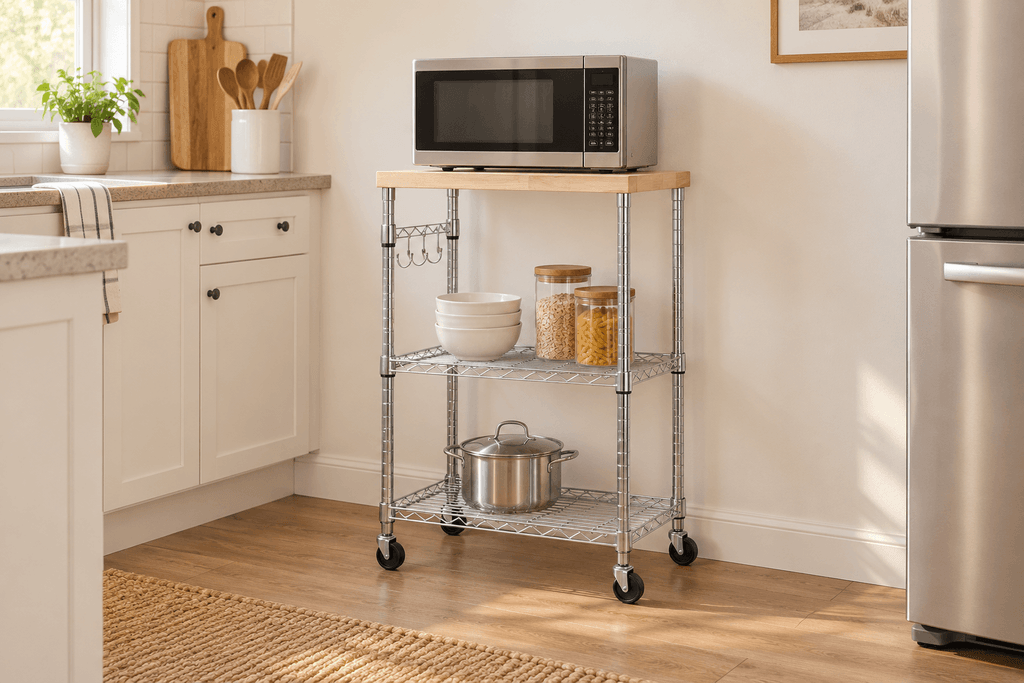
The Amazon Basics cart earns the overall position because it balances appliance support, storage and footprint better than the other options in this guide.
Its 21-inch width is compact enough for a short kitchen wall, the end of a counter run or an apartment kitchenette. The 15-inch depth is also more manageable than that of a full kitchen island, although you still need to confirm that your microwave’s feet fit securely on the top.
Unlike carts that place the microwave directly on wire shelving, this model provides a continuous wood surface. That makes positioning the appliance easier and prevents smaller feet from landing awkwardly between shelf wires.
The two lower shelves can be adjusted in one-inch increments. This is more useful than a fixed-tier design when you need one tall opening for cookware, a compact appliance or large pantry containers.
Four removable hooks create somewhere to hang oven mitts, towels or lightweight utensils without consuming shelf space.
The cart’s 36.7-inch height is close to standard countertop height, which should feel more natural for many users than a low utility trolley. However, a microwave placed at that height may still be too tall for some people once the appliance controls and hot contents are considered.
The main limitation is the 15-inch depth. It is appropriate for many compact microwaves, but larger countertop models may extend beyond the top or fail to achieve the required ventilation clearance. Measure the appliance rather than relying on the “microwave cart” label.
Pros
- Continuous wood top provides a more practical appliance surface than open wire shelving
- Compact width uses less wall space than most rolling kitchen islands
- Adjustable lower shelves accommodate cookware and appliances of different heights
- Counter-height design keeps the microwave more accessible than low utility carts
- Hooks create storage for lightweight items without using shelf space
- Established product with a much larger review history than most newer alternatives
- Chrome-plated frame is easier to wipe down than fabric or unfinished wood storage
Cons
- The 15-inch depth will not suit every microwave
- No drawer or concealed storage for loose utensils
- Open wire shelves can make stored items look visually busy
- Only the total capacity and lower-shelf limits are clearly established; buyers should not assume the entire 175 lb applies to the wood top
- Casters are better suited to occasional repositioning than constant movement over thresholds
- Chrome utility-cart appearance may not suit every kitchen style
Verdict
Choose the Amazon Basics cart when you want a compact, purpose-designed microwave station with adjustable storage underneath.
It does not offer the largest worktop or the most decorative appearance. It wins because it solves the most common small-kitchen problem without becoming unnecessarily wide, deep or complicated.
Check the Amazon Basics 3-Tier Microwave Cart on Amazon
2. ThreeHio 3-Tier Rolling Microwave Cart — Best for Tight Kitchens
Key Specifications
- Dimensions: Approximately 20.47″W × 15.35″D × 34.64″H
- Storage: Three tiers
- Materials: Wood and metal
- Shelving: Adjustable configuration
- Base: Rolling casters
- Finish: Rustic brown with black frame
- Care: Wipe with a dry cloth
Why We Chose It
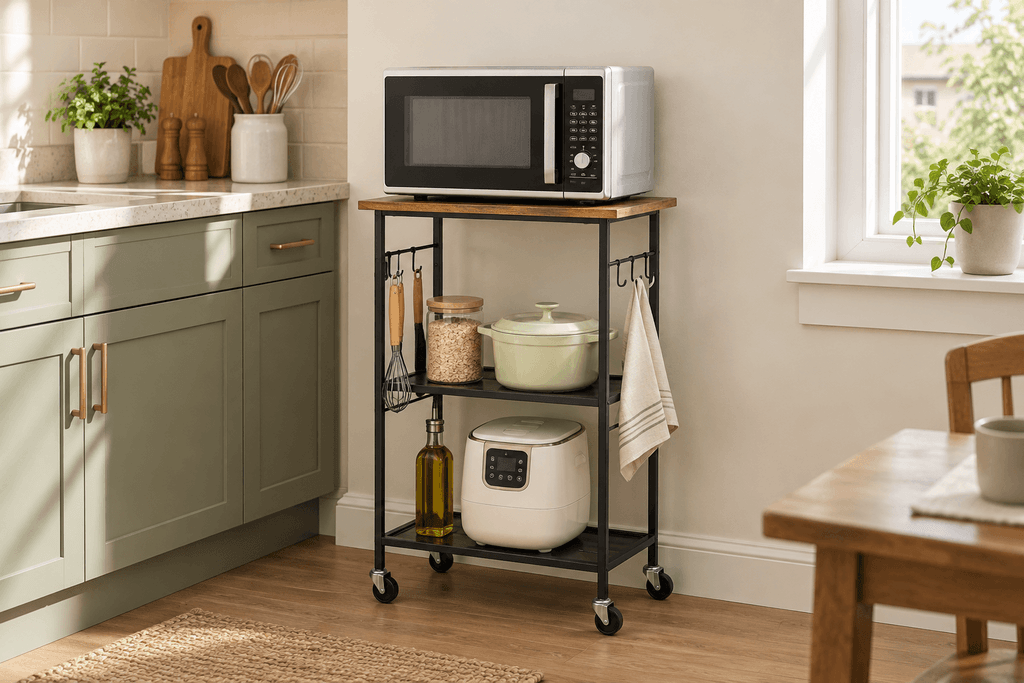
The ThreeHio is the narrowest conventional microwave cart in this guide.
At approximately 20.5 inches wide, it requires slightly less wall space than the Amazon Basics cart while retaining a continuous top and storage underneath. That difference is small on paper, but even half an inch can matter when a cart must fit between an appliance and a doorway or at the end of a short cabinet run.
Its 15.35-inch depth is still compact, and its approximately 34.6-inch height places the worktop slightly below a conventional kitchen counter. That may make the microwave controls easier to reach for some users, although it also means bending slightly lower when placing food inside.
The wood-and-metal construction looks more like residential furniture than commercial wire shelving. This makes it easier to use as a coffee station or open kitchen shelf if the microwave is removed later.
The tradeoff is evidence depth. The ThreeHio has a respectable body of customer feedback in some Amazon marketplaces, but it is not as established as the Amazon Basics model. Its exact dimensions have also been displayed inconsistently across regional listings, making it especially important to confirm the selected version before ordering.
Pros
- Uses slightly less wall width than the Amazon Basics microwave cart
- Continuous top avoids the appliance-placement issue created by open wire shelving
- Three-tier design adds storage without becoming unusually tall
- Lower worktop may improve control visibility for shorter users
- Wood-and-metal finish feels more appropriate in a furnished kitchen than chrome utility shelving
- Adjustable storage provides more flexibility than permanently fixed tiers
- Can continue functioning as a coffee cart or general kitchen trolley if the microwave is moved
Cons
- Compact worktop still excludes some full-size microwaves
- Exact measurements have appeared inconsistently across regional Amazon listings
- Lower worktop may be less comfortable for taller users
- Open shelving does not hide pantry clutter
- Available evidence is weaker than for the Amazon Basics models
- Dark rustic finish may make a very small kitchen feel visually heavier than a lighter cart
Verdict
Choose the ThreeHio when approximately 21 inches is the maximum width available and you prefer a wood-and-metal cart over chrome shelving.
It is the stronger compact alternative to the Amazon Basics model. The ThreeHio earns its place by fitting a slightly narrower location.
Check the ThreeHio 3-Tier Rolling Microwave Cart on Amazon
3. Amazon Basics 3-Shelf Wire Cart — Best Heavy-Duty Utility Storage
Key Specifications
- Dimensions: Approximately 23.2″W × 13.4″D × 32.75″H
- Storage: Three adjustable wire shelves
- Materials: Steel with chrome finish
- Shelf adjustment: One-inch increments
- Base options: Four casters or four leveling feet
- Listed capacity with leveling feet: Up to 250 lb per shelf and 750 lb total
- Listed capacity on stationary wheels: Up to 73 lb per shelf and 220 lb total
- Listed capacity while rolling: Up to 50 lb per shelf and 150 lb total
- Wheels: Four casters, including locking casters
Why We Chose It
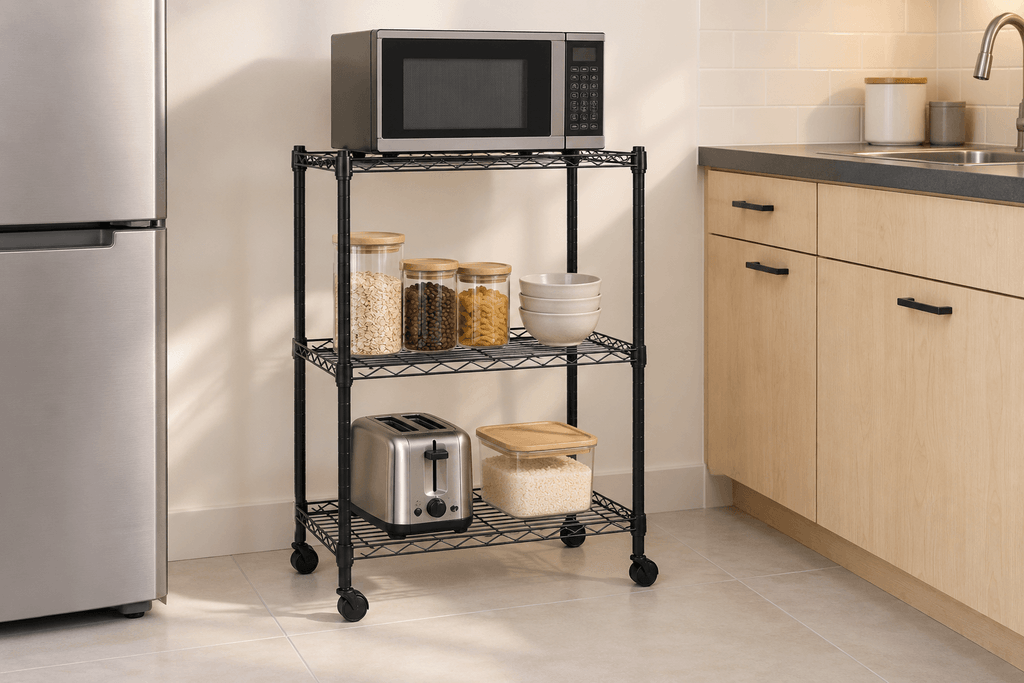
This Amazon Basics unit is not a decorative microwave cart. It is heavy-duty adjustable shelving that can function as an appliance station when the microwave fits the top securely.
Its strength is the shelving system. The three shelves adjust in one-inch increments, and the unit includes both wheels and leveling feet. That gives you a choice between mobility and higher static capacity.
The capacity figures require careful interpretation. The maximum 750-pound figure applies only when the unit stands on leveling feet. Capacity drops to 220 pounds when the wheels are installed and stationary, and to 150 pounds while the cart is moving. Those are still substantial figures for a compact rack, but quoting only the largest number would be misleading.
The 13.4-inch depth is the major weakness. Although the shelf is wider than several carts in this guide, it is also shallower. Many countertop microwaves are deeper than 13.4 inches. This cart should only be selected after confirming that the microwave’s supporting feet fit safely and that the required ventilation remains unobstructed.
The wire surface presents another complication. Microwave feet may not align properly with the shelf wires. A rigid, properly fitted shelf liner can create a continuous surface, but any modification must remain stable and comply with the appliance and shelving instructions.
Pros
- Clearly documented capacities distinguish fixed, stationary-wheeled and moving use
- Adjustable shelves can accommodate heavy cookware, water containers or bulk pantry goods
- Leveling feet offer a more stable alternative when mobility is unnecessary
- Steel construction is better suited to utility storage than lightweight particleboard
- Tool-free shelf adjustment makes later reconfiguration easier
- Large review history provides stronger real-world evidence than most newer carts
- Shallow footprint limits how far the rack projects into a walkway
Cons
- The 13.4-inch depth is too shallow for many microwaves
- Open wire top is less convenient than a continuous wood surface
- A rigid shelf liner may be needed beneath smaller appliance feet
- Maximum 750-pound capacity does not apply when the wheels are installed
- Utility-rack appearance may feel out of place in a finished kitchen
- Low height may require taller users to bend when accessing the microwave
- No drawer, hooks or concealed storage
Verdict
Choose this Amazon Basics rack when strength, shelf adjustment and evidence quality matter more than appearance.
Do not buy it simply because it has the highest capacity. Its shallow wire top makes appliance compatibility more restrictive than the numbers suggest. The purpose-designed Amazon Basics microwave cart is the safer default when your microwave fits both.
Check the Amazon Basics 3-Shelf Wire Cart on Amazon
4. OGEMXU 4-Tier Microwave Cart — Best Four-Tier Storage
Key Specifications
- Dimensions: Approximately 23.62″W × 15.75″D × 27.56″H
- Storage: Four levels
- Materials: Wood work surface with metal mesh shelving
- Shelving: Adjustable lower tiers
- Base: Rolling casters
- Wheels: Lockable design
- Configuration: Open vertical storage
Why We Chose It
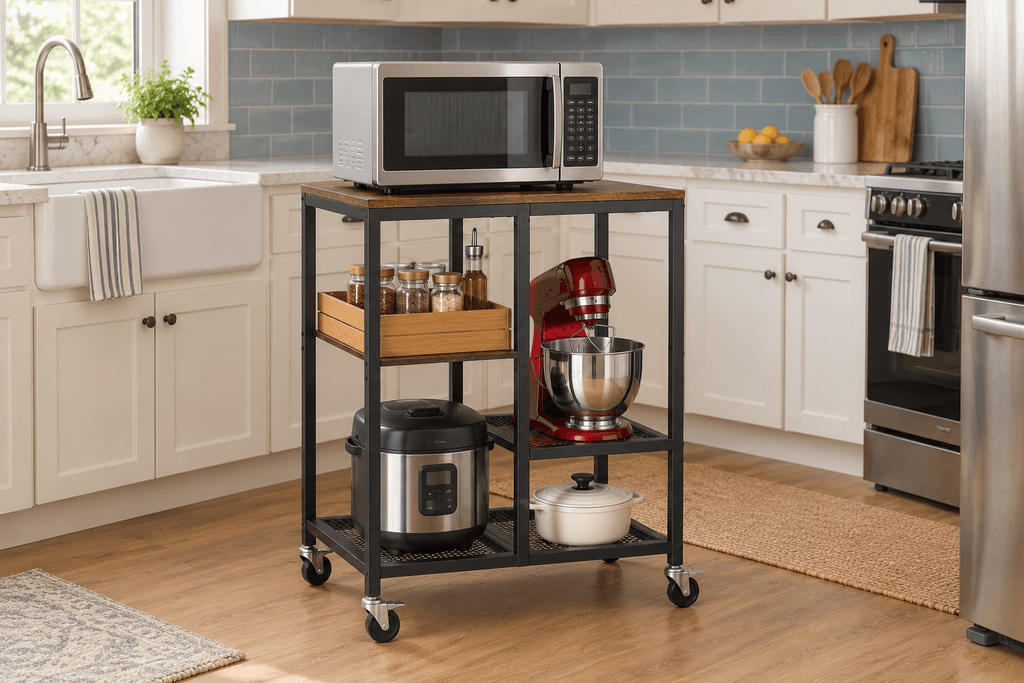
The OGEMXU makes better use of the space below the microwave than a basic two-shelf trolley.
Its four-level configuration divides cookware, pantry goods and small appliances into separate zones instead of forcing everything onto one or two crowded shelves. The adjustable metal mesh tiers also provide more flexibility than a rack with permanently fixed openings.
At approximately 23.6 inches wide and 15.75 inches deep, it remains relatively compact. It is wider than the ThreeHio and Amazon Basics microwave cart, but the difference buys additional storage organization.
The unusual feature is its height. At approximately 27.6 inches, it sits considerably lower than a normal kitchen counter. That can be helpful beneath a window or for users who find a counter-height microwave difficult to reach. For many adults, however, the low position will require more bending.
This is not a cart that should be selected on shelf count alone. Four tiers sound impressive, but the available vertical clearance between them determines what can actually be stored. Large stockpots and tall appliances may not fit once all tiers are installed.
Pros
- Four levels separate pantry goods, cookware and appliances more effectively
- Adjustable mesh shelves provide more flexibility than fixed compartments
- Continuous wood surface is more appliance-friendly than an exposed wire top
- Compact width remains manageable in many apartment kitchens
- Low profile can fit beneath some windows or wall-mounted shelving
- Lockable wheels allow the cart to remain stationary during appliance use
- Open construction keeps frequently used kitchen supplies accessible
Cons
- Low worktop requires many adults to bend when using the microwave
- Four tiers can create cramped openings for tall cookware
- Wider footprint than the most compact carts in this guide
- Open shelves can quickly appear cluttered
- Product evidence is more limited than for the Amazon Basics carts
- Mesh shelving is less suitable for small bottles and packets unless bins are added
- Exact capacities for the microwave surface should be confirmed before purchase
Verdict
Choose the OGEMXU when vertical organization underneath the microwave matters more than countertop-height access.
It works best as a low appliance and pantry station. If you expect to use the microwave several times a day and dislike bending, the taller Amazon Basics, ThreeHio or Vasagle cart will be more comfortable.
Check the OGEMXU 4-Tier Microwave Cart on Amazon
5. Vasagle Rolling Kitchen Island — Best Furniture-Style Cart
Key Specifications
- Dimensions: Approximately 23.6″W × 17.7″D × 35.4″H
- Storage: Drawer, adjustable middle shelf and bottom shelf
- Extras: Two removable hooks
- Materials: Particleboard, MDF and steel
- Wheels: Four swivel casters, two with brakes
- Listed total static capacity: Approximately 257.9 lb
- Listed worktop capacity: Approximately 88.2 lb
- Listed shelf capacity: Approximately 68.3 lb per shelf
- Listed drawer capacity: Approximately 11 lb
- Product weight: Approximately 28.7 lb
Why We Chose It
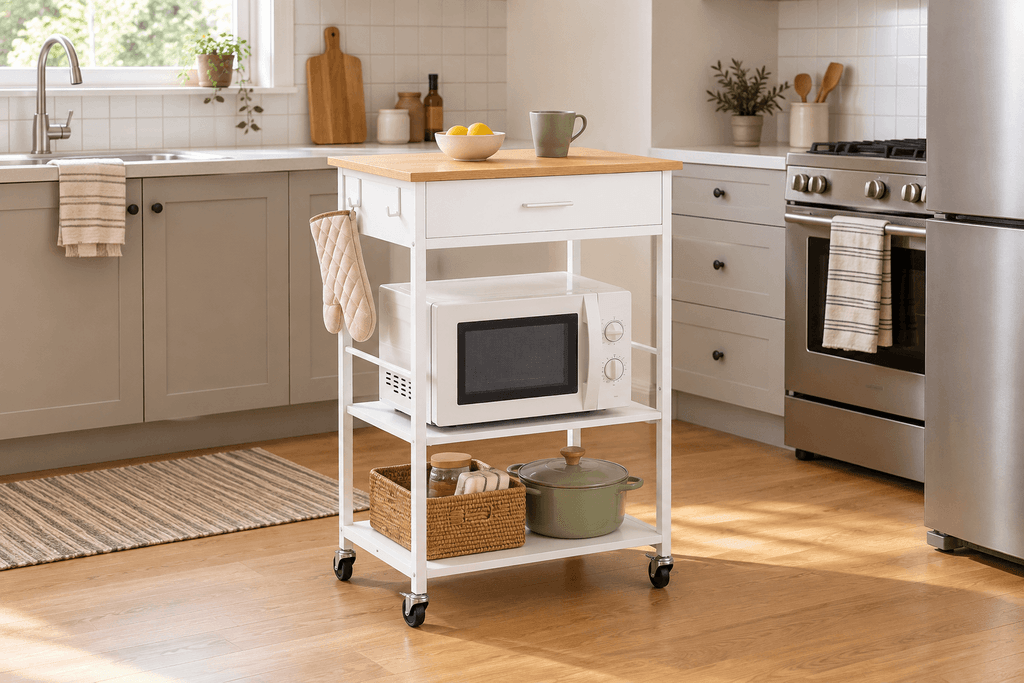
The Vasagle is the strongest choice for someone who wants the cart to look like intentional kitchen furniture rather than industrial storage.
Its oak-beige worktop, matte-white frame and enclosed drawer create a more finished appearance than open chrome shelving. The drawer also solves a problem the other carts largely ignore: where to keep loose utensils, appliance manuals, clips and other small items that look messy on an open shelf.
The middle shelf can be installed at two heights, allowing the lower storage to accommodate different combinations of cookware, baskets and small appliances. Two hooks can hang towels or oven mitts on either side.
At 17.7 inches deep, the worktop is more accommodating than the compact 13- to 15-inch carts. Its listed 88.2-pound worktop capacity is also clearly separated from the total capacity, making appliance suitability easier to evaluate.
The compromise is footprint. It requires approximately 23.6 inches of wall width and projects 17.7 inches into the room. That is still compact compared with many kitchen islands, but it is not the best choice for a particularly narrow galley kitchen.
Pros
- Finished design looks more like kitchen furniture than utility shelving
- Drawer controls visual clutter and keeps small utensils accessible
- Deeper worktop accommodates more microwave sizes than the narrowest carts
- Worktop capacity is listed separately from the total cart capacity
- Adjustable middle shelf supports different storage arrangements
- Two locking casters stabilize the cart during use
- Hooks can be positioned according to the available side clearance
- Counter-height surface is comfortable for many adults
Cons
- Deeper footprint occupies more aisle space than the compact Amazon Basics and ThreeHio carts
- Particleboard and MDF require prompt cleanup after spills
- Only two of the four casters lock
- Drawer and shelf assembly is more involved than assembling a simple wire rack
- Light finish may show food marks and wheel grime more readily
- Maximum capacity is static and should not be treated as a safe moving load
- Newer listing has less long-term evidence than the established Amazon Basics cart
Verdict
Choose the Vasagle when the microwave cart will remain visible in a finished kitchen, dining area or studio apartment.
It is not the smallest cart, but the extra depth provides a more usable worktop, and the drawer makes it considerably easier to control small-item clutter.
Check the Vasagle Rolling Kitchen Island on Amazon
6. WDT 3-Tier Rolling Kitchen Cart — Best for Large Microwaves
Key Specifications
- Dimensions with handle: Approximately 35.4″W × 18.1″D × 31.9″H
- Dimensions without handle: Approximately 30.3″W × 18.1″D × 31.9″H
- Construction: Metal frame with wooden tabletop
- Storage: Wooden top, ventilated basket and two lower wire shelves
- Shelving: Two adjustable shelves with 1-inch adjustment intervals
- Mobility: Four casters, including two locking wheels
- Extras: Push handle and six removable hooks
- Manufacturer-listed total capacity: Up to 650 lb while on its wheels
Why We Chose It
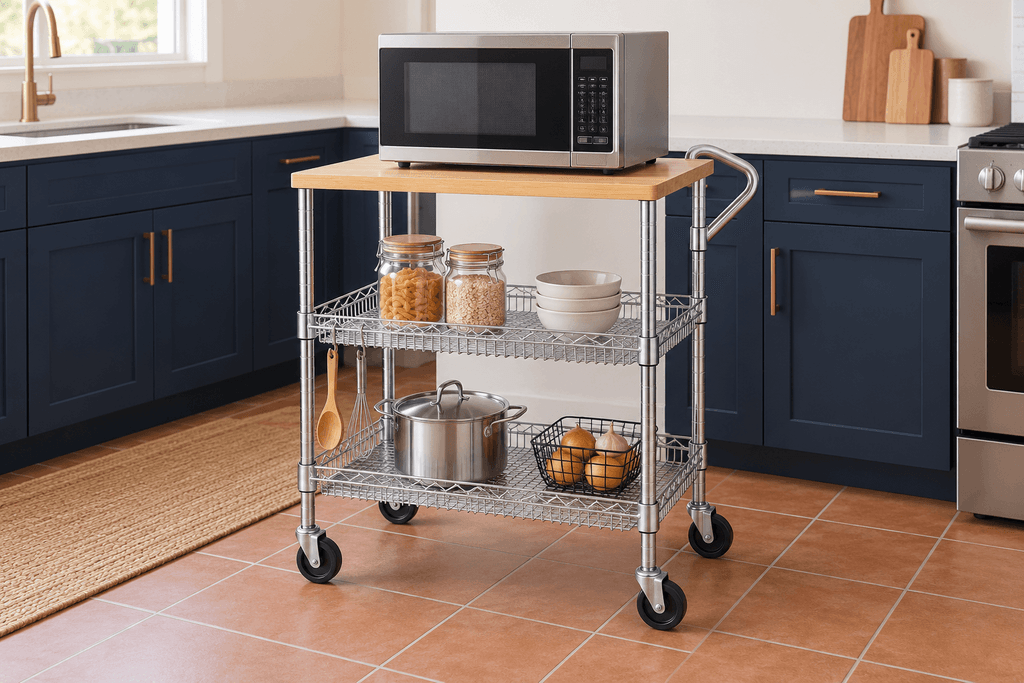
The WDT 3-Tier Rolling Kitchen Cart provides one of the largest appliance surfaces in this guide without becoming as deep as a conventional kitchen island.
Its complete width is approximately 35.4 inches when the handle is included, but the cart body itself is closer to 30.3 inches wide. The 18.1-inch depth is particularly important. It gives a larger microwave more support than the very shallow carts designed primarily for coffee makers, yet it does not project 24 or 25 inches into the room like many full-size islands.
The wooden top provides a dedicated appliance surface, while the two adjustable shelves can hold cookware, pantry supplies or smaller appliances underneath.
The shelves adjust at 1-inch intervals, so the lower storage can be configured around taller items rather than forcing everything into two fixed-height openings.
A push handle and four casters make the loaded cart easier to reposition. Two of the wheels lock, which matters when opening a microwave door or removing a hot container. The six hooks are useful for lightweight utensils, oven mitts and towels, although they increase the cart’s practical width when occupied.
WDT lists a substantial 650-pound total capacity, but that figure applies to the complete cart rather than establishing that the wooden top alone can carry 650 pounds. A microwave is unlikely to challenge the overall structure, but buyers should still confirm the appliance’s weight, base dimensions and ventilation requirements.
Pros
- Broad wooden top accommodates larger microwaves more comfortably than narrow utility carts
- Approximately 18-inch depth provides useful appliance support without creating a full-size island footprint
- Adjustable lower shelves accommodate cookware and appliances of different heights
- Two locking casters help prevent movement while the microwave is being used
- Push handle makes a heavily loaded cart easier to reposition
- Six hooks keep lightweight utensils and towels off the shelves
- More established customer history than several nearly identical marketplace alternatives
- Metal frame is better suited to substantial appliance storage than lightweight plastic construction
Cons
- At 35.4 inches wide with the handle, this is not suitable for an extremely narrow gap
- The 31.9-inch height is lower than standard kitchen-counter height
- Open wire shelving leaves stored items visible
- The hooks and handle require additional side clearance
- The 650-pound figure is the manufacturer’s total-cart claim, not a separate rating for the wooden top
- Assembly is required despite the listing’s relatively short estimated setup time
- A microwave must still fit the usable tabletop and retain its required ventilation clearances
Verdict
Choose the WDT when your microwave needs a wider, sturdier platform and you also want substantial storage underneath. It is not the smallest cart in this guide, but its relatively shallow depth prevents its larger top from turning it into a bulky kitchen island.
Check the WDT 3-Tier Rolling Kitchen Cart on Amazon
7. Origami RBT Series Folding Kitchen Cart — Best Foldable Microwave Cart
Key Specifications
- Open dimensions: Approximately 25.3″W × 19.8″D × 36.2″H
- Folded dimensions: Approximately 5.8″W × 19.8″D × 36.2″H
- Construction: Powder-coated steel frame with wooden top
- Storage: Wooden countertop and two lower shelves
- Manufacturer-listed countertop capacity: Up to 100 lb
- Manufacturer-listed lower-shelf capacity: Up to 50 lb per shelf
- Manufacturer-listed total capacity: Up to 200 lb
- Mobility: Four caster wheels
- Extras: Integrated towel bar
- Assembly: Arrives assembled apart from attaching the wheels
Why We Chose It
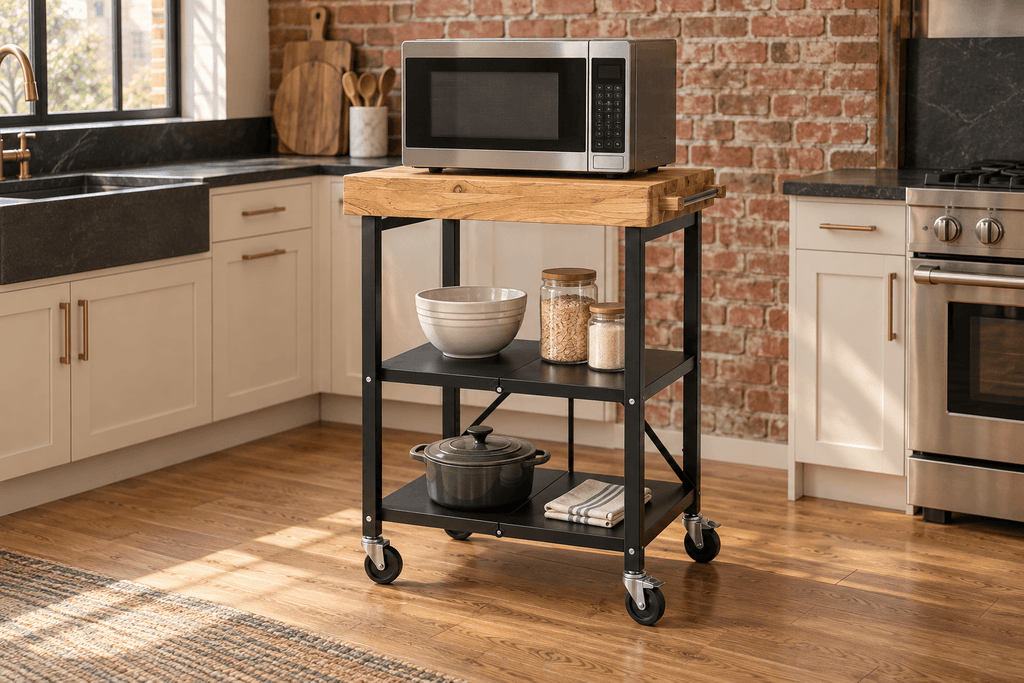
The Origami RBT Series Folding Kitchen Cart solves a problem the fixed carts cannot: it can provide a proper microwave station without permanently claiming the same amount of floor space.
When open, the cart measures approximately 25.3 inches wide and 19.8 inches deep. That is not the smallest active footprint in the guide, but it provides a countertop deep enough for many microwaves and other countertop appliances. The manufacturer lists the wooden top for up to 100 pounds, giving it a clearly stated surface capacity rather than relying only on a combined rating for the entire cart.
When the cart is no longer needed, the frame folds to approximately 5.8 inches wide. It can then be stored beside a refrigerator, inside a utility room or against a wall. The folding process is also more practical because the main structure arrives assembled; only the casters need to be attached.
The two lower shelves provide another 100 pounds of combined listed capacity. They can hold cookware, pantry supplies or another appliance, although they are fixed rather than adjustable. The integrated towel bar is useful when the cart is functioning as a preparation or serving station.
There is an important limitation: folding the cart does not help if the microwave remains permanently installed on top. The appliance and everything stored below must be removed before the cart can be collapsed. This is therefore most useful for renters, occasional cooking stations or multipurpose kitchens where the cart genuinely will be cleared and stored.
Pros
- Folds from approximately 25.3 inches wide to only 5.8 inches
- Wooden top has a separately stated 100-pound capacity
- Counter-height surface is more comfortable for food preparation than shorter utility carts
- Arrives largely assembled, avoiding a complicated furniture build
- Steel frame provides more structural confidence than lightweight folding designs
- Two lower shelves retain useful storage when the cart is open
- Wheels allow it to move between cooking, serving and storage positions
- Considerably larger customer history than newer foldable alternatives
- Can serve as temporary counter space even when it is not holding a microwave
Cons
- One of the most expensive carts in the guide
- Microwave and stored supplies must be removed before the cart can be folded
- Its 19.8-inch depth still occupies meaningful walkway space while open
- Lower shelves are not adjustable
- Open shelves do nothing to conceal visual clutter
- No enclosed drawer or cabinet storage
- The folding feature offers little benefit if the cart will remain permanently loaded
- A 25.3-inch-wide top may not provide enough lateral clearance for every oversized microwave
Verdict
Choose the Origami when you need appliance storage or additional counter space only part of the time. Its strongest feature is not simply that it folds; it folds into a genuinely narrow stored profile and does not require a lengthy assembly process every time it is brought back into use.
Do not pay its premium if your microwave will remain on the cart permanently. In that situation, the WDT provides more storage and a wider top for considerably less money.
Check the Origami RBT Series Folding Kitchen Cart on Amazon
What to Look for in a Rolling Microwave Cart
Measure the microwave before choosing the cart
Measure the microwave’s full width, depth and height.
Then examine the position of its supporting feet. The body may be slightly larger than the base, so the external dimensions alone do not tell you whether the appliance will sit securely.
The microwave feet must remain fully supported. Do not assume that a narrow cart is acceptable simply because most of the microwave fits on top.
Check the ventilation requirements
Microwaves release heat and require clearance around specific sides, vents or the rear panel.
The exact requirements vary by model. Follow the appliance manufacturer’s instructions rather than applying one universal clearance rule.
A deeper cart is not necessarily better if the microwave is pushed tightly against a wall or surrounded by stored objects that obstruct airflow.
Compare worktop capacity, not only total capacity
A cart advertised with a 200-pound total capacity may divide that figure across three or four shelves.
That does not mean the top alone supports 200 pounds.
Look for a separately listed worktop limit. If the manufacturer provides only a total figure, avoid assuming that the full amount applies to the microwave surface.
Distinguish static capacity from moving capacity
A shelving unit may support substantially more weight while standing on fixed feet than while resting on casters.
The Amazon Basics wire cart illustrates this clearly: its capacity changes depending on whether it uses leveling feet, stationary wheels or moving wheels.
This is one reason a loaded microwave cart should be moved carefully and only when necessary.
Treat the cart as movable, not constantly mobile
Wheels are useful when cleaning, reorganizing or temporarily reclaiming floor space.
They do not mean the cart should be rolled around while the microwave is operating or while it contains hot food. Lock the casters and confirm that the unit is stable before using the appliance.
Choose an appropriate height
A cart near standard counter height feels natural for many adults.
Lower carts can improve access for shorter users or fit beneath a window, but they may require more bending. Very tall carts can place hot food and liquids uncomfortably close to face level.
Consider the height of the microwave controls, door and interior not just the height of the empty cart.
Decide whether you need a drawer
Open shelves suit pots, bowls, appliances and baskets.
A drawer is more useful for small utensils, clips, napkins and appliance accessories. If you choose an entirely open cart, expect to add one or two containers to stop loose items from spreading across the shelves.
Check the wheel locks
At least two locking casters are preferable for a cart carrying an appliance.
The locks should be engaged whenever the microwave is used. If the cart still shifts on your flooring, it is not sufficiently stable for that placement.
Consider the electrical connection
Position the cart where the microwave cord reaches an appropriate outlet without crossing a walkway or being stretched tightly.
Do not assume that an ordinary extension cord or lightweight power strip is suitable for a microwave. Follow the microwave manufacturer’s electrical instructions and any applicable household safety requirements.
Account for side accessories
Handles, hooks and towel rails increase the cart’s practical width.
They may be useful when the cart has open space on both sides, but they can become obstructions when the unit must fit tightly between cabinets or beside a doorway.
Where a Rolling Microwave Cart Works Best
At the end of a counter run
A compact cart can extend an existing counter without requiring fitted cabinetry.
Aligning it with the end of the counter can make the microwave feel integrated, but the cart should not obstruct a drawer, dishwasher or cabinet door.
Along an unused kitchen wall
A short blank wall is often the most straightforward placement.
This keeps the microwave away from the main food-preparation surface while allowing the lower shelves to function as a small pantry or appliance zone.
Inside a walk-in pantry
A rolling microwave cart can create an appliance station inside a sufficiently ventilated pantry.
Do not place a microwave inside a closed cabinet or poorly ventilated enclosure unless the appliance is specifically designed and installed for that use.
In an apartment kitchenette
The Amazon Basics and ThreeHio carts are the strongest options where wall width is limited.
The Vasagle is better when the kitchenette needs both an appliance surface and a drawer, provided its greater depth does not block circulation.
As a combined microwave and coffee station
A wider cart can hold coffee supplies below the microwave or beside it when the worktop is large enough.
Avoid crowding the microwave vents with a coffee maker, jars or decorative objects. The combination only works when both appliances retain the space and electrical setup required for safe use.
A Rolling Cart Should Solve More Than One Problem
A rolling kitchen microwave cart should do more than move the appliance off the counter.
It should provide a secure surface, recover useful storage underneath and fit the kitchen without making normal movement more difficult.
For most small kitchens, the Amazon Basics 3-Tier Microwave Cart offers the best balance. The ThreeHio fits a slightly narrower area, while the Vasagle provides a deeper worktop, drawer and more finished appearance.
The Amazon Basics wire rack is the strongest utility option, but its shallow wire surface demands more careful appliance measurement. The WDT solves the opposite problem by accommodating larger microwaves, although its wide footprint rules it out for many genuinely small kitchens.
Measure first. Confirm the worktop capacity. Check the microwave’s ventilation requirements. Then choose the smallest cart that supports the appliance properly and provides storage you will actually use.
That is more useful than buying the cart with the most shelves, the highest advertised capacity or the word “microwave” repeated most often in its product title.