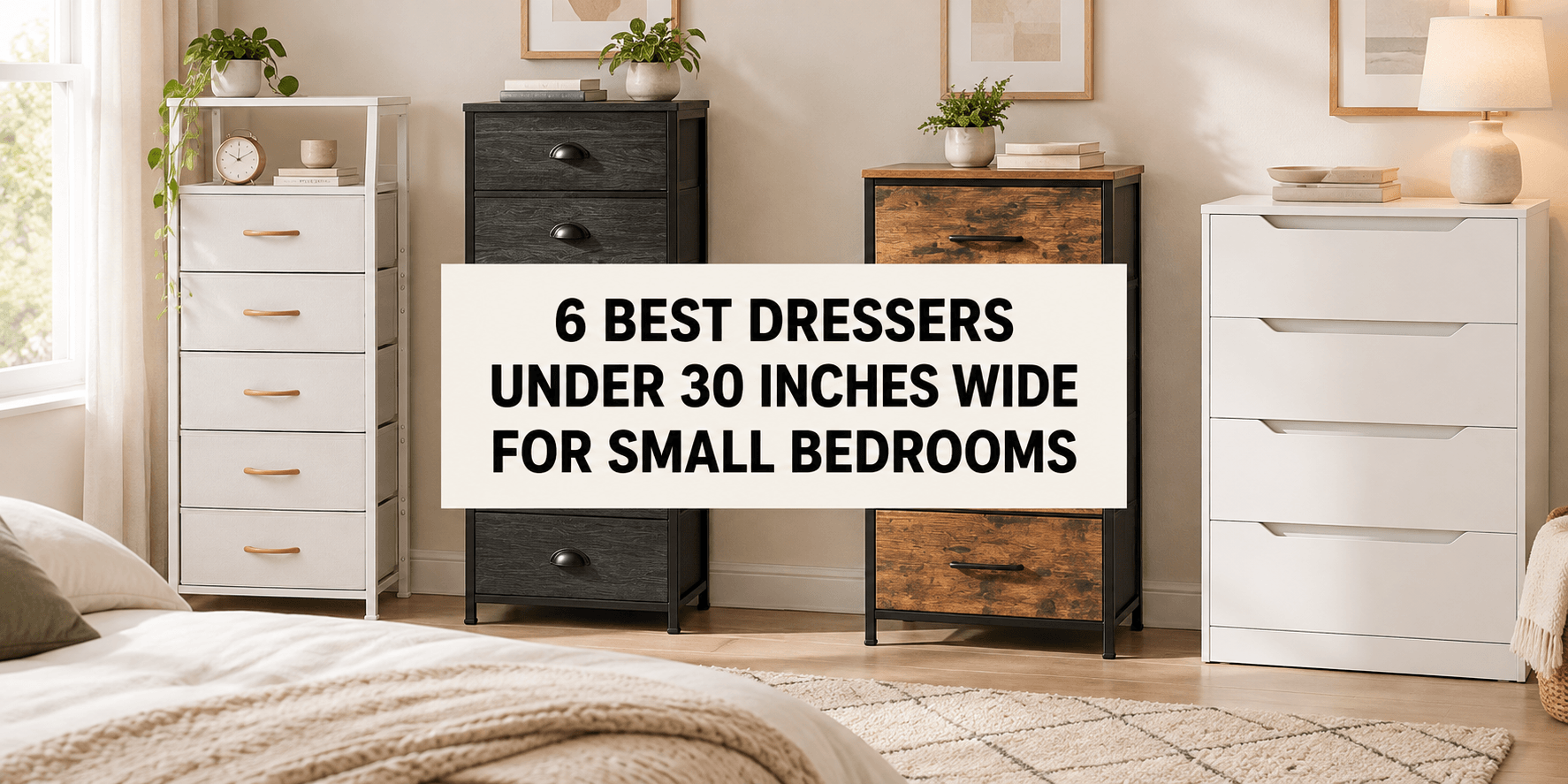
6 Best Dressers Under 30 Inches Wide for Small Bedrooms
Finding a dresser for a small bedroom is not simply a matter of searching for “compact furniture.”
Many dressers described as narrow still measure more than 30 inches wide. Others save wall space but project too far into the room, leaving an awkward passage between the dresser and the bed. Some provide several drawers that look useful in photographs but are too small or lightweight for the clothes you need to store.
For this guide, I applied a strict cutoff: every dresser measures less than 30 inches wide.
I also compared depth, height, drawer construction, practical storage, stability, assembly requirements and the strength of the available product evidence.
The final selection includes lightweight fabric-drawer towers as well as one conventional engineered-wood dresser because those designs solve different problems.
A fabric dresser is usually better when you need inexpensive, lightweight storage in the smallest possible footprint. A hard-sided dresser is the stronger choice when you want furniture that feels more permanent and can handle heavier folded clothing.
The right choice depends on which compromise works better in your room.
The Best Dressers Under 30 Inches Wide at a Glance
| Product | Best For | Dimensions | Drawer Type | Standout Feature |
|---|---|---|---|---|
| Furnulem 5-Drawer Vertical Dresser | Best Overall | 16.1″W × 11.5″D × 43.3″H | Five fabric drawers | Strong balance of storage and footprint |
| Furnulem 6-Drawer Vertical Dresser | Maximum Divided Storage | Approximately 16″W × 11.5″D × 39.6″H | Six fabric drawers | Most drawer compartments in a very narrow frame |
| Furnulem 5-Drawer Dresser With Charging Station | Charging Electronics | 16.1″W × 11.5″D × 43.3″H | Five fabric drawers | Two outlets and two USB ports |
| AODK 4-Drawer Dresser | Compact Low Storage | 15.7″W × 11.7″D × 31.8″H | Four fabric drawers | Shorter profile for restricted walls |
| Songmics Bellah Dresser | Best Budget Pick | 15.6″W × 11.8″D × 29″H | Three fabric drawers | Simple, low-cost supplemental storage |
| Hostack Modern Dresser | Traditional Dresser | 27.2″W × 15.4″D × 32.3″H | Four engineered-wood drawers | Conventional hard-sided construction |
How I Chose These Narrow Dressers
A genuine width under 30 inches
Every selected model measures less than 30 inches across its exterior frame.
I did not include dressers that are exactly 30 inches wide or listings that describe a product as “narrow” without providing dimensions that support the claim.
Width is only the beginning, however. The complete footprint matters in a small bedroom.
Width and depth together
A dresser can use very little wall space and still become an obstruction if it projects too far into the room.
The narrowest fabric models in this guide are approximately 16 inches wide and less than 12 inches deep. They are easier to place beside a bed, inside a closet or along a restricted wall than a conventional dresser.
The Hostack requires more floor space at 27.2 inches wide and 15.4 inches deep. It remains below the article’s width limit, but it is not intended for the same extremely tight gaps as the fabric towers.
Usable storage rather than drawer count alone
More drawers do not automatically mean more total capacity.
Fabric dressers frequently divide their storage into several lightweight bins. That is useful for separating underwear, sleepwear, accessories and smaller folded clothing, but it does not make each drawer suitable for heavy stacks of jeans or bulky sweaters.
Hard-sided drawers can generally handle denser clothing more confidently, but the dresser itself will be heavier, wider and more involved to assemble.
I considered how each drawer configuration is likely to function rather than ranking the products by the largest number in the title.
Height and accessibility
Tall furniture recovers vertical space, but it creates different practical considerations.
A 43-inch dresser provides more storage without using additional floor width. It may also make the upper drawers or top surface less accessible to shorter users.
Shorter models are easier to reach and can fit below artwork, windows or wall-mounted shelving, but they sacrifice vertical capacity.
Stability and anchoring
Tall, narrow furniture must be secured properly.
An anti-tip kit does not compensate for careless assembly, uneven flooring or overloading. Follow the manufacturer’s instructions, distribute heavier clothing toward the bottom and anchor the unit to an appropriate wall structure.
Evidence quality
These selections are based on current product specifications, manufacturer and retailer information, and recurring customer-feedback patterns where sufficient feedback was available.
The Furnulem, AODK and Hostak models have more established review histories than some recently introduced alternatives.
1. Furnulem 5-Drawer Vertical Dresser — Best Overall
Key Specifications
- Dimensions: Approximately 16.1″W × 11.5″D × 43.3″H
- Storage: Five removable fabric drawers
- Frame: Metal
- Top and shelving: Engineered-wood surfaces
- Base: Four adjustable feet
- Safety: Anti-tip hardware included
- Product weight: Approximately 16.7 lb
- Assembly required
Why We Chose It
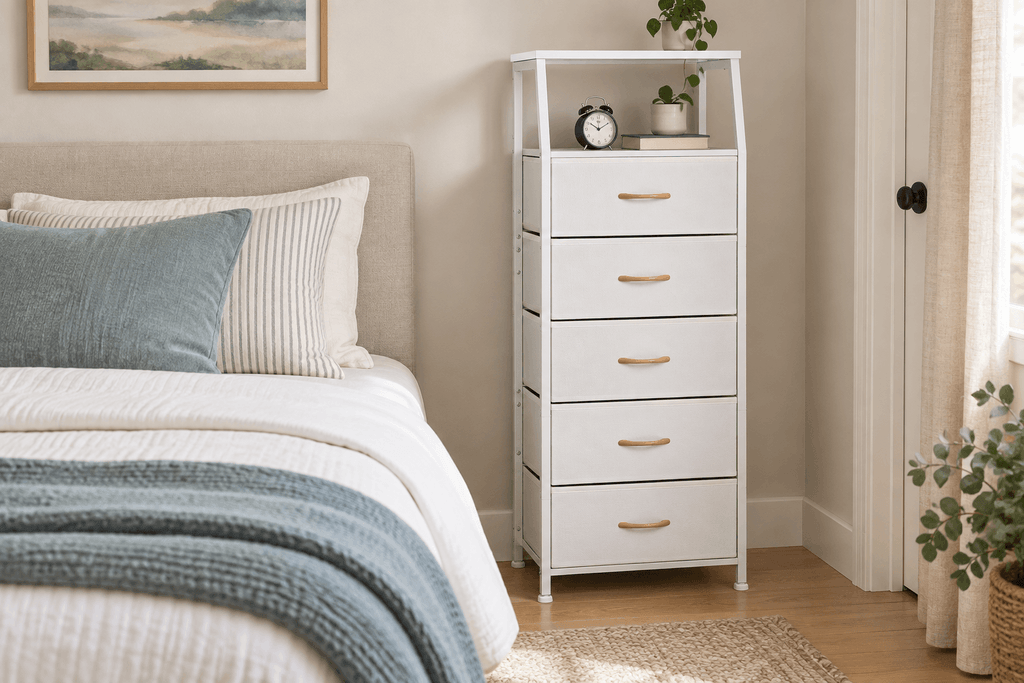
The Furnulem five-drawer dresser earns the overall position because it provides useful vertical storage while consuming very little floor space.
Its 16.1-inch width is narrow enough for locations where a traditional dresser would be impossible. The 11.5-inch depth is equally important because it limits how far the unit extends into the walking area beside a bed or through a compact dressing zone.
Five separate drawers provide enough division for several clothing categories without turning the dresser into an unusually tall tower. Socks, underwear, sleepwear, workout clothing and lightweight tops can each have a dedicated location instead of being stacked together in one deep drawer.
The open upper shelf and finished top add accessible storage for items that do not belong inside a fabric bin. Books, a small lamp, frequently used accessories or a charging tray can remain within reach without covering the drawer fronts.
This is still a lightweight fabric dresser. It should not be mistaken for a conventional wooden chest capable of holding dense stacks of heavy clothing. Its advantage is efficient organization, not furniture-grade capacity.
At 43.3 inches high, wall anchoring is essential. The adjustable feet can help level the frame, but they do not replace the supplied anti-tip hardware.
Pros
- Combines five clothing categories with a footprint barely wider than many nightstands
- Shallow frame preserves more walking space beside a bed
- Upper shelf keeps frequently used items separate from folded clothing
- Lightweight construction is easier for renters to reposition
- Removable drawers simplify sorting and reorganizing
- Adjustable feet help stabilize the frame on slightly uneven flooring
- Established review history provides more evidence than many newer marketplace alternatives
Cons
- Fabric bins are not intended for dense stacks of heavy clothing
- Tall, narrow profile must be anchored securely
- Drawers do not slide like conventional wooden drawers
- Open shelf can become visibly cluttered
- Lightweight materials feel less permanent than traditional bedroom furniture
- White fabric surfaces may show marks more quickly than darker alternatives
Verdict
Choose the Furnulem five-drawer dresser when you need the strongest balance of narrow dimensions, divided clothing storage and everyday accessibility.
It is particularly suitable for a small bedroom, dorm room, closet or rental where a conventional dresser would occupy too much floor space. Choose the Hostack instead if hard-sided drawers and a permanent furniture appearance matter more than minimizing the footprint.
Check the Furnulem 5-Drawer Vertical Dresser on Amazon
2. Furnulem 6-Drawer Vertical Dresser — Best for Maximum Divided Storage
Key Specifications
- Dimensions: Approximately 16″W × 11.5″D × 39.6″H
- Storage: Six removable fabric drawers
- Frame: Metal
- Top: Engineered wood
- Base: Adjustable feet
- Safety: Anti-tip hardware included
- Configuration: Vertical storage tower
- Assembly required
Why We Chose It
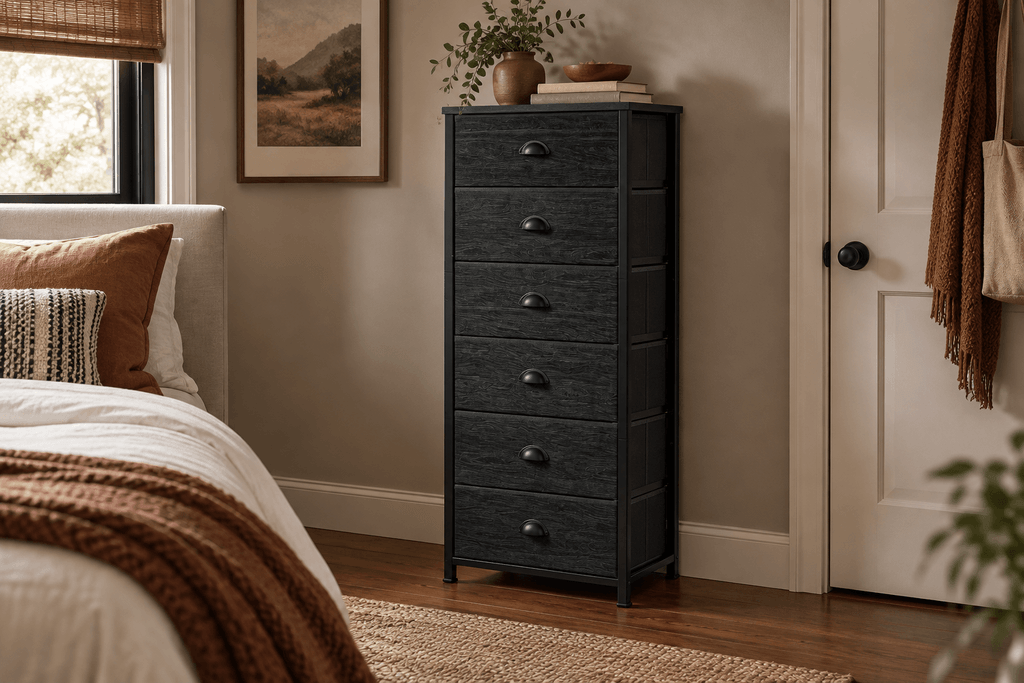
The six-drawer Furnulem is the strongest option for shoppers who want to separate more clothing categories without giving the dresser additional wall space.
Its footprint remains approximately 16 inches wide and 11.5 inches deep. That makes it substantially narrower than a traditional six-drawer chest, which normally arranges drawers across a much broader frame.
The advantage is organization rather than dramatically greater total capacity. Six separate bins make it easier to assign one drawer to underwear, another to socks, another to sleepwear and the remaining drawers to tops, activewear or accessories.
This can work better than a few large drawers when smaller garments tend to become mixed together. It can also reduce the number of dividers or internal organizers needed inside each bin.
The tradeoff is that six small fabric drawers are not equivalent to six conventional dresser drawers. Bulky sweaters, thick denim and heavy clothing will use the available space quickly and may strain the lightweight bins.
The approximately 39.6-inch height is slightly lower than the five-drawer Furnulem models in this guide. It therefore provides more separate drawers without becoming the tallest option, although it still needs to be secured to the wall.
Pros
- Provides the most separate clothing compartments among the narrowest finalists
- Uses vertical space without expanding beyond an approximately 16-inch width
- Makes small garments easier to categorize and retrieve
- Shallower than most conventional dressers
- Lower than the 43.3-inch Furnulem models despite providing six drawers
- Removable bins can be carried to the bed or laundry area while reorganizing
- Metal frame is easier to assemble and move than a full engineered-wood cabinet
Cons
- Additional drawer count does not mean six full-size dresser drawers
- Smaller bins are poorly suited to bulky sweaters and heavy jeans
- Fabric drawers can bow when overloaded
- Narrow frame requires secure wall anchoring
- No built-in charging station
- Limited finished surface area for displaying or storing larger objects
- Similar appearance to inexpensive closet furniture rather than a conventional dresser
Verdict
Choose this model when separating several categories is more important than storing bulky garments in large drawers.
It is the more organized alternative to the five-drawer Furnulem, but it is not automatically the higher-capacity choice for thick clothing. If most of your wardrobe consists of jeans, sweaters or substantial folded items, the Hostack’ss hard-sided drawers may be more appropriate.
Check the Furnulem 6-Drawer Vertical Dresser on Amazon
3. Furnulem 5-Drawer Dresser With Charging Station — Best With Charging
Key Specifications
- Dimensions: Approximately 16.1″W × 11.5″D × 43.3″H
- Storage: Five removable fabric drawers
- Charging: Two electrical outlets and two USB ports
- Frame: Metal
- Shelving: Engineered-wood top and upper shelf
- Base: Four adjustable feet
- Safety: Anti-tip hardware included
- Assembly required
Why We Chose It
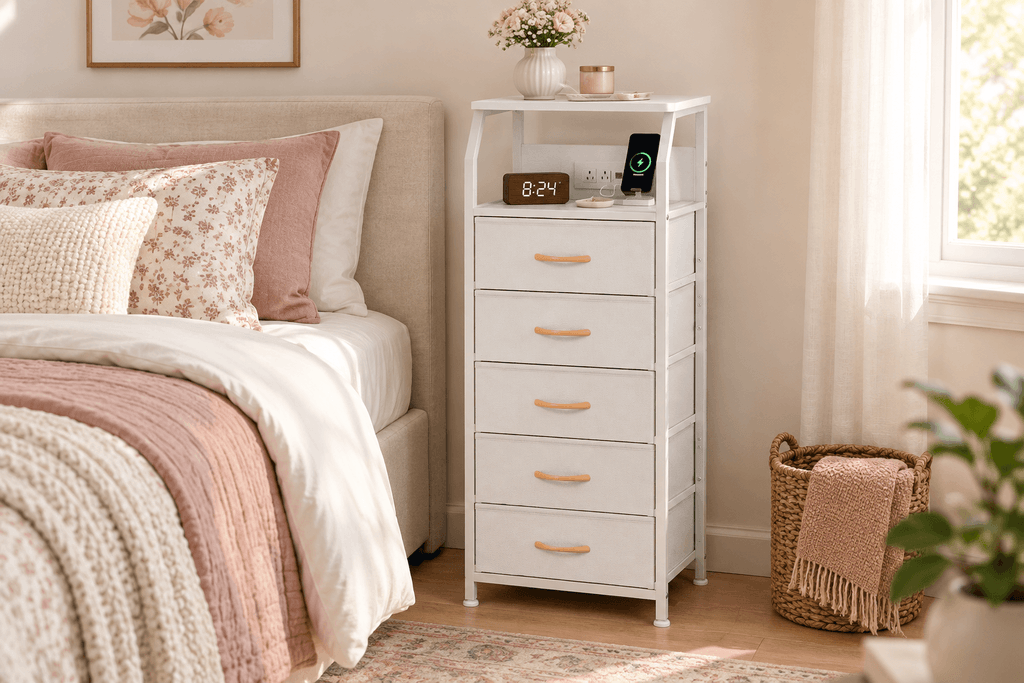
This Furnulem model combines the storage of a narrow vertical dresser with the charging access normally provided by a nightstand.
The integrated station includes two electrical outlets and two USB ports. That creates a dedicated place for a phone, lamp, watch or other small electronics without requiring a separate charging table beside the dresser.
This is most useful when the available wall cannot accommodate both a dresser and a nightstand. At only 16.1 inches wide and 11.5 inches deep, the unit can potentially perform both jobs within the footprint of one narrow piece of furniture.
The raised shelf helps separate electronics from the main surface. A phone and charging cables can remain accessible above while the lower top holds a lamp, books or daily accessories.
The charging station should not be treated as a reason to overload the surface with electronics. Cables still need a clear route to the wall outlet, and the dresser should not be placed where cords cross a walking path.
The five fabric drawers offer the same basic strengths and limitations as the non-powered Furnulem. They work well for lightweight folded clothing and smaller categories, but they are not substitutes for heavy wooden drawers.
Pros
- Replaces a separate charging table in bedrooms with limited wall space
- Keeps phone and lamp cables concentrated in one location
- Upper shelf separates electronics from other bedside items
- Five drawers provide useful clothing organization beneath the charging surface
- Narrow and shallow footprint fits spaces where a dresser and nightstand would not
- Two outlets accommodate plugs that cannot use USB connections
- Adjustable feet help level the tall frame
Cons
- Costs more than a comparable dresser without electrical features
- Charging station provides little value when an outlet is not conveniently located
- Cords can still create clutter around the upper shelf
- Fabric drawers are intended for lightweight storage
- Tall frame must be anchored properly
- Placing drinks near the powered surface requires extra caution
- Electrical components make the dresser less flexible to position away from an outlet
Verdict
Choose this Furnulem when one narrow piece of furniture needs to provide both clothing storage and a charging surface.
It is not worth paying extra for if the dresser will sit far from an outlet or if you already have a functional bedside charging station. In that situation, the standard five-drawer Furnulem provides nearly the same storage without the unused electrical hardware.
Check the Furnulem 5-Drawer Dresser With Charging Station on Amazon
4. AODK 4-Drawer Dresser — Best Compact Low Dresser
Key Specifications
- Dimensions: Approximately 15.7″W × 11.7″D × 31.8″H
- Storage: Four removable fabric drawers
- Frame: Steel
- Top: Finished engineered-wood surface
- Base: Adjustable feet
- Safety: Anti-tip hardware included
- Product weight: Approximately 11 lb
- Assembly required
Why We Chose It
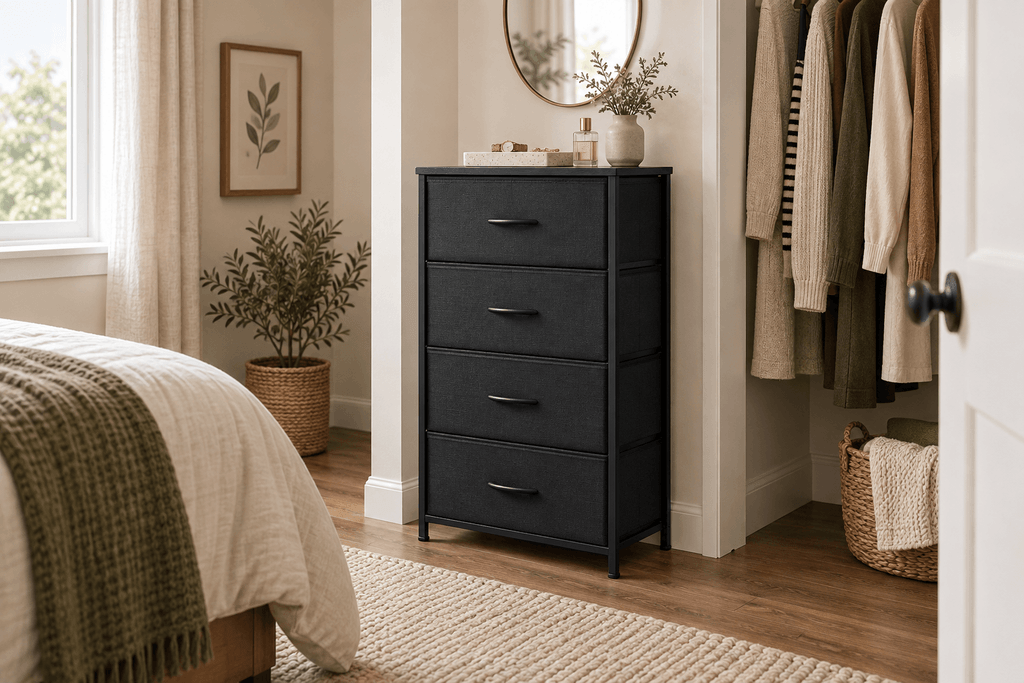
The AODK is the best option here for someone who needs narrow storage without adding a tall furniture tower.
It measures approximately 15.7 inches wide, making it slightly narrower than the Furnulem models. Its 31.8-inch height is the more important difference. The lower profile can fit beneath artwork, wall-mounted shelving or other features that prevent the use of a 40-inch dresser.
That height also makes the top easier to reach. The AODK can function as a compact bedside surface, accessory station or secondary dresser without placing everyday objects above shoulder level.
Four fabric drawers provide less divided storage than the five- and six-drawer Furnulem units. That is the necessary compromise for the shorter frame.
This dresser is better suited to underwear, socks, sleepwear, children’s clothing and other lightweight categories than to an entire adult wardrobe. It can also work inside a closet where vertical clearance is restricted by a hanging rail.
At approximately 11 pounds, it is easy to reposition before being loaded. That portability benefits renters, but it also makes correct anchoring and sensible weight distribution important.
Pros
- Short profile fits beneath features that rule out tall storage towers
- Top remains accessible from a seated or bedside position
- Extremely small width and depth preserve floor space
- Four drawers provide useful supplemental clothing organization
- Lightweight frame is manageable during assembly and moving
- Can fit beneath some closet rails
- Finished top adds a practical surface without requiring a separate table
Cons
- Four lightweight drawers will not hold a complete large wardrobe
- Lower profile leaves vertical wall space unused
- Fabric bins are unsuitable for very heavy contents
- Lightweight frame can shift if it is not leveled and anchored
- Small top cannot accommodate many bedside items
- Better as supplemental storage than as the only dresser for two people
Verdict
Choose the AODK when height is as restricted as width.
It provides more accessible low-level storage than the tall Furnulem towers and is easier to place beneath existing wall features. It is not the strongest choice when maximum clothing capacity is the primary goal.
Check the AODK 4-Drawer Dresser on Amazon
5. Songmics Bellah 3-Drawer Dresser — Best Budget Pick
Key Specifications
- Dimensions: Approximately 15.6″W × 11.8″D × 29″H
- Storage: Three fabric drawers
- Frame: Steel
- Top and drawer fronts: MDF
- Base: Adjustable feet
- Style: Rustic brown and black industrial finish
- Product weight: Approximately 10.9 lb
- Assembly required
Why We Chose It
The Songmics Bellah is the simplest dresser in this guide.
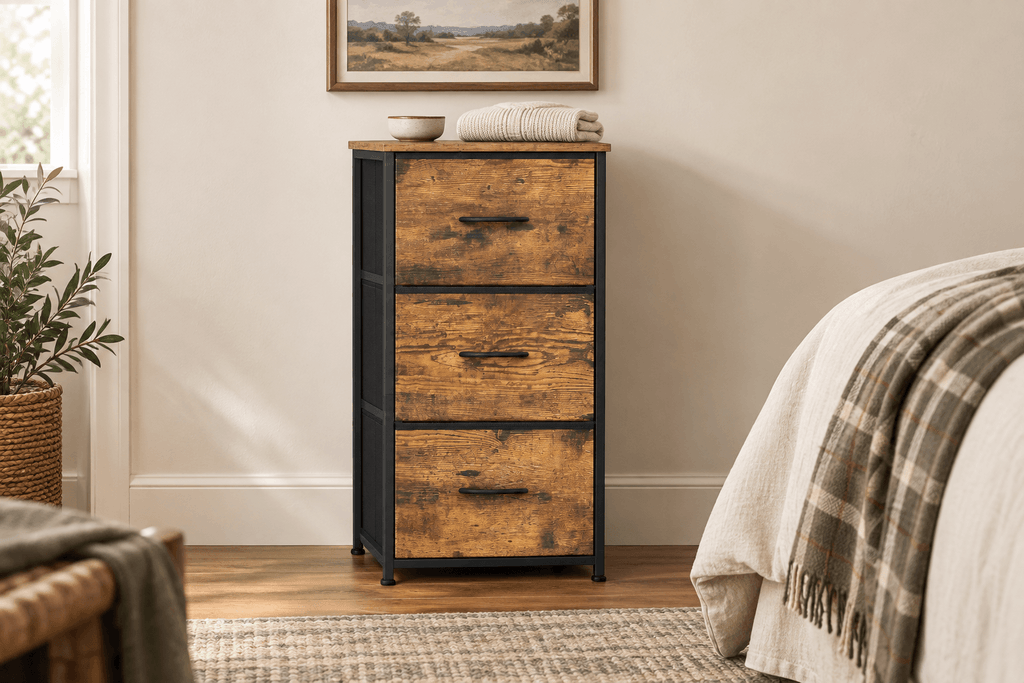
It provides three fabric drawers within a frame measuring only 15.6 inches wide and 11.8 inches deep. At approximately 29 inches high, it can function more like a small nightstand or supplemental storage cabinet than a full-height dresser.
That limited scope is what makes it a defensible budget choice. You are not paying for a charging station, six drawer compartments or a large engineered-wood cabinet. It provides a modest amount of enclosed clothing storage and a finished top in an unusually small footprint.
The MDF drawer fronts give the bins a more structured appearance than exposed fabric handles alone. They do not convert the drawers into wooden boxes, but they help the unit look less like an open closet organizer.
Three drawers will not solve a severe clothing-storage shortage. This model makes more sense for a small selection of underwear, sleepwear, accessories, children’s clothing or clothing that cannot fit in an existing closet.
Prices fluctuate, so confirm that it remains meaningfully cheaper than the larger alternatives before treating the budget label as a reason to buy it.
Pros
- Costs less by avoiding unnecessary electrical and shelving features
- Fits into one of the smallest footprints in the guide
- Low top can double as a bedside or accessory surface
- MDF drawer fronts create a more finished appearance than plain fabric bins
- Three drawers are sufficient for a focused clothing category
- Lightweight construction suits temporary rooms and rentals
- Dark frame conceals minor marks better than an all-white fabric tower
Cons
- Three drawers offer the least storage in the guide
- Poor choice for anyone seeking a primary full-wardrobe dresser
- Fabric bins cannot support the same loads as hard-sided drawers
- Rustic brown and black finish may feel visually heavy in a very small bedroom
- Low frame does not take full advantage of vertical wall space
- Budget value disappears if its price approaches that of a five-drawer model
Verdict
Choose the Songmics when you need inexpensive supplemental storage rather than a complete dresser replacement.
It earns its position through simplicity and a small footprint, not capacity. Check the live price before purchasing; if a five-drawer alternative costs only slightly more, the larger model will usually provide better long-term value.
Check the Songmics Bellah 3-Drawer Dresser on Amazon
6. Hostack Modern 4-Drawer Dresser — Best Traditional Dresser
Key Specifications
- Dimensions: Approximately 27.2″W × 15.4″D × 32.3″H
- Storage: Four hard-sided drawers
- Material: Engineered wood and MDF
- Drawer hardware: Metal slides
- Listed drawer capacity: Up to 25 lb per drawer
- Product weight: Approximately 68 lb
- Safety: Anti-tip hardware included
- Assembly required
Why We Chose It
The Hostack is the strongest option in this guide for someone who wants a conventional dresser rather than a fabric storage tower.
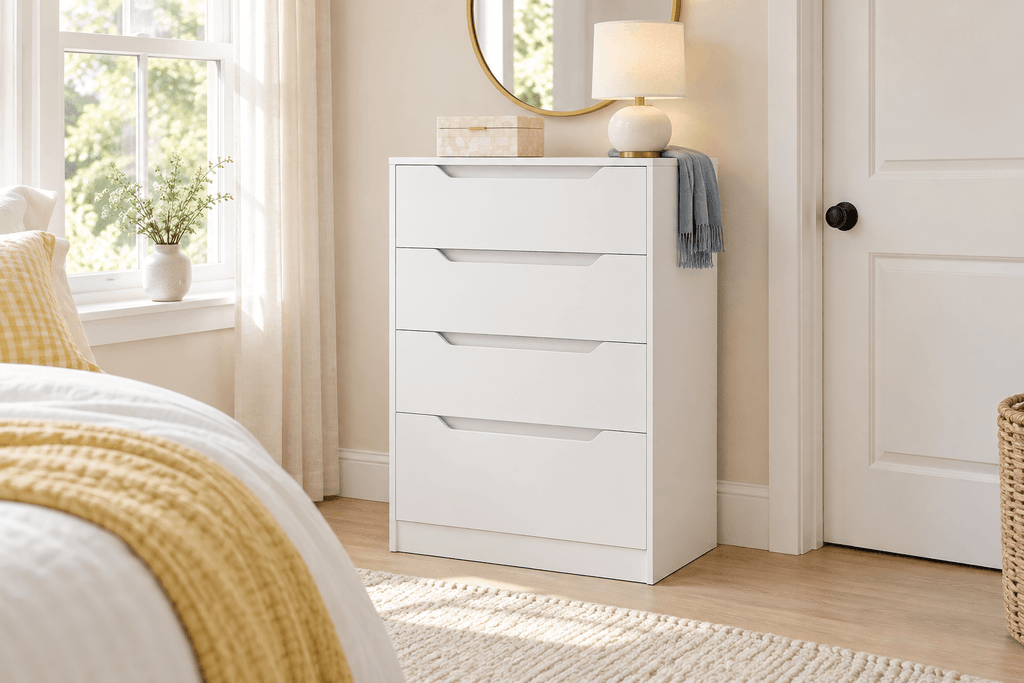
Its four hard-sided drawers run on metal slides and can handle heavier folded clothing more confidently than lightweight fabric bins. The closed engineered-wood frame also looks more like permanent bedroom furniture.
At 27.2 inches wide, the Hostack satisfies the under-30-inch requirement, but it occupies substantially more wall space than the approximately 16-inch-wide fabric models. Its 15.4-inch depth also projects farther into the room.
That larger footprint provides practical benefits. The top offers enough usable surface for a lamp, mirror, accessories or frequently used bedroom items. The wider drawers are more appropriate for folded shirts, jeans and sweaters that would quickly fill narrow fabric bins.
The cost is reduced portability. At approximately 68 pounds before clothing is added, this is not furniture you will casually move around the bedroom. Assembly is also more involved because the cabinet and each drawer must be aligned correctly.
Although the design may be described casually as a wood dresser, it is made from engineered wood and MDF rather than solid timber. That distinction matters for durability expectations and moisture resistance.
Pros
- Hard-sided drawers accommodate heavier folded clothing more confidently
- Metal slides provide more conventional drawer operation
- Closed frame looks like permanent bedroom furniture
- Wider drawers suit jeans, sweaters and substantial garments
- Large top provides considerably more usable surface area
- Listed 25-pound drawer limit is clearer than the vague capacities of many fabric bins
- Four enclosed drawers hide clothing more completely
- Remains below the strict 30-inch width cutoff
Cons
- Uses almost twice as much wall width as the narrowest fabric dressers
- Heavier construction is inconvenient for frequent movers
- Assembly requires more time and careful alignment
- Engineered wood can chip if hardware is overtightened
- Greater depth occupies more walking space beside a bed
- Four drawers provide less category separation than six smaller bins
- Must still be anchored despite its lower, broader frame
- Costs more than lightweight fabric alternatives
Verdict
Choose the Hostack when hard-sided drawers, heavier clothing storage and a conventional furniture appearance matter more than obtaining the smallest possible footprint.
It is not the best option for an extremely narrow gap or a renter who moves frequently. It earns its place because it serves shoppers who want an actual engineered-wood dresser under 30 inches wide rather than another variation of a fabric tower.
Check the Hostack Modern 4-Drawer Dresser on Amazon
What to Look for in a Dresser Under 30 Inches Wide
Confirm which measurement is the width
Furniture dimensions are not always presented in the same order.
One listing may use width × depth × height, while another uses depth × width × height. Marketplace titles sometimes shorten the measurements without labeling them clearly.
Confirm the manufacturer’s dimensional diagram before ordering. For this guide, “under 30 inches” refers specifically to the exterior width across the front of the dresser.
Measure depth as carefully as width
Width determines whether the dresser fits along the wall. Depth determines whether you can still move through the room.
Measure from the wall toward the bed, doorway or nearest furniture. Then account for the space your body needs to walk through comfortably.
A shallow 16-inch-wide fabric dresser can fit locations where even a relatively narrow traditional dresser would make the passage uncomfortable.
Leave room to open the drawers
The dresser’s closed footprint is not its complete operating space.
Measure the drawer extension and confirm that a fully opened drawer will not hit the bed, block a doorway or prevent someone from walking past.
This is particularly important when placing a dresser directly opposite the side or foot of a bed.
Account for baseboards
Baseboards may prevent the dresser from sitting flush against the wall.
That small gap can increase the effective depth and change where the wall anchor reaches. Measure from the farthest projecting trim rather than assuming the back of the dresser will touch the wall.
Think about what will actually go inside
Do not choose by drawer count alone.
Fabric drawers work particularly well for: Underwear, socks, sleepwear, lightweight tops, activewear, children’s clothing, scarves and accessories.
Hard-sided drawers are generally more appropriate for: Jeans, sweaters, heavier folded shirts, dense clothing stacks and items that need greater structural support
If you own mostly bulky garments, fewer large drawers may be more useful than several small bins.
Decide whether portability matters
A lightweight fabric dresser can be carried between rooms or moved during cleaning with much less effort. That makes it useful in dorms, rentals and temporary bedrooms.
A heavier engineered-wood dresser feels more permanent and can support heavier contents, but it is harder to assemble, relocate and carry upstairs.
Neither construction is universally better. The correct choice depends on how long the furniture will remain in place and what it needs to hold.
Treat tall dressers as anchor-required furniture
A narrow base and increased height can make a dresser easier to tip, particularly when several upper drawers are open.
Use the supplied anti-tip hardware and follow the manufacturer’s installation instructions. Do not allow children to climb on drawers, and avoid placing the heaviest contents at the top.
Adjustable feet can reduce wobbling on uneven floors, but they do not secure the dresser to the wall.
Check the top before assigning it another job
A narrow dresser may also function as a nightstand, charging station or small vanity surface, but the available top area varies considerably.
The approximately 16-inch fabric towers offer limited surface space. The 27.2-inch Hostack provides more room but also occupies substantially more floor area.
Do not cover the entire top with accessories if doing so recreates the clutter problem the dresser was supposed to solve.
Fabric Drawers vs. Hard-Sided Drawers
Fabric dressers are not simply cheaper versions of traditional dressers. They are a different type of storage.
Their strengths are low weight, shallow dimensions, simpler assembly and more drawer divisions within a narrow frame. They work well for small garments and renters who may need to move the furniture later.
Their weaknesses are reduced load capacity, less rigid drawer operation and a more temporary appearance.
Hard-sided engineered-wood dressers provide more structure and generally handle heavier clothing better. They also look more like conventional bedroom furniture and offer broader top surfaces.
The tradeoff is a larger footprint, higher weight, longer assembly and reduced portability.
Choose fabric drawers when saving floor space is the priority. Choose hard-sided drawers when the dresser must hold heavier clothing and remain in place as a permanent part of the bedroom.
A Narrow Dresser Should Fit the Clothes and the Room
The smallest dresser is not automatically the best dresser.
For most small bedrooms, the Furnulem five-drawer model provides the strongest balance of storage, footprint and everyday accessibility. The six-drawer version is better when separating more clothing categories matters most, while the powered Furnulem makes sense when the dresser must also function as a charging station.
The shorter AODK fits locations where a tall tower would interfere with existing wall features. The Songmics provides simple supplemental storage at a lower price, provided the live price remains meaningfully below the larger alternatives.
The Hostack is the clear choice for shoppers who do not want fabric drawers. It requires more room and more assembly, but it provides the conventional construction and heavier clothing support the narrow towers cannot match.
Measure the width, depth and drawer clearance. Decide what clothing needs to go inside. Then choose the smallest dresser that stores those items properly without making the bedroom harder to move through.
That will produce a better result than choosing the dresser with the most drawers, the lowest price or the word “small” repeated most often in its Amazon title.