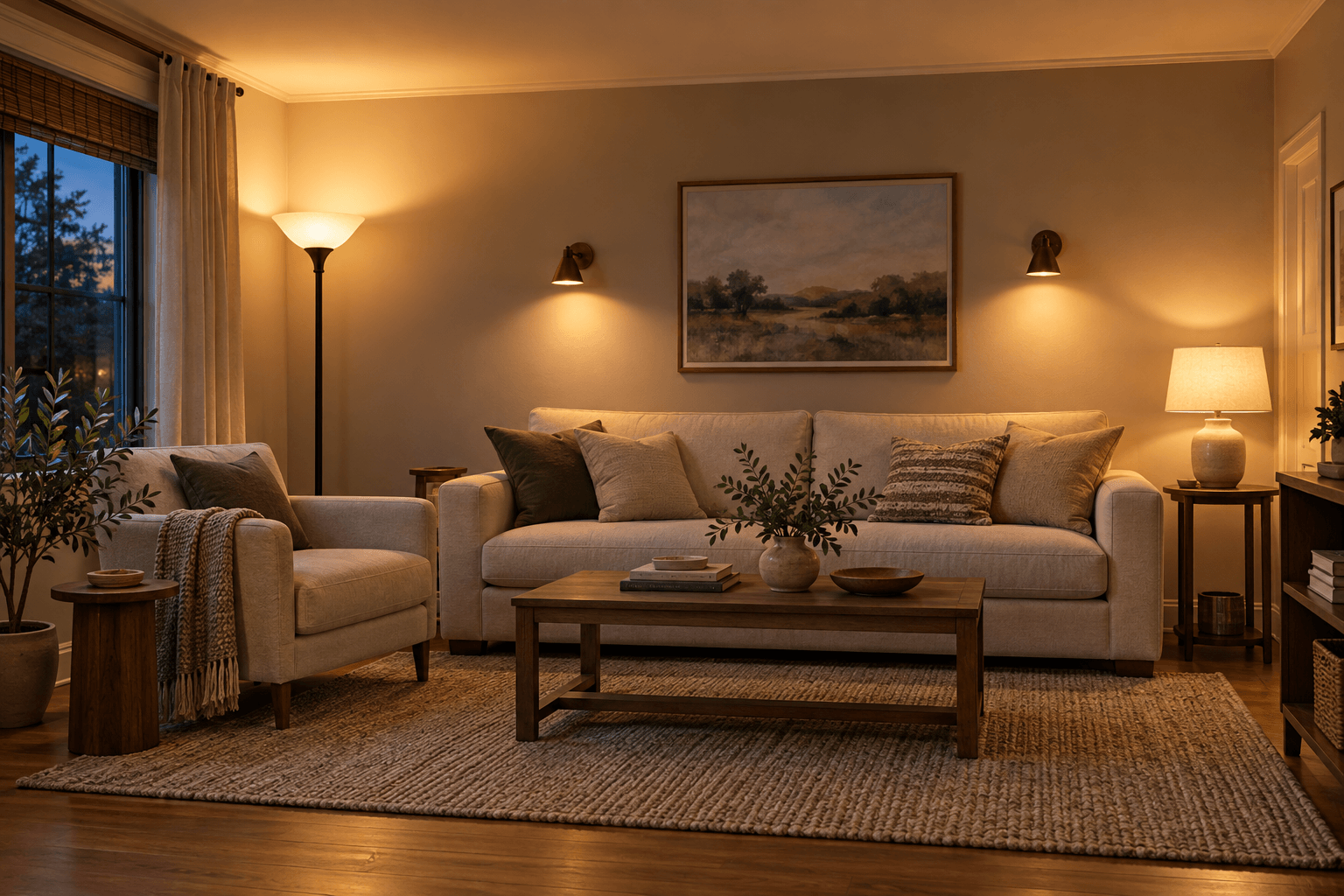
How to Brighten a Dark Room Without Overhead Lighting
Disclosure
This post may contain affiliate links. If you purchase through these links, I may earn a small commission at no extra cost to you. As an Amazon Associate I earn from qualifying purchases.
A dark room without an overhead light can feel like a problem that requires rewiring, a new ceiling fixture or several lamps squeezed into every available corner.
It usually doesn’t.
The bigger problem is often how the available light is distributed.
One bright lamp aimed at a small area may provide enough light to read, but it might not make the entire room feel brighter. A decorative lamp with an opaque shade may look beautiful while sending very little useful light into the room. And several lamps placed at the same height can leave the ceiling, walls and opposite corners in shadow.
The solution is not simply to add more lighting.
It is to use a combination of ambient, task and indirect light, place those sources where they can reach different parts of the room and choose bulbs based on actual light output rather than wattage alone.
Here is how to brighten a dark room without installing an overhead fixture or turning the room into a collection of extension cords and mismatched lamps.
First, Work Out Why the Room Feels Dark
Before buying another lamp, identify what the room is currently missing. A room can feel dark because:
- It has only one light source
- The existing lamp is too dim
- The light is concentrated in one small area
- Dark walls, floors or furniture absorb much of the available light
- The lamp shade blocks light from reaching the ceiling and walls
- Corners remain unlit
- The room depends on task lighting but has no general ambient light
- Furniture or curtains obstruct the available natural light
- The bulbs have enough wattage but insufficient lumen output
- Every light sits at approximately the same height
These problems require different solutions.
If the room already has enough total light but it is badly distributed, adding another powerful lamp beside the first one will not help much. The opposite side of the room will still feel dark.
If the room has several decorative lamps but all of them produce very little light, rearranging them will not solve the brightness problem either.
Start by turning on every existing light and observing the room from the doorway.
Which surfaces remain dark? Does the ceiling receive any light? Are all the lamps concentrated around one sofa, desk or bed? Is the center of the room relatively bright while the perimeter disappears into shadow?
That assessment tells you whether you need more output, better positioning or a different type of lamp.
Create Layers of Light Instead of Relying on One Lamp
A room without ceiling lighting needs more than one kind of light. The three useful layers are:
Ambient lighting
Ambient lighting provides the room’s general illumination. Without a ceiling fixture, this job can be handled by:
- A torchiere floor lamp
- A bright floor lamp that directs light upward
- A lamp positioned to wash a wall with light
- A wide-shade floor or table lamp that diffuses light around the room
- Plug-in wall sconces
- Multiple moderate-output lamps positioned in different areas
Ambient light should make it possible to enter and move through the room comfortably. It does not need to provide perfect light for reading, detailed work or applying makeup.
Task lighting
Task lighting illuminates a specific activity. Examples include:
- A reading lamp beside a chair
- A desk lamp aimed at a work surface
- A bedside lamp
- A clip-on light attached to a headboard or shelf
- A directional wall light beside the bed
- A floor lamp with an adjustable reading arm
Task lighting is deliberately more concentrated than ambient lighting.
The mistake is expecting one small task lamp to brighten the entire room. A desk lamp may illuminate your keyboard extremely well while doing almost nothing for the rest of the space.
Accent lighting
Accent lighting is not essential for visibility, but it can prevent the room from looking flat or unfinished. This might include:
- A small lamp on a bookcase
- LED lighting underneath a shelf
- A picture light above artwork
- A low lamp in a previously dark corner
- Lighting behind a television or headboard
- A portable lamp on a console
Accent lights work best after the room already has functional ambient and task lighting. They should complete the lighting plan, not compensate for the absence of adequate general light.
Use a Floor Lamp to Bounce Light Off the Ceiling
When a room has no overhead fixture, the closest substitute is often a floor lamp that directs a substantial amount of light upward.
A torchiere or uplighter sends light toward the ceiling, where it spreads across a larger surface before reflecting back into the room. This generally produces broader illumination than a downward-facing reading lamp.
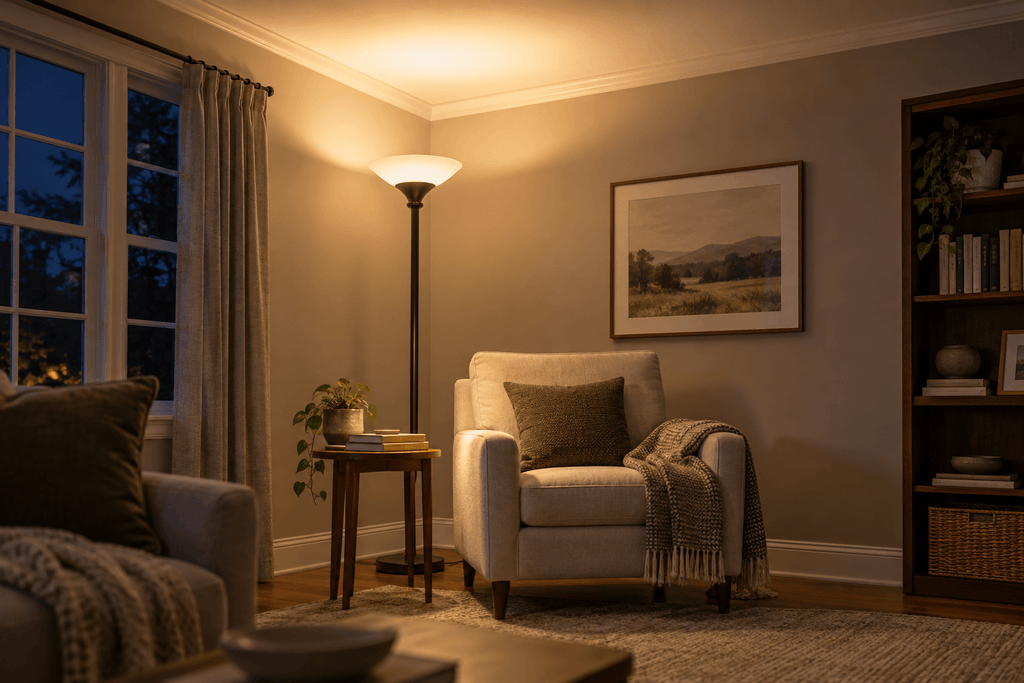
The effect works best when:
- The ceiling is relatively light in color
- The lamp is tall enough to send light above eye level
- The shade or light head is open at the top
- The fixture produces enough lumens for the room
- Tall furniture does not block the light
- The lamp is not hidden in an enclosed furniture gap
Place the uplighter near one of the darker parts of the room rather than automatically positioning it beside the brightest existing lamp.
If your main problem is insufficient brightness rather than limited floor space, our guide to the best floor lamps for dark rooms compares high-output options designed to illuminate more than a small reading area.
For a compact room where the lamp’s footprint matters just as much as its output, see the best floor lamps for small spaces.
Light the Walls, Not Just the Floor
A lamp can produce plenty of light and still leave the room looking dark if most of that light lands on the floor or one small surface.
Walls occupy a large portion of what you see when entering a room. Illuminating them can make the entire space appear brighter.
Try positioning a floor lamp or directional lamp so that some of its light reaches a pale wall. The wall becomes a large reflective surface that spreads softer light back into the room.
This is particularly useful in:
- Dark corners
- Narrow rooms
- Windowless rooms
- Rooms with dark flooring
- Spaces where the center is illuminated but the perimeter is not
- Living rooms where all the lamps currently surround the seating area
The lamp should not sit so close to the wall that it creates one harsh, concentrated patch of light. Give the beam enough distance to spread.
You can also use plug-in or rechargeable wall sconces to introduce light higher on the wall. This helps fill the visual gap between a table lamp and the ceiling without requiring hardwiring.
Renters can find suitable options in our guide to the best rechargeable wall sconces that do not require hardwiring.
Place Light Sources in Different Parts of the Room
Three lamps grouped beside one sofa still behave like one lighting zone. To make the room feel evenly illuminated, distribute the lights.
A practical starting arrangement is:
- One bright ambient light near a dark corner
- One task light beside the primary seating, desk or bed
- One smaller light on the opposite side of the room
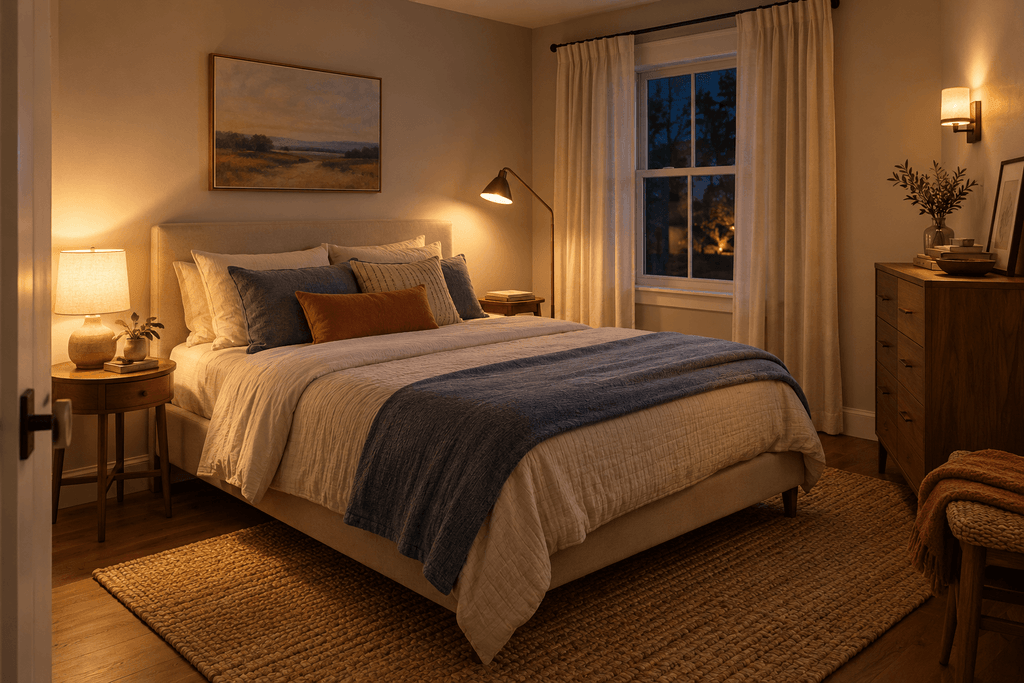
The sources do not have to match. What matters is that they serve different areas and produce compatible light.
If possible, position two of the main light sources diagonally from each other. This reduces the sharp contrast between a brightly lit corner and a dark opposite side.
Avoid placing every lamp along one wall unless the room is extremely narrow. Lighting only one side can make the other side visually recede and leave the room feeling uneven.
In a small room, each lamp should justify the space it occupies. A lamp with shelves, a built-in table or charging may replace another piece of furniture, but multifunctionality only helps when you genuinely need those extra functions.
If storage is part of the problem, the best floor lamps with shelves for small spaces include options that combine lighting with usable vertical storage.
Choose Bulbs by Lumens, Not Watts
Watts tell you how much energy a bulb uses. They do not directly tell you how bright it will be. Brightness is measured in lumens.
The U.S. Department of Energy’s lighting guidance recommends checking the Lighting Facts label for brightness, measured in lumens, as well as light appearance, wattage and expected lifespan.
As a rough starting point, Department of Energy guidance suggests approximately 10 to 20 lumens per square foot for bedrooms and living areas. A 100-square-foot room could therefore begin with roughly 1,000 to 2,000 lumens distributed across its light sources.
That is not a universal formula.
You may need more light if the room has:
- Dark walls or ceilings
- Very little natural light
- Dark upholstery or flooring
- High ceilings
- Several enclosed lamp shades
- Detailed work areas
- Older occupants who need stronger task lighting
You may need less if the room is used primarily for relaxing in the evening. The important point is to calculate the light from the room as a whole rather than expecting every lamp to be extremely bright.
For example, you might combine:
- A 1,500-lumen uplighter for ambient light
- An 800-lumen reading lamp
- A 400-lumen table lamp on the opposite side of the room
That would provide 2,700 lumens in total while still allowing you to control each zone separately.
Whenever possible, choose dimmable lamps or bulbs. A dark room may need substantial output during the day but softer light at night.
Choose the Right Color Temperature
Brightness and color temperature are not the same thing.
Color temperature describes whether white light appears warmer and more yellow or cooler and more blue. It is measured in kelvins.
According to Energy Star, approximately 2700K to 3000K produces warmer white light, while 4000K and above appears progressively cooler.
For most living rooms and bedrooms:
- 2700K creates a warm, relaxed evening atmosphere
- 3000K remains warm but can look slightly clearer
- 3500K can work in multipurpose spaces
- 4000K provides a cooler, more task-oriented appearance
- 5000K and above can look stark in a relaxing room, particularly at night
Do not assume that choosing a higher color temperature will automatically make the room brighter. A 5000K bulb may appear crisper or bluer, but its actual output still depends on its lumens.
The best choice depends on what you do in the room.
A bedroom may feel most comfortable around 2700K to 3000K. A home office or craft area may benefit from a clearer 3000K to 4000K task light during the day.
Try to avoid extreme mismatches. A very warm lamp beside a blue-white lamp can make the room look disjointed even when both bulbs are individually suitable.
Color-changing or tunable-white lamps can help when the same room serves several purposes. Brighter, cooler light can support daytime tasks, while warmer, dimmer light creates a more comfortable evening setting.
Add Focused Light Where You Actually Need It
Trying to make every corner equally bright wastes energy and often creates an unpleasantly flat room.
Instead, provide stronger light where activities happen.
Beside a reading chair
Use an adjustable floor lamp that directs light over your shoulder and onto the page without shining directly into your eyes.
A torchiere may brighten the room, but it is not automatically a good reading lamp. Some models combine an uplight with a separate adjustable reading arm, allowing one fixture to provide both ambient and task lighting.
Our guide to the best floor lamps for reading in small spaces explains which features matter when the light needs to reach a book rather than merely brighten the room.
Beside the bed
A bedside lamp should be easy to operate from bed and provide enough light for your actual nighttime routine.
If the nightstand is small, do not sacrifice the entire surface to an oversized lamp. Consider a compact table lamp, wall-mounted light or clip-on option instead.
The best bedside lamps for small bedrooms include compact, cordless and wall-mounted options for limited bedside space.
At a desk
Use a directional desk lamp instead of trying to increase the brightness of the entire room every time you work.
Position it to illuminate the work surface without creating glare on the screen. If you are right-handed, placing the lamp toward the left can reduce the shadow cast by your hand; reverse the arrangement if you are left-handed.
The desk lamp should supplement the room’s ambient light, not operate in complete isolation. Looking repeatedly between a bright monitor or work surface and a dark surrounding room can feel uncomfortable.
Consider Plug-In and Rechargeable Wall Lighting
A room without overhead lighting does not have to rely entirely on floor and table lamps.
Wall lighting introduces illumination higher in the room and preserves valuable floor and surface space.
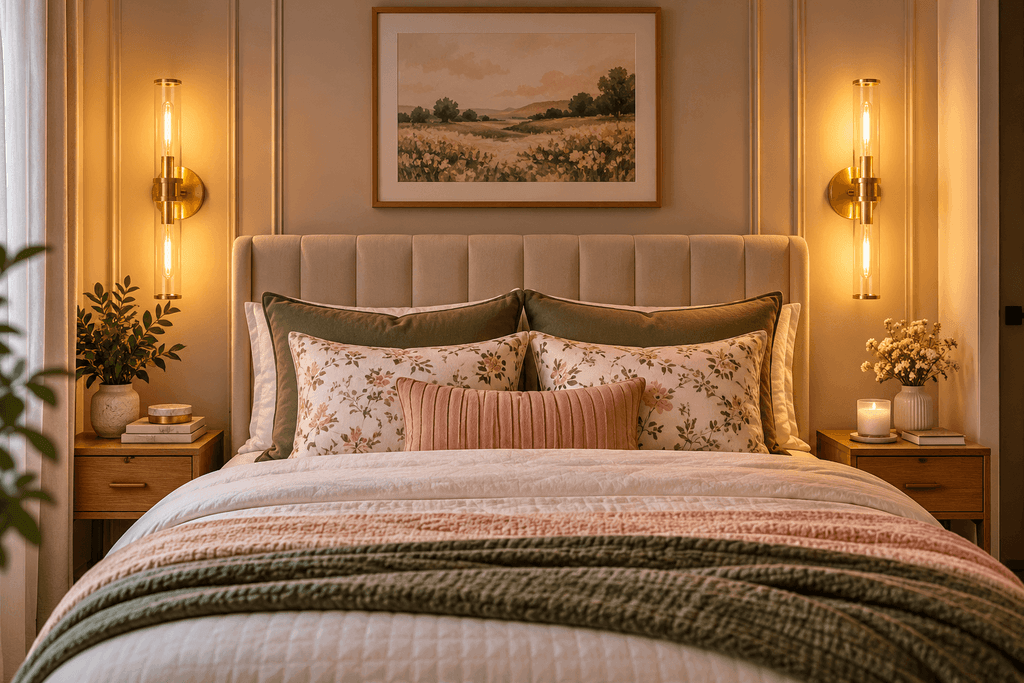
Options include:
- Plug-in sconces
- Rechargeable sconces
- Battery-operated picture lights
- Adhesive-mounted lights
- Clip-on lights
- Plug-in pendants suspended from a ceiling hook
Plug-in sconces usually provide more consistent output than small rechargeable models, but they require access to an outlet and leave a visible cord unless it is concealed safely.
Rechargeable sconces are easier to install and can work well for bedside reading, accent lighting and occasional use. They are less convincing as the room’s only source of general illumination because battery life and output can be limited.
Do not use adhesive mounting for a fixture unless both the fixture and mounting system are designed for it. Consider the wall finish, weight of the light and possibility of the adhesive weakening over time.
We made a guide on some particularly varied options on this post: Rechargeable Wall Sconces for Renters Who Can’t Hardwire Lighting.
Use Mirrors to Multiply Useful Light
A mirror cannot create light, but it can redirect the light already available.
The common advice is to place a mirror opposite a window. That can work when the window receives meaningful daylight, but it is not the only useful position.
In a room with limited natural light, try placing a mirror where it can reflect:
- A bright lamp
- A pale illuminated wall
- A window at an angle
- An open doorway leading to a brighter room
- A decorative light source you want to repeat visually
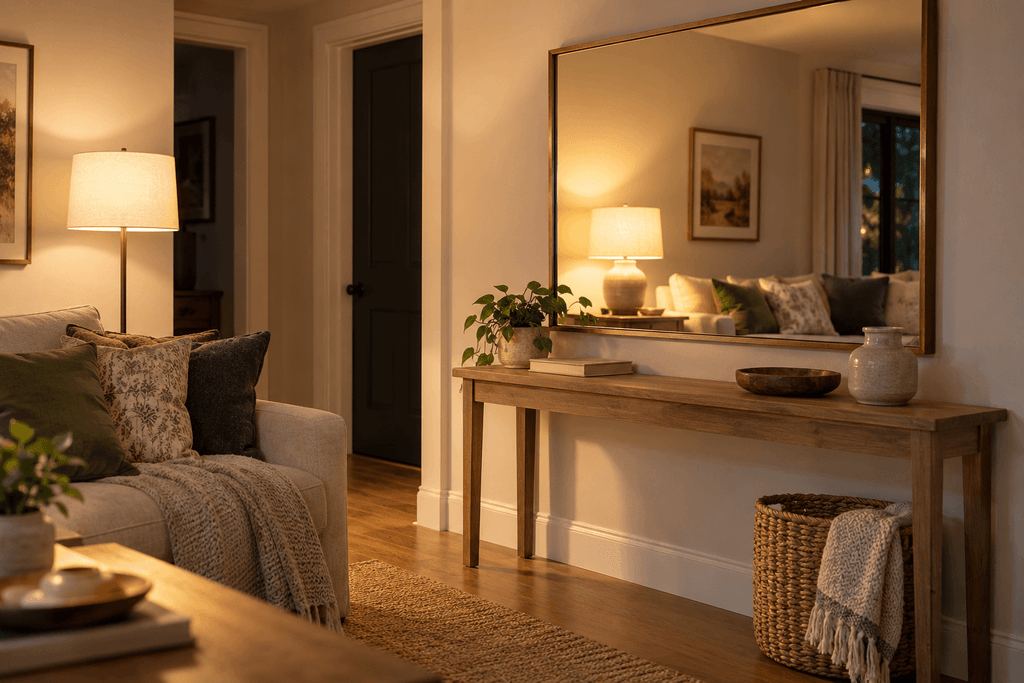
Do not position the mirror where it reflects the darkest part of the room, a cluttered storage area or the direct glare from an exposed bulb.
A larger mirror generally reflects more light than several tiny decorative mirrors, but it should still suit the scale and layout of the room. The goal is to redirect useful brightness, not fill the walls with reflective objects.
Remove Things That Block Natural Light
A room can remain dark even when it has a decent window because much of the daylight never reaches the interior.
Look for:
- Heavy curtains that remain closed during the day
- Furniture placed directly in front of the window
- Tall plants blocking the glass
- Cluttered windowsills
- Dark blinds that absorb light
- Dirty windows
- Exterior plants or branches obstructing the opening
If privacy is the concern, sheer curtains, privacy film or blinds that can open from the top may allow more daylight into the room without leaving it completely exposed.
Mounting a curtain rod slightly wider than the window can also allow the curtains to sit beside the glass when open instead of covering part of it.
This will not solve a windowless room, but it prevents the room from losing the limited natural light it already has.
Use Lighter and More Reflective Surfaces Strategically
You do not need to turn the entire room white. But in a genuinely dark room, large dark surfaces absorb more of the available light.
The surfaces with the greatest visual impact usually include:
- Walls
- Ceiling
- Flooring
- Curtains
- Large rugs
- Bedding
- Sofas
- Wardrobes
- Large cabinet fronts
If repainting is possible, a light or mid-tone paint with a suitable reflective finish can help light travel farther than an extremely dark, flat surface.
If repainting is not possible, introduce lighter surfaces selectively:
- Add a light rug over dark flooring
- Replace heavy dark curtains
- Use pale bedding
- Choose a light sofa cover
- Add artwork with a light background
- Use a pale lampshade that allows light through
- Place a mirror or reflective object near a useful light source
Do not add dozens of small white accessories expecting them to brighten the room. A few larger surfaces will usually have a greater effect than scattered decorative objects.
Make Several Lamps Easy to Control
One reason people continue using inadequate lighting is inconvenience.
If brightening the room requires walking to four different switches, reaching behind furniture and turning on individual lamps one by one, the lighting plan will become irritating quickly.
You can make multiple lamps easier to manage with:
- Switched outlets
- Remote-control outlets
- Smart plugs
- Smart bulbs
- Lamps with physical remotes
- Timers
- Voice control
A smart plug can control a conventional lamp as long as the lamp has a compatible physical switch that remains in the on position. It will not necessarily provide dimming or color-temperature control unless the lamp and plug specifically support those functions.
If you already own suitable lamps, automation may be cheaper and less wasteful than replacing them. Our guide to things you can automate with smart plugs in a small apartment explains where smart plugs are genuinely useful and where they are not.
How to Light Different Rooms Without an Overhead Fixture
The same lighting arrangement will not work everywhere.
Small bedroom
Start with:
- One bedside lamp or wall light
- One floor lamp aimed upward or toward a wall
- Optional low-level light for the closet or route to the door
The bedside light handles reading and evening use. The floor lamp provides broader illumination. A motion-activated or rechargeable light can cover a dark closet without filling the bedroom with another piece of furniture.
Keep evening lighting relatively warm and place the controls within easy reach of the bed.
Living room
Start with:
- One strong ambient floor lamp
- One reading light beside the main seat
- One smaller lamp across the room
If the living room is large or divided into zones, each seating or activity area may need its own task light.
Do not position every lamp around the television. That can leave the rest of the room dark and create distracting reflections on the screen.
Home office
Start with:
- One broad ambient light
- One adjustable desk lamp
- Optional wall or shelf lighting behind or beside the monitor
The objective is to illuminate both the work surface and the surrounding room. A very bright desk lamp in an otherwise dark office can create uncomfortable contrast.
Windowless room
Start with:
- One high-output ambient source
- Light directed toward the ceiling or a large pale wall
- Task lighting for specific activities
- A smaller secondary source on the opposite side
A windowless room benefits particularly from adjustable brightness and color temperature. You can use clearer light during active daytime hours and warmer light in the evening.
Common Mistakes That Keep a Room Dark
Buying lamps based on appearance alone
A beautiful lamp with an opaque shade may contribute very little useful light. Check the lumen output, shade design and direction of the light before assuming it will solve the room’s brightness problem.
Using only downward-facing lamps
Downward light is useful for reading and work, but it can leave the walls and ceiling dark. Add at least one source that sends light upward or outward.
Concentrating every lamp in one area
Lighting one corner extremely well does not brighten the opposite side of the room. Distribute the sources.
Choosing color temperature instead of brightness
A cooler bulb is not automatically brighter. Compare lumens first, then choose an appropriate color temperature.
Using only small rechargeable lights
Rechargeable lights can be excellent for accent, bedside and task lighting. Many are not designed to provide sustained whole-room illumination. Use them where their flexibility matters, but do not expect several tiny battery lights to replace one adequate ambient source.
Ignoring the lamp shade
Dark, dense and opaque shades limit the amount of light entering the room. They may work beautifully for mood lighting but poorly when the objective is general brightness.
Adding too many weak lights
Six decorative lamps are not necessarily better than three properly selected ones. More fixtures mean more cords, switches, surfaces and visual clutter. Begin with one effective ambient light and one task light, then add another source only if part of the room remains underserved.
A Simple Order for Fixing a Dark Room
If you are unsure where to begin, make changes in this order:
1. Maximize the natural light already available
Open the window area, move obstructions and reconsider heavy window treatments.
2. Add one effective ambient source
Use a floor lamp that throws light upward, outward or onto a large wall.
3. Illuminate the activity areas
Add focused light beside the bed, desk, sofa or reading chair.
4. Check the opposite side of the room
If it still disappears into shadow, add a smaller secondary lamp there.
5. Compare the bulbs
Check lumens, color temperature, dimming compatibility and whether the shades allow enough light through.
6. Improve reflective surfaces
Use a mirror, lighter textile or pale wall surface where it can redirect useful light.
7. Simplify the controls
Connect compatible lamps to a remote outlet, smart plug or other convenient control system. Do not buy all the lighting at once.
Add the main ambient source first, observe the room at different times of day and then address the areas that remain dark.
You Want Better Distribution, Not Maximum Brightness
A dark room does not necessarily need to look like an office, showroom or operating theater.
It needs enough general light to move around comfortably, focused light where activities happen and a reasonable balance between the brightest and darkest parts of the space.
That usually comes from several purposeful light sources at different heights, not one painfully bright lamp.
Start with an uplight or another effective ambient source. Add task lighting where you read, work or relax. Then use wall lighting, mirrors and smaller lamps to address the remaining shadows.
Without installing a ceiling fixture, you can still create a room that feels brighter, more functional and far more intentional.
The key is to stop treating each lamp as an isolated object and start treating the entire room as one lighting plan.


