Too Many Clothes but Love Them All? How to Make a Small Closet Work

Disclosure
This post may contain affiliate links. If you purchase through these links, I may earn a small commission at no extra cost to you. As an Amazon Associate I earn from qualifying purchases.
There’s a particular kind of closet problem that ordinary decluttering advice doesn’t solve.
The closet is overflowing. Getting dressed in the morning involves moving things to find other things. You know, logically, that there is too much in there. But every time you try to declutter, you hit the same wall: you actually like your clothes.
You bought them intentionally. You can picture wearing them. Some have memories attached to them. Some are beautiful. Some are pieces you still genuinely want to wear, just not very often.
So the usual advice: just get rid of things you don’t wear, doesn’t quite fit and getting rid of them feels wrong.
You don’t necessarily need a minimalist wardrobe. You need a wardrobe that works within the amount of space you actually have.
In a small bedroom, that means figuring out which clothes need prime access, which can live in secondary storage, which need a different storage solution, and which you’re keeping for reasons that have little to do with how you actually dress.
The goal isn’t to own fewer clothes for the sake of owning fewer clothes. The goal to make the clothes you want to keep work in the space you have.
1. Stop Asking Which Clothes You Should Get Rid Of
That question puts you in the wrong frame immediately. It makes every garment feel like a potential loss rather than a decision about how you want to use your limited space.
The better question is this: which clothes deserve the easiest access to my space?
That reframe changes the whole exercise.
The clothes you reach for most often earn the closet section you can reach without moving anything. Front of the rail, the eye-level shelves, the accessible drawer.
That doesn’t mean everything else has to leave.
A dress you wear twice a year doesn’t need to compete with your everyday jeans for the same section of the rail. A formal outfit doesn’t need to sit at the front of the closet simply because you love it. A winter coat doesn’t need to occupy prime space during months when you never touch it.
Instead of defending every item against elimination, you’re making decisions about priority. The question becomes less about how many clothes you own and more about whether the space is being allocated according to how you actually use them.
That distinction matters because you can have a relatively large wardrobe that functions extremely well, or a small wardrobe that is so badly organized that getting dressed is still frustrating.
2. Separate Loving a Garment from Actually Wearing It
You can love a garment without actually wearing it very often.
You might love it because it’s beautiful. Because it was expensive. Because you wore it somewhere meaningful. Because it looks incredible on a hanger or represents a style you love. Or because you’ve imagined a version of yourself who wears it regularly.
None of those things are inherently a problem. But they are different from actually wearing something.
A useful distinction is: I love this garment versus I regularly choose this garment.
Your worn-in jacket that you automatically reach for on an ordinary day belongs in the second category. So does the pair of trousers you wear constantly, even if they’re not the most exciting things in your closet.
The beautiful dress you’ve worn twice in 1 year may belong in the first category. Neither one is automatically a candidate for removal. They simply shouldn’t necessarily receive the same amount of accessible storage.
This is where a small closet becomes easier to manage. Once you stop expecting every garment to justify its existence by being worn constantly, you can give different clothes different levels of access.
The clothes you actually live in stay easy to reach. The clothes you love but rarely need can still stay, just somewhere that doesn’t interfere with your everyday wardrobe.
3. Before You Declutter or Buy More Storage, Figure Out Why the Closet Isn’t Working
A full closet doesn’t automatically mean you have too many clothes. There are at least three different problems that can create the same feeling:
You don’t have enough storage capacity
Everything you own is genuinely useful and regularly worn, but there simply isn’t enough physical space to store it properly.
In that case, better storage may be the answer.
You have enough storage, but you can’t access it properly
The rail is packed so tightly that clothes disappear into a solid wall of fabric. Shelves are stacked too deeply. Drawers are overfilled. You keep moving five things to get to the one you want.
That’s an organization and accessibility problem.
Your wardrobe keeps expanding
Every storage improvement works for a few months, then the closet is full again. There is a chance you’re buying duplicates because you can’t find what you own, or buying new versions of things you already have.
That’s a consumption problem and more storage won’t solve that one.
If the problem is that your clothes are packed so tightly that you can’t see or reach them, an additional storage product may simply create another place to pack things tightly.
If the problem is genuinely insufficient capacity, however, storage can make a substantial difference. The point is to diagnose the problem before buying the solution.
4. Give Your Clothes Different Levels of Access
Once you’ve established that you want to keep a large portion of your wardrobe, stop trying to make every item equally accessible.
A small closet works better when it has levels.
Prime storage: clothes you reach for constantly
This is the easiest-to-access part of the closet.
Use it for the clothes that make up most of your normal wardrobe: everyday tops, frequently worn trousers, favorite jeans, work clothes you use regularly, or whatever you actually reach for most.
These pieces should be the easiest to see and remove.
If you have to dig past six rarely worn garments to reach the clothes you wear every week, the closet is organized around the wrong priority.
Secondary storage: clothes you wear regularly but not constantly
Secondary storage is for clothing worn regularly but not daily. Work pieces used a few times a week, specific seasonal items currently in use, going-out clothes for weekends. These live in the closet but further back, on higher shelves, in the lower drawers.
Deep storage: clothes you genuinely need but rarely use
Formalwear, special-event clothing, heavy coats during warmer months, travel-specific pieces and other genuinely occasional garments don’t need prime closet space.
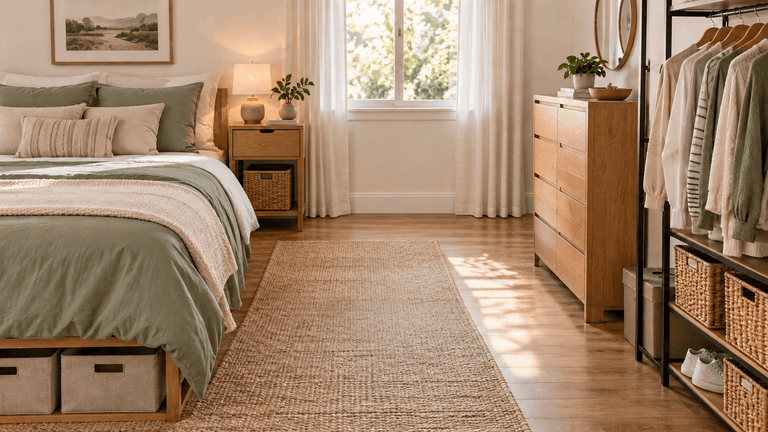
Under-bed storage is particularly useful for this category because it uses space that would otherwise sit empty. The same principle applies to seasonal rotation, but you don’t need to live somewhere with dramatic seasons for this idea to work.

You can rotate based on frequency, not just weather. A formal dress you wear twice a year can move out of your everyday closet space even if the weather never changes. A heavy coat that only comes out during a few particularly cold weeks can do the same.
The important thing is that the system reflects how often you actually use something, not an arbitrary rule about how many clothes you’re allowed to own.
The post on how to organize a small bedroom without a closet covers these storage solutions in more depth for bedrooms where the closet is minimal or non-existent.
5. What to Do with Clothes You Love but Rarely Wear
This is the category most wardrobe edits don’t handle well. Standard clothes decluttering advice says get rid of it. That advice ignores the real variation in why something is rarely worn. That can fall into several categories.
Keep it accessible
You may genuinely wear it, but it gets buried and you end up forgetting it exists. If you find yourself saying, “Oh, I forgot I had this,” the problem may be storage rather than the garment.
Move it somewhere you can actually see it.
Keep but relocate
You love it. You want to keep it. You just don’t need to see it every morning.
Move occasional pieces into secondary or deep storage so they remain available without competing with your everyday wardrobe.
Repair or alter
Sometimes the reason you don’t wear something is extremely specific.
The hem is wrong. A button is missing. The sleeves need adjusting. The fit needs a small alteration.
If fixing that one problem would genuinely make you wear the garment and you’ll actually do it, keep it but give yourself a deadline.
However, if you’ve been meaning to fix it for two years, be honest. A garment that has been “waiting to be repaired” for two years isn’t really being saved by the intention to repair it.
Test it
Sometimes you’re not sure whether you actually enjoy wearing something because you haven’t worn it recently.
Instead of standing in front of your closet trying to decide, deliberately wear it. Put the outfit together. Wear it on an ordinary day when appropriate. Notice how you feel in it.
If you like wearing it, you’ve learned something useful. If you consistently avoid it even after deliberately giving it a chance, you’ve learned something else.
Let go
There will also be clothes you’re attached to for reasons that have little to do with wearing them.
Maybe the attachment is to the memory, the price paid, the person who gave it, or the imagined future version of yourself who wears it.
You don’t have to force yourself to get rid of those pieces immediately.
But if a garment has occupied valuable closet space for years without being worn, it’s worth being honest about what you’re actually keeping: the garment, the memory, or the possibility. Those are different things.
And if you eventually decide the garment no longer deserves space in your bedroom, that’s a decision about how you want to use your limited space, not a declaration that you made a bad purchase.
6. The Outfit in Your Head Is Not the Same as an Outfit You Wear
A garment can survive indefinitely in a small closet because you’ve mentally styled it into a perfect outfit.
You know exactly what you’d wear with the skirt.
You can picture the trousers with a particular top.
You bought the jacket because you had a whole look in mind.
The problem is that you’ve never actually worn the outfit.
This is surprisingly easy to do. A garment can remain permanently justified by a hypothetical outfit that exists only in your head.
Before giving that garment prime space, ask: Have I actually assembled and worn the outfit, or have I only imagined it? If you’ve never worn it, look at why.
Maybe you don’t have the shoes you need. Maybe the outfit isn’t practical for your normal life. Maybe it requires an occasion that rarely happens. Or maybe you’ve simply been imagining yourself wearing it for much longer than you’ve actually wanted to wear it.
Again, this doesn’t automatically mean the garment has to go. But it probably doesn’t deserve prime closet space.
Move it to secondary storage, wear it deliberately within the next few weeks, or decide that the imagined outfit is more appealing than the real one. The important thing is to stop letting a hypothetical version of your wardrobe occupy the same priority level as the clothes you actually wear.
7. Make the Closet Bigger Without Making the Bedroom Bigger
Once you’ve identified the clothes you genuinely want to keep, you may discover that the problem really is storage capacity.
This is where small-space storage becomes useful. The trick is to first recover unused vertical and hidden space before adding another large piece of furniture.

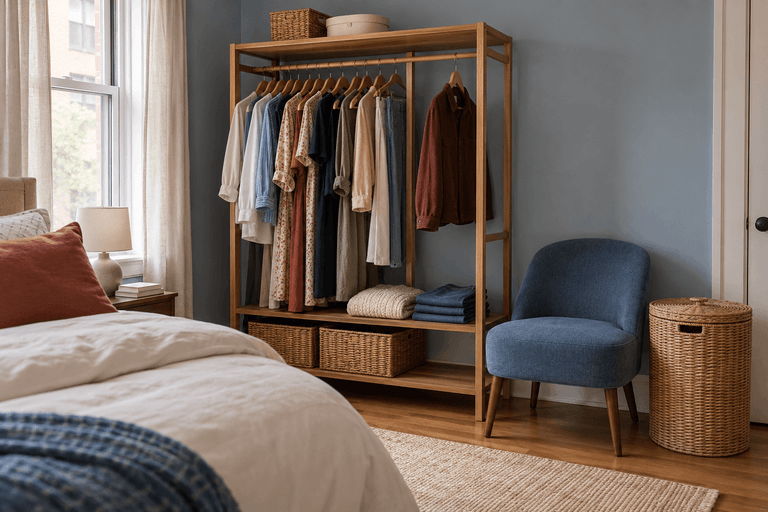
A second hanging rail can use the vertical space beneath a standard rail for shorter garments.
Hanging shelf organizers can move folded clothing into otherwise unused vertical space.
The back of the closet door can hold shoes, scarves, belts and accessories without consuming shelf or floor space.
And under-bed storage can take care of the pieces you need but don’t need to access every morning.
These solutions are particularly useful when the problem isn’t that your wardrobe is excessive, but that the existing storage is poorly configured.
The same principle applies outside the closet. In a small bedroom, vertical storage, under-bed storage and shallow furniture can often add meaningful capacity without taking additional floor space.
If your closet is genuinely too small or needs a bit of configuring, 7 Products That Fixed My Tiny Closet and Doubled My Storage is the more product-focused guide to the specific storage upgrades worth considering.
The important part is to add storage after you’ve established what needs storing and where it should go. Otherwise, it’s very easy to spend money creating more places for the same problem to accumulate.
8. When Keeping Everything Is Actually Fine
Here’s the part most minimalist wardrobe advice leaves out: You may not need to get rid of anything.
If your clothes fit within your available storage, you can find what you need, getting dressed isn’t frustrating, you’re not constantly buying duplicates and your wardrobe isn’t spilling into the rest of the bedroom, then the number of clothes you own isn’t necessarily a problem.
A large wardrobe that functions well is better than a tiny wardrobe that doesn’t.
You don’t need to own 30 pieces because someone on the internet decided that 30 is the correct number. You need enough clothes for your actual life, stored in a way that allows you to use them.
The problem begins when the quantity or arrangement of your wardrobe creates friction: you can’t find things, you forget what you own, getting dressed becomes an excavation, or clothing starts consuming space that the rest of your bedroom needs.
If none of that is happening, leave the wardrobe alone.
Minimalism isn’t the goal. Function is.
A Small Bedroom Wardrobe Reset That Actually Makes Sense
If your closet has reached the point where small adjustments aren’t enough, do a full reset.
But don’t start by buying organizers. Start by finding out what you’re actually dealing with.
Step 1: Empty the wardrobe completely.
This is the only way to see what you actually have.
Step 2: Group everything by category.
Tops together, bottoms together, dresses, jackets, knitwear, formal, occasional. This reveals duplicates and gaps immediately.
Step 3: Identify your high-use clothes.
Which pieces do you reach for repeatedly? Set these aside. They’ll be going in your easy-rection section of the wardrobe.
Step 4: Separate occasional and seasonal clothing.
These go to secondary or deep storage regardless of how much you love them.
Step 5: Apply the wear test to everything that’s left.
Work through the remaining clothes using the questions from earlier in the article. Don’t make decisions based solely on whether you like something. Ask whether you’re actually using it.
Step 6: Repair or alter anything genuinely worth saving.
Set a deadline. If it doesn’t happen within a reasonable period, it won’t happen.
Step 7: Rebuild the closet around your real life.
Put your most-used clothing where it’s easiest to reach.
Step 8: Store low-frequency items elsewhere.
Use under-bed storage, vacuum bags, high shelves, garment bags or another suitable storage area.
Step 9: Measure what’s left.
Only now should you decide whether you need another hanging rail, shelf organizer, drawer unit, under-bed container or another storage solution.
You may discover that you didn’t need much additional storage at all. Or you may discover that your closet genuinely is too small for the wardrobe you want to keep.
Either answer is useful because now you’re solving the actual problem rather than guessing.
A Wardrobe That Works Is More Useful Than a Wardrobe That Impresses
The point of all of this is function, not minimalism. A small bedroom closet that holds the clothes you actually wear, makes them easy to find and easy to see your clothes and access, and doesn’t spill into the rest of the room is a successful closet regardless of how many items it contains.
You don’t have to get rid of the clothes you love. You do have to be honest because liking everything isn’t enough to make everything equally deserving of prime space.
Some clothes are part of your everyday life. Some are occasional. Some are sentimental. Some are things you genuinely want to test before deciding what they mean to you.
Once you stop treating all of those categories as though they need identical storage, a small closet becomes much easier to manage.
Ultimately, you don’t necessarily need fewer clothes. You need a better system for the clothes you actually want to keep.
FAQ
How do I fit too many clothes in a small closet?
Start by separating clothes according to how frequently you use them rather than trying to give everything equal access. Keep everyday pieces in the easiest-to-reach areas and move occasional, seasonal and formal clothing into secondary or under-bed storage. If everything you own is genuinely used and still doesn’t fit, then look for ways to add vertical or hidden storage.
Should I get rid of clothes I love but rarely wear?
Not necessarily. A garment can be worth keeping even if you rarely wear it. First determine whether it needs better access, a repair, relocation to deeper storage or simply a deliberate trial. The more important question is whether the garment deserves its current amount of storage space.
How do I know if I actually have too many clothes?
Look at the function of the wardrobe rather than the number of garments. If you can find what you need, your clothes fit within your available storage and getting dressed isn’t frustrating, the quantity itself may not be the problem. If clothing is consistently spilling into the bedroom or making the wardrobe difficult to use, something needs to change.
Should I buy closet organizers before decluttering?
Usually, no. First determine whether you have a capacity problem, an organization problem or an accessibility problem. Once you know what is actually limiting your closet, you can buy a storage solution designed for that specific problem rather than adding more containers indiscriminately.