Why Your Bedroom Doesn’t Feel Relaxing: 11 Small-Space Mistakes to Fix

Disclosure
This post may contain affiliate links. If you purchase through these links, I may earn a small commission at no extra cost to you. As an Amazon Associate I earn from qualifying purchases.
A bedroom can look perfectly nice and still feel terrible to be in. The bed is made. The surfaces are relatively clear. Nothing is obviously wrong. And yet you walk in and feel restless rather than calm.
There’s a difference between a bedroom that looks relaxing in a photo and one that actually functions as a restful space. The difference is rarely about how much money was spent. It’s about a set of specific design decisions that either support rest or work quietly against it.
In a small bedroom, those decisions matter even more. There’s less room for furniture to spread out, fewer places for visual clutter to disappear and less floor space to absorb a layout mistake.
The good news is that you usually don’t need to redecorate the entire room.
Here are 11 common small-bedroom mistakes that can make a room feel less relaxing than it should, along with practical ways to fix them.
1. Your Bedroom Has Too Much Visual Clutter
Clutter in a bedroom isn’t only piles of clothes or unopened mail or things that haven’t been put away.
A bedroom can be technically tidy and still feel visually busy.

It includes too many decorative objects on a single surface, shelves so full there’s no breathing room between items, furniture crammed together without adequate spacing, exposed storage where the contents are clearly visible, and too many colors or patterns can all contribute to that feeling.
In a small bedroom, more of the room tends to remain within your immediate sightline. That makes visual noise harder to ignore.
What to remove first in a small bedroom
Don’t try to declutter the entire bedroom in one afternoon if that’s going to turn into another overwhelming project.
Start with the surfaces you see most often from the bed.
Clear the nightstand. Remove anything from the dresser that doesn’t need to be there. Look at the wall directly opposite the bed and ask whether every visible object actually needs to remain. Then move to open shelving and other areas that are visible as soon as you enter the room.
A useful rule: every surface in a small bedroom should hold only what is useful or something you genuinely want to see. If it doesn’t do either it probably doesn’t need to occupy valuable visual space in your bedroom.
2. The Lighting Is Too Harsh
A bedroom can have beautiful furniture, bedding and artwork and still feel completely wrong at night if the lighting is harsh.

A single bright ceiling fixture tends to illuminate everything evenly. That’s useful when you’re cleaning, getting dressed or looking for something in a drawer, but it isn’t necessarily the atmosphere you want when you’re trying to wind down.
Cool, bright bulbs can make the effect even stronger.
How to make bedroom lighting feel softer
Instead of relying on one bright source, use several smaller sources at different heights.
A bedside lamp, wall sconce, dresser lamp or small lamp on a shelf can create a softer pool of light than a ceiling fixture illuminating the entire room.
You also don’t need every bulb to be exactly the same.
For evening lighting, warm white bulbs in roughly the 2700K–3000K range are a good starting point. If you prefer slightly brighter or cooler light for reading or getting dressed, keep those task lights separate from the softer ambient lighting.
The important difference is between light you need to perform a task and light you want while you’re winding down.
If your bedroom is too small for another lamp, you don’t necessarily need another piece of furniture. Rechargeable wall lights, hidden LED strips and other cordless lighting can add a softer layer without taking up a nightstand or valuable floor space. A small smart bulb or smart plug can also make an existing lamp easier to control without adding another fixture.
You can check more smart ideas specifically designed around small bedrooms, in our guide to No-Drill Smart Lighting Ideas for Small Bedrooms.
If possible, make the brightest overhead fixture optional rather than your only source of light.
A small bedroom can feel significantly different simply because the lighting has been changed.
3. Your Bed Doesn’t Feel Like a Restful Focal Point
The bed will usually be the visual and functional anchor of a bedroom.
When the bedding is mismatched, the pillows are piled without logic, competing patterns are fighting across the surface, or the bed is pushed into an awkward position the space will feel unsettled.
This isn’t an argument for expensive bedding. It’s an argument for intentional bedding. A simple base layer, a few pillows in a related color family and one textured throw can be enough.
You can also use contrast deliberately. A neutral duvet with blue pillows, a warm-toned throw and natural wood furniture can feel much more considered than using the same color on every surface.
Bed placement matters too. If the bed is blocking a natural walking route, crowding a door or leaving an awkward amount of unused floor space elsewhere in the room, changing the bedding won’t solve the underlying problem.
4. The Color Palette Is Working Against the Mood
Relaxing doesn’t automatically mean beige.
That’s worth making clear because a lot of bedroom advice treats neutral colors as though they’re the only possible route to a calm space.
They’re not.
Muted blues, dusty sage greens, warm terracotta at low saturation, soft lavender, earthy taupes and warm off-whites all create restful environments.
The issue is usually less about whether a color is “calming” and more about how much of it you’re using, how saturated it is and whether the colors relate to one another.
A deep blue-green on the wall behind the bed can create a cozy, intimate feeling. The same color covering every surface in a tiny room may feel overwhelming.
Likewise, lavender doesn’t automatically make a room feel soft and feminine. A muted lavender used with cream, warm wood and restrained patterns can feel elegant. A highly saturated purple combined with several unrelated accent colors can feel chaotic.
Don’t confuse light with relaxing
Light colors can make a small bedroom feel more open because they reflect more light and create less visual weight.
But that doesn’t mean dark colors are forbidden. If you love deep blue, charcoal, forest green or another richer shade, consider using it strategically rather than avoiding it altogether.
Aim for cohesion, not a specific color temperature. Choose a dominant color family, then decide where you want the stronger version of that color and where you want quieter supporting shades.
5. Your Small Bedroom Has Too Many Hard, Cold Surfaces
A bedroom made almost entirely from painted walls, bare flooring, wood, glass and metal can feel visually hard even when it’s beautifully organized. This is where texture matters.
A woven throw on the bed, an upholstered headboard, curtains, a rug underfoot, textured pillow covers, or an upholstered introduces softness without requiring a complete redesign.
You don’t need all of them. In fact, putting soft texture on every surface would create a different problem. The point is to balance the harder surfaces already present in the room.
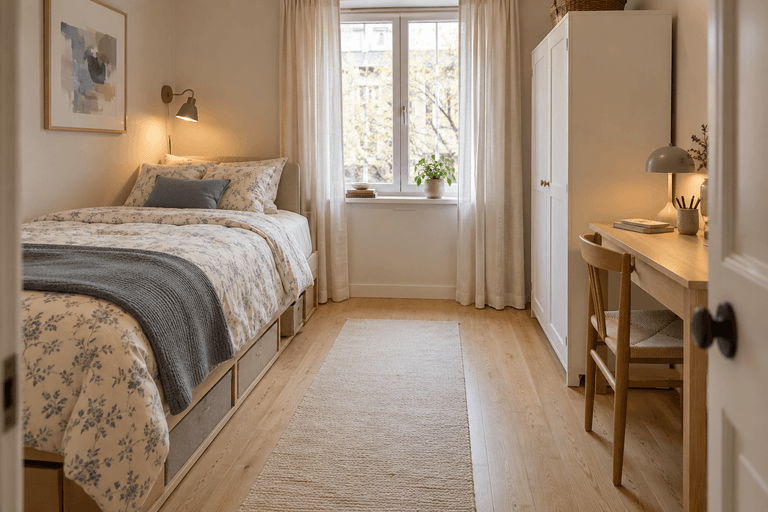
For example, a bedroom with a wooden bed frame, wood nightstand and hard flooring may feel considerably warmer once you introduce a rug, softer bedding and curtains.
It’s contrast that makes the room feel layered.
6. Your Furniture Is Making the Room Hard to Move Through
This is one of the easiest problems to overlook because you eventually get used to navigating around badly placed furniture.

When the path around the bed is too narrow, a nightstand forces you to turn sideways, the wardrobe barely opens or the chair has to be moved every time you reach the closet, the room creates friction every time you use it.
None of these problems seems dramatic on its own. Together, they make the bedroom harder to live in. A bedroom that’s supposed to feel restful shouldn’t require you to constantly negotiate with the furniture.
The small-bedroom circulation test
Walk the path you take every morning: from the door to the bed, from the bed to the wardrobe, from the wardrobe to the door. Pay attention to every point where you have to squeeze past something, turn sideways, take an awkward detour or move furniture out of the way. Those are your problem areas.
Don’t automatically assume you need smaller furniture. Sometimes moving one piece is enough.
In other cases, the problem really is the furniture’s depth. A shallow dresser, floating nightstand or wall-mounted shelf can perform the same function without projecting as far into the room.
As a rough starting point, around 24 inches of clear walking space is useful where the layout allows it, but don’t treat that number as a hard design rule. Door swings, furniture dimensions and the way you actually use the room matter more than hitting an exact measurement.
If the room is particularly narrow, our guide to how to arrange furniture in a small narrow bedroom goes deeper into protecting the central walking path, choosing furniture depth and using vertical space.
7. Your Windows Aren’t Helping the Room Feel Calm
Windows are one of the most powerful tools in a small bedroom.
They bring in light and make the space feel larger than it is. But a window that’s not treated properly can work against the room.
Bare glass can leave a bedroom feeling exposed or unfinished. Heavy curtains can block too much natural light. Curtains mounted too low or too narrowly can also make a small window look even smaller.
A layered approach is often the most flexible.
A sheer or light-filtering layer close to the window can soften daylight while maintaining brightness. A heavier curtain can then provide privacy and darkness when you need it.
You don’t necessarily need both layers in every bedroom. The right combination depends on how much natural light, privacy and darkness you need.
Make a small window look larger
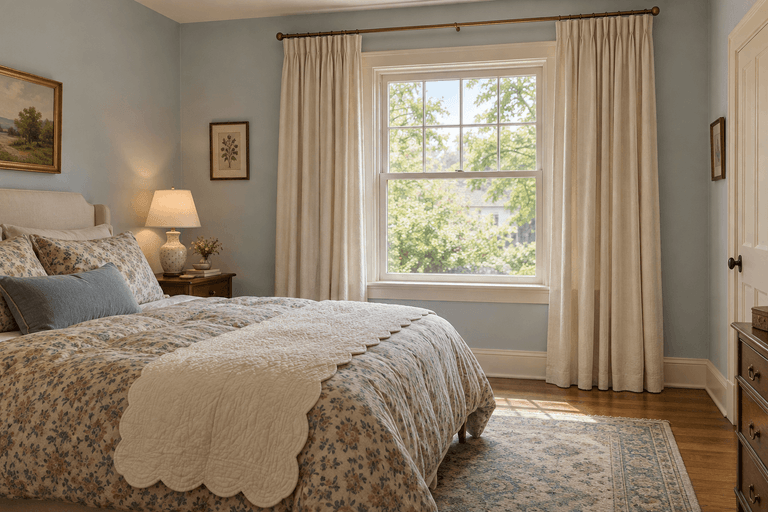
When the layout allows, mount curtains higher than the top of the window and extend the rod beyond the window frame. This allows the curtains to sit outside the glass when they’re open rather than covering part of the window.
The result isn’t just decorative. More of the window remains visible, which can make the room feel brighter and the window appear larger.
If privacy is the main problem, choose the treatment based on what you actually need: filtered daylight, nighttime privacy, blackout capability or some combination of the three. A pretty curtain that doesn’t provide the privacy you need isn’t a successful bedroom solution.
8. Everything Is Fighting for Attention
A room can be technically tidy and still feel exhausting because there is no clear visual hierarchy.
Imagine a bed with a patterned duvet, patterned curtains, a colorful gallery wall, several accent colors, open shelving filled with objects and a statement rug.
None of those things is necessarily bad. The problem is when everything is trying to be the feature.
A well-balanced room usually has a visual hierarchy but that doesn’t mean it can have only one focal point. A bedroom can successfully have two or three areas that attract attention, provided they don’t all compete at the same visual volume.
The bed will often act as the main anchor because of its size and position, while artwork, a window, lighting fixture or reading corner can create secondary points of interest. The eye moves between them rather than getting stuck in visual chaos.
Problems arise when everything is trying to be the star: a patterned bed, dramatic artwork, several competing accent colors, statement lighting and heavily decorated shelves all demanding equal attention. At that point, there’s no hierarchy, just noise.
In a small bedroom, decide which element should dominate, which one or two can support it, and which pieces should stay quiet. You don’t have to remove interesting features. You have to give them different levels of visual weight.
9. Your Storage Is Visible Everywhere
A small bedroom can be tidy and still feel busy when too many belongings remain visible.
Open shelves packed with miscellaneous objects, clothes spilling from an open wardrobe, shoes and bags on the floor, toiletries covering the dresser and random items accumulating on the nightstand all add visual information to the room.
The problem isn’t that your belongings exist. It’s that the eye has to process all of them at once.
Make visible storage look intentional
You don’t have to hide everything behind closed doors. The trick is to control what remains visible.
Use baskets or matching containers to group smaller belongings on open shelving. Keep frequently used items together instead of spreading them across several surfaces. Reserve the most visible areas for things that are attractive enough to function as part of the room’s decor.
For example, a stack of books, a small plant and a decorative object can make an open shelf feel intentional. Twenty unrelated objects usually won’t.
In a small bedroom, grouping is often more effective than simply adding more storage.
Don’t forget the space under the bed
Under-bed storage is particularly useful because it uses space that would otherwise remain empty.
Seasonal clothing, spare bedding, shoes and other things you don’t need every day can move underneath the bed instead of occupying a dresser or wardrobe.

Choose containers that are easy to pull out and keep the contents organized. Otherwise, you’re not really solving the storage problem, you’re simply moving the clutter somewhere less convenient.
Vertical storage can also help. Wall-mounted shelves, hooks, over-the-door organizers and the space above a wardrobe can all add capacity without taking additional floor space. Keep everyday belongings from spreading across every visible surface.
10. You’re Trying to Make the Room Cozy by Adding More Stuff
This is where “cozy bedroom” advice can go badly wrong.
There is a particular kind of bedroom that photographs beautifully: layers of pillows, several throws, candles, plants, baskets, framed prints, decorative books, flowers and small objects covering every available surface.
It can look wonderful.
But copying the entire formula in a small bedroom can have the opposite effect. The room becomes crowded rather than cozy.
Cozy doesn’t mean crowded
Coziness in a small space comes from a combination of texture, lighting, softness, visual comfort and warmth. It doesn’t require a high number of objects.
One well-chosen throw on a well-made bed can feel cozy. A rug can warm up a hard floor, curtains can soften a window. Lighting can change the atmosphere after dark.
The edit is what creates the cozy feeling in a small bedroom. What stays on the nightstand, what stays on the shelves, what stays on the bed.
Every item that gets removed creates more space for the items that remain to be noticed and to do their visual work.
In a large bedroom, abundance can feel generous. In a small bedroom, abundance almost always feels like too much.
11. The Room Doesn’t Have a Clear Wind-Down Feeling
A bedroom can be beautifully decorated and still feel like a place where tasks are waiting.

Work materials on the desk, laundry pile on the chair, a phone charging on the nightstand with notifications visible, exercise equipment folded against the wall.
None of these are overwhelming individually. But when the bedroom becomes a combination of sleeping space, office, dressing room, storage room and laundry area, it can become difficult for the room to feel like a place to stop.
For small bedrooms where multiple functions are often unavoidable, the solution isn’t necessarily to remove every non-bedroom activity.
It’s to create a clear transition between daytime functions and nighttime use.
Give work a place to disappear
The bedroom is supposed to signal wind-down. But signals require consistency. If the last things you see before sleep are visual reminders of what you haven’t done yet, the room is working against you regardless of how soft the lighting is.
If you work or study in your bedroom, establish a simple end-of-day reset.
Put the laptop away. Clear paperwork from the desk. Return cosmetics and accessories to their storage. Put clothes into the hamper rather than leaving them on the chair. Turn off task lighting.
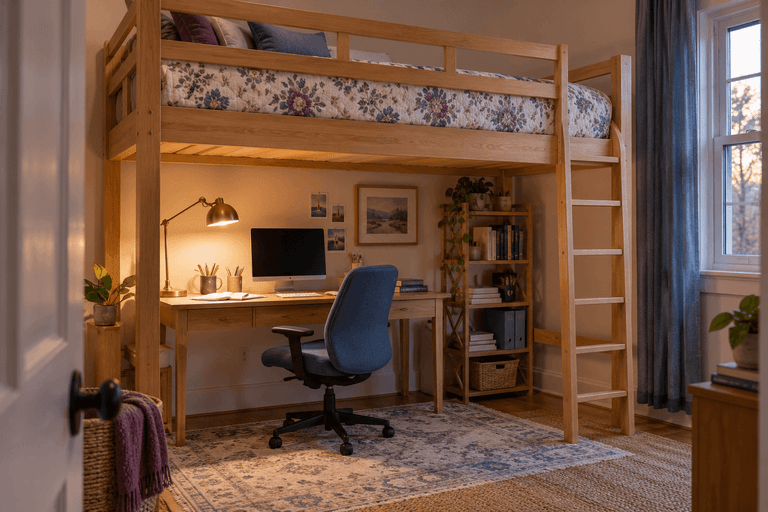
If you have a compact workspace that doubles as another bedroom function, make it easy to close down. A desk with drawers, a folding desk or a setup where equipment can be moved into a cabinet makes this considerably easier.
The bedroom doesn’t have to be completely free of work-related items. They simply shouldn’t remain visually active when you’re trying to rest.
Small Details That Can Also Affect How Relaxing a Bedroom Feels
Not every improvement needs to involve furniture or decoration. The sensory experience of the room matters too.
Sound
A bedroom next to a busy road, television or noisy living area may never feel completely peaceful simply because the room looks beautiful.
If noise is an issue, consider practical changes such as heavier curtains, a rug, upholstered furniture or a white-noise machine. Soft furnishings won’t eliminate external noise, but they can reduce the amount of hard, echoing surfaces in the room.
Scent
A pleasant, subtle scent can contribute to the atmosphere of a bedroom, but don’t treat candles or diffusers as mandatory bedroom accessories.
If you like them, use them. If you don’t, leave them out.
A bedroom doesn’t become relaxing because it smells like a particular fragrance.
Temperature and bedding
Your bedding should suit the temperature of the room and your own comfort. A beautiful layered bed is useless if you’re too hot under it or uncomfortable because the fabric doesn’t suit you.
Comfort should come before styling. That principle applies to the entire room.
How to Make a Small Bedroom Feel More Relaxing Without Redecorating Everything
If your bedroom needs a reset, don’t start by buying new furniture. Work through the room in this order.
Step 1: Remove the most visible surfaces
Start with the nightstand, dresser and whatever you can see most clearly from the bed. Remove things that don’t need to be there.
Don’t worry about creating perfect storage yet. The first goal is simply to reduce what you’re looking at.
Step 2: Fix the lighting
Swap overly cool evening bulbs with warmer ones where appropriate. Then add a secondary light source if the bedroom currently relies entirely on the ceiling fixture.
You don’t need three lamps immediately. Even one bedside lamp can give you an alternative to turning on the main light.
Step 3: Clear the bed and simplify the bedding
Remove unnecessary decorative pillows. Straighten the bedding. Check whether the colors and patterns actually work together.
If the bed feels visually chaotic, simplify before buying anything.
Step 4: Improve the walking path.
Move any furniture that narrows the circulation path to less than 24 inches. If a nightstand is too large, replace it with a wall-mounted shelf or a smaller piece.
Step 5: Edit the color palette
You don’t need to repaint the entire room. Instead, look at the colors that are already there.
Is there one color that appears repeatedly and helps connect the room? Are there one or two colors that feel completely unrelated? Could you remove an unwanted color through bedding, accessories or storage rather than replacing the furniture itself?
A cohesive palette usually matters more than whether the room is neutral, colorful, dark or light.
Step 6: Add softness where the room needs it
Look around and identify the hardest surfaces.
Bare floor? Add a rug. Plain window? Consider curtains. Hard wooden chair? Add an upholstered cushion or replace it if necessary. Flat bedding? Introduce one or two different textures.
You don’t need to soften everything. You just need enough contrast.
Step 7: Create a nighttime reset
Hide the things that make the room feel like a workspace, dressing area or a storage room. Closed hamper, covered storage, work materials out of sight.
The room doesn’t need a complete transformation every night. It just needs to stop looking like tomorrow’s responsibilities are already waiting for you.
A Relaxing Bedroom Doesn’t Have to Look Like Pinterest
The most relaxing bedroom isn’t necessarily the one with the most carefully styled shelves, the most expensive bedding or the greatest number of decorative layers.
And it doesn’t have to look minimalist either. A colorful bedroom can feel calm. A dark bedroom can feel cozy. A feminine bedroom can feel sophisticated without being covered in pink.
A small bedroom can have several decorative focal points without becoming visually chaotic.
The difference is whether the individual decisions work together.
You need somewhere comfortable to sleep. Lighting that works for the time of day. Furniture that allows you to move through the room without constantly navigating around it. Enough softness and texture to balance harder surfaces. Storage that keeps everyday belongings under control. And a visual environment that doesn’t make every object compete for attention.
In a small bedroom, those choices matter more because there is less room to absorb mistakes.
But that’s also why small changes can have a surprisingly large effect.
You may not need a new bed. You may not need to repaint the walls. You may not need a completely different aesthetic.
You may simply need to remove what is unnecessary, move what is in the wrong place and make the things that remain earn their place
Start with what is making the room feel wrong. Then fix that before buying anything else. That is usually a better place to begin than trying to make a small bedroom look more relaxing by adding another layer of decor.