
Window AC Blowing Directly Onto Your Bed? How to Redirect the Air

Disclosure
This post may contain affiliate links. If you purchase through these links, I may earn a small commission at no extra cost to you. As an Amazon Associate I earn from qualifying purchases.
A window air conditioner can cool a small bedroom while making one particular spot uncomfortable: your pillow.
Turning the temperature up may leave the rest of the room too warm. Moving the bed may block the closet. And placing something in front of the AC can interfere with its airflow.
If your window AC is blowing directly onto your bed, start with its built-in airflow controls. Then check whether a small change to your sleeping position or bed placement helps. Consider an add-on deflector only after confirming that it suits the unit and can redirect air without obstructing it.
The goal is to cool the room while keeping the strongest air stream away from where you sleep.
Is The Air Hitting You, Or Is The Whole Room Too Cold?
Before rearranging furniture, check where the discomfort occurs.
With the AC running normally, compare how it feels beside the bed, at your usual pillow position and elsewhere in the room.
You may notice one of three patterns:
- The room feels comfortable, but your face or shoulders are in a strong cold stream. Start by changing airflow direction.
- The whole bedroom feels too cold. Review the temperature setting and operating mode first.
- The bed feels cold while another part of the room stays warm. Check airflow direction and obstructions before assuming a higher temperature setting will solve everything.
These problems can overlap. Changing one setting at a time makes it easier to tell what helped.
Also check when the problem happens. A continuous draft is different from a burst of air each time cooling resumes. Note the mode and fan setting so you can reproduce the conditions when testing an adjustment.
Start With The AC’s Built-In Airflow Controls
Find your model number and look up the owner’s manual before moving parts.
The small slats at the air outlet are called louvers. Depending on the model, they may direct air upward and downward, side to side, or both. Some units also have a powered swing function.
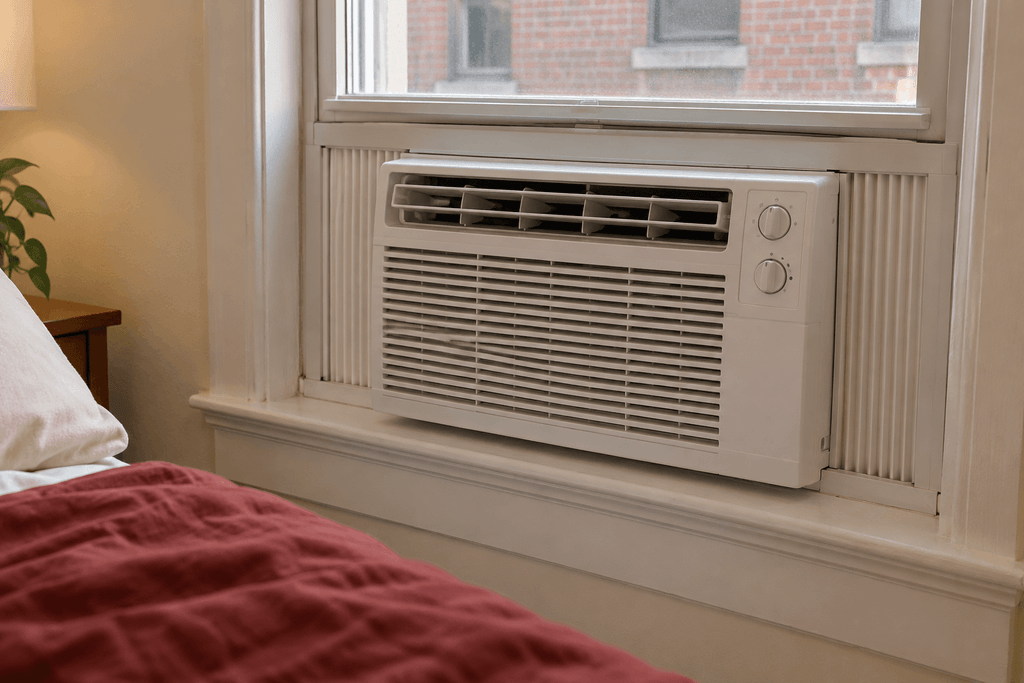
GE’s explanation of adjustable louvers shows how these arrangements differ. LG likewise advises checking the manual because directional controls vary by model.
Aim Away From Pillow Height
Where the controls allow it, try directing the outlet air toward an open part of the room rather than straight across the pillow.
For some arrangements, a more upward direction may help. For others, a sideways adjustment is what moves the strongest stream away from the bed.
Make a modest adjustment, then return to your normal sleeping position to assess it. Standing beside the AC tells you little about how the air feels where your head rests.
Don’t force fixed slats or manually push a motorized flap unless the instructions permit it.
Check Whether Swing Helps Or Makes The Draft Return
A moving outlet may spread airflow across more of the room, but it can also send a repeated cold stream over the bed.
If your model allows a fixed direction, compare that with swing mode. Keep the setting that improves comfort while still distributing air through the bedroom.
Identify The Correct Control
A fresh-air or ventilation lever is not the same as an airflow-direction control.
On applicable Frigidaire models, the fresh-air control changes ventilation through the unit; it does not aim the cooled air away from your pillow. Use your model’s instructions to distinguish these functions.
Adjust Temperature And Fan Settings Separately
If the room is too cold overall, raise the temperature setting and reassess.
If the temperature feels right but the air stream is too forceful, try a lower available fan speed, following the manual. Check whether the room remains comfortable farther from the unit.
Don’t assume that every setting labeled “Sleep,” “Eco” or “Auto” changes airflow in the same way.
For example, Frigidaire describes a Sleep mode that gradually raises the selected temperature. That can address overnight temperature preferences, but it does not physically redirect the outlet.
Use temperature settings to address excessive cooling and directional settings to address where the air goes. You may need both, but they serve different purposes.
Check Whether A Small Bed Adjustment Is Enough
You don’t have to begin by moving the bed to another wall.
First, consider whether the strongest stream crosses only one part of the mattress. A small sideways shift might move the pillow out of that stream without changing the whole layout.

Test the idea before committing. Check the position of the bed frame, then account for bedding and the space needed to get in and out.
Any adjustment should preserve:
- The bedroom door’s movement.
- Access to the closet and drawers.
- A usable route around the bed.
- Access to the window and AC controls.
- The clearances required by the AC manufacturer.
A shift that improves the draft but prevents you from reaching your clothes is not a good everyday solution.
When The AC Is Beside The Head Of The Bed
Start with the outlet direction and whether the bed can move sideways.
If two people share the bed, check both pillow positions. Redirecting the stream from one person onto the other only relocates the problem.
When The AC Faces The Foot Of The Bed
Check whether the louvers can direct air upward or toward a clear side of the room.
There may be no need to rotate the bed if a built-in adjustment keeps the air from traveling along the mattress toward your upper body.
Could You Sleep At The Other End?
For an occasional night, reversing your sleeping position may help you assess whether pillow location is the main issue.
It is only a practical ongoing option if the bed and surrounding space support it. Consider pillows falling off, nearby furniture, reading-light access and anyone else sharing the bed.
Don’t build an elaborate workaround around an arrangement that makes sleeping or getting up awkward.
When A Window AC Deflector Is Worth Considering
A deflector changes the direction of air leaving the outlet. It may be worth investigating when the built-in louvers cannot aim far enough away from the bed.
Add-on deflectors are a possible option where louvers are fixed or unsuitable for the desired direction. That is not confirmation that every accessory fits every unit.
Before buying a window AC air deflector, check:
- Unit type: Is it intended for a window air conditioner rather than a wall-mounted mini-split?
- Outlet position: Does its shape match where your unit releases air?
- Mounting: Can it attach securely using an appropriate method?
- Clearance: Will it leave the intake, controls, filter access and other required openings unobstructed?
- Direction: Can it send air toward usable room space rather than into a curtain, headboard or nearby wall?
- Compatibility: Do the AC manufacturer’s instructions permit the arrangement?
“Universal” in a listing is not enough evidence of compatibility.
A suitable deflector should redirect the outlet stream without turning the front of the AC into an enclosed pocket. If the fit is uncertain, ask the AC manufacturer before purchasing or attaching it.
Don’t drill into the housing or attach an accessory to moving louvers.
Keep Curtains, Bedding And Furniture Away From The Unit
A small bedroom can place several obstructions close to a window AC: a tall headboard, curtain panels, pillows, a nightstand or an overflowing laundry basket.
Check the unit from the front and sides. Follow the clearances in its manual rather than assuming that a visible outlet means the installation is unobstructed.
GE’s poor-airflow guidance specifically identifies furniture, drapes and plants as potential grille obstructions.

Pay particular attention to curtains when they are closed. Fabric that sits harmlessly beside the window during the day may fall across the unit at night.
Likewise, oversized bedding should stay clear when someone is actually in bed not just when the room has been neatly arranged.
Don’t Use A Screen Or Headboard As A Makeshift Air Barrier
Placing a folding screen, cushion or board directly in front of the AC may stop air reaching you, but it can also obstruct the unit.
A tall piece of furniture is not a substitute for a compatible airflow accessory.
If curtains or furniture are causing the conflict, change their position rather than adding another barrier.
What If The Bed Cannot Move?
In a small room, the bed may already occupy the only position that leaves the door and clothing storage usable.
Work through the remaining options in this order:
- Confirm which directional adjustments your model provides.
- Test a different outlet direction from your pillow position.
- Review temperature and available fan settings separately.
- Remove nearby airflow obstructions.
- Investigate a compatible deflector if built-in adjustment is insufficient.
If none produces a satisfactory result, contact the manufacturer or, for a landlord-provided unit, the property manager. Explain the constraint clearly: the room temperature is acceptable, but the outlet stream reaches the only workable sleeping position.
That is more useful than simply reporting that the AC is “too cold.”
Some units offer limited directional control. If replacement eventually becomes necessary, check the adjustment range before buying not just cooling capacity, price and noise claims.
Test The Change Before Leaving It Overnight
Test any new arrangement while you are awake and able to observe it.
Return to the sleeping position that caused the problem. Then check another part of the room.
Look for both outcomes:
- Has the direct stream at the pillow become more comfortable?
- Is the rest of the bedroom still cooling satisfactorily?
For an accessory, also check its stability and whether it interferes with controls, filter removal or normal operation. Stop using it if it shifts, causes interference or produces a new problem.
If the AC develops ice, indoor leaking, an error message or unusual noise, return to the manufacturer’s troubleshooting guidance. Those symptoms need attention beyond rearranging the bed.
The best fix for a window AC blowing on your bed is the smallest effective change that preserves the unit’s airflow and the bedroom’s everyday use. Start with the controls already provided, test from where you actually sleep, and buy an accessory only when its fit and purpose are clear.