
Why Your Bedroom Curtains Are Making the Room Look Smaller

Disclosure
This post may contain affiliate links. If you purchase through these links, I may earn a small commission at no extra cost to you. As an Amazon Associate I earn from qualifying purchases.
Curtains can make a small bedroom feel softer and more finished. But if the open panels cover much of the glass, the hems gather around furniture or the fabric forms a bulky pile beside the window, the room can feel more crowded.
Curtains that make a room look smaller are often a proportion or placement problem not simply the wrong color.
You do not need to give up blackout coverage, patterned fabric or a style you enjoy. The aim is to make the window treatment work with the room.
1. The Rod Emphasizes the Window’s Small Size
A rod sitting close to the top of a small window can emphasize the window’s outline rather than the height of the wall. With short panels beneath it, the treatment may look like a small rectangle floating on a much larger surface.
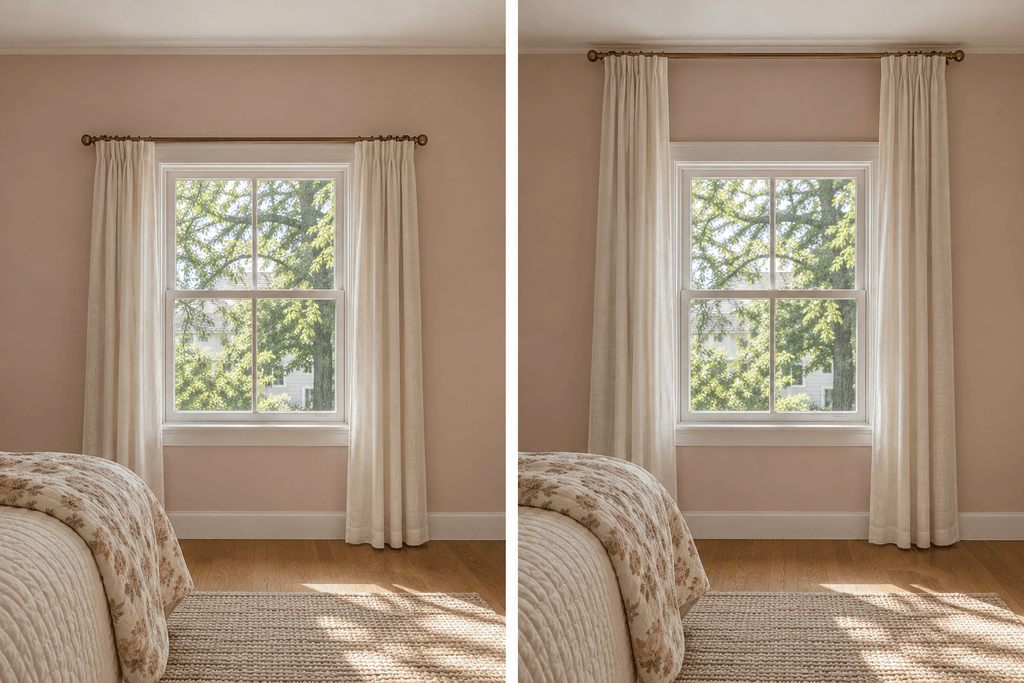
If there is usable wall space above the frame, raising the rod can create a longer vertical line. This is a styling option, not a rule that every bedroom needs ceiling-height curtains.
Before changing the position, check:
- Whether the wall can support the required mounting hardware.
- Whether molding, a sloping ceiling or another obstruction limits placement.
- Whether the panels will reach the intended endpoint from the new height.
- Whether you can operate the curtains comfortably.
Choose rod height and curtain length together. Raising a rod while keeping panels that are already barely long enough can leave an awkward gap beneath them.
There is no single correct distance from the ceiling. A higher position may suit one wall; a position closer to the frame may suit a window beneath deep molding or a room where shorter curtains are the practical choice.
2. The Open Curtains Still Cover Too Much Glass
Pull your curtains fully open and look at the window.
If a large part of the glass remains behind the gathered fabric, the rod may not give the panels enough space to move aside. This matters especially when the window supplies most of the bedroom’s daylight.
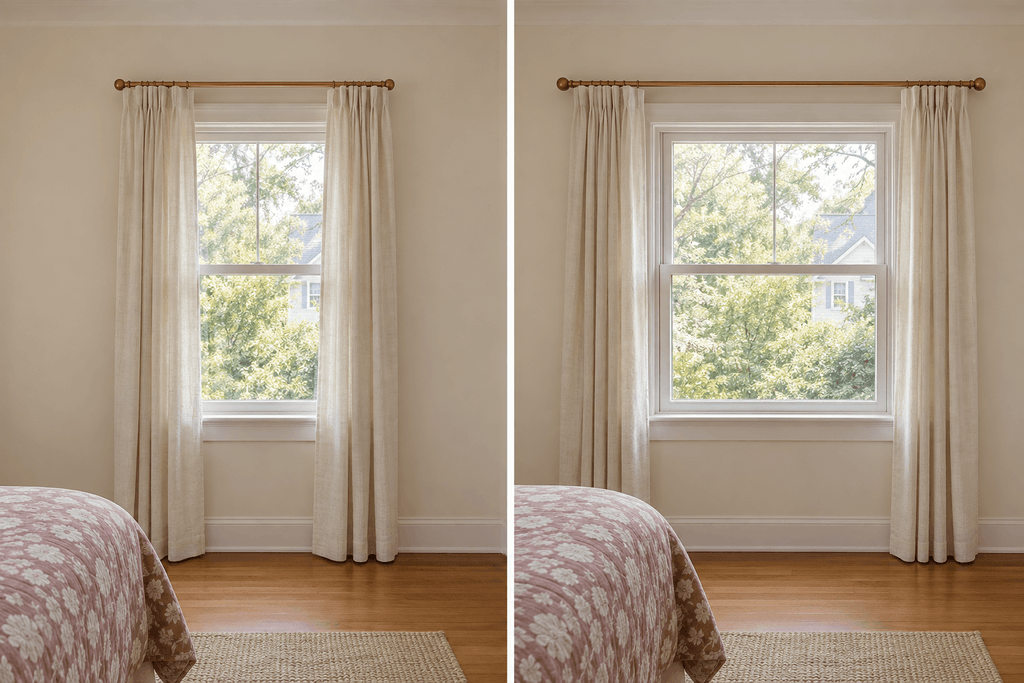
Separate Rod Width From Panel Width
These measurements do different jobs:
- Usable rod or track width: The span available for the curtains to travel across.
- Panel width: The fabric available to cover that span when closed.
- Space for the gathered fabric: The room the open panels occupy beside or partly over the window.
Adding wider panels does not fix a rod that is too short. It can increase the amount of fabric covering the glass when the curtains are open.
IKEA’s window-measuring guide uses at least six inches of extension on each side as a starting point. Your actual requirement depends on the fabric, heading style, window and available wall space. See its curtain measurement guide.
For example, a 36-inch window with eight inches of extension on each side needs a 52-inch usable span:
36 + 8 + 8 = 52 inches.
That calculation establishes the proposed rod span. It does not prove that every curtain will gather into those eight-inch spaces. Thick lined panels may need more room than a lighter fabric.
Check Curtain Fullness Before Buying Panels
Curtain fullness describes how much fabric covers the usable rod or track span. Too little fabric can look stretched flat when closed; extra fabric creates folds but also needs more room when gathered open.
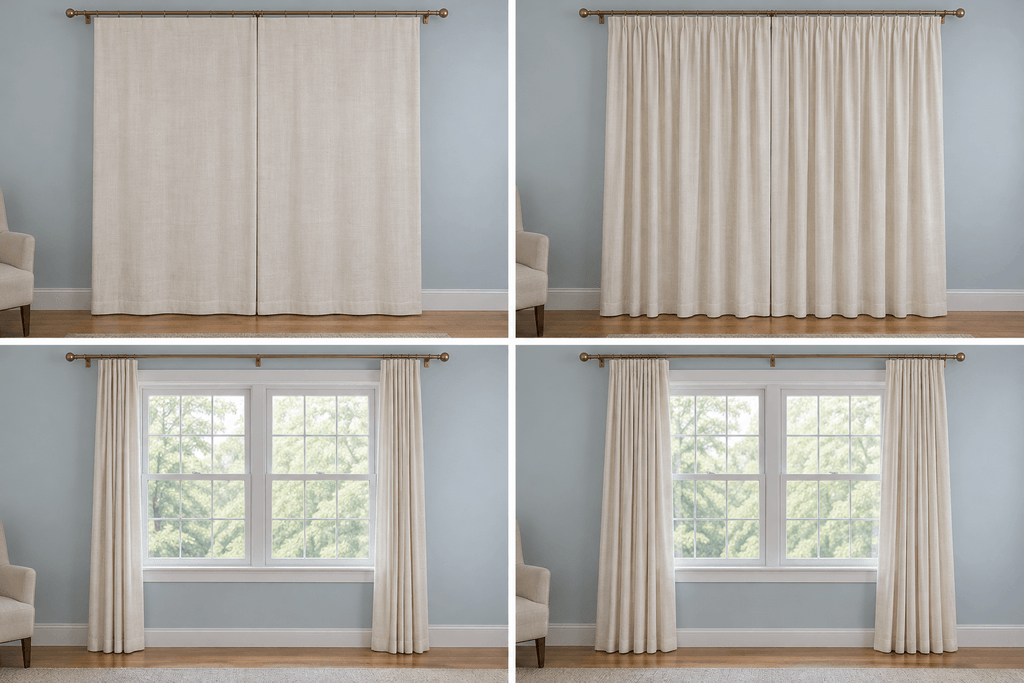
For example, two flat panels measuring 52 inches wide each provide 104 inches of fabric. Across a 52-inch usable rod span, that gives 2× fullness: 104 ÷ 52 = 2.
This is a calculation example, not a universal buying rule. Follow the curtain manufacturer’s recommended fullness for the heading style. For ready-pleated curtains, check the stated finished coverage rather than applying the same calculation to the fabric width. Also check whether the listing gives dimensions for one panel or the pair.
Check both positions: Enough coverage and folds when closed, and manageable gathered fabric when open. Buying wider panels alone will not solve curtains that already cover too much glass.
When the Window Is Close to a Corner
Do not force equal extensions if the wall cannot accommodate them.
Use the available space, then assess whether one panel drawing toward the more open side, a less bulky fabric or a fitted shade would work better. An asymmetric arrangement can be practical, but it still needs enough coverage when closed.
Expose as much useful glass as the room allows without creating a new obstruction.
3. The Curtain Length Looks Accidental or Gets in the Way
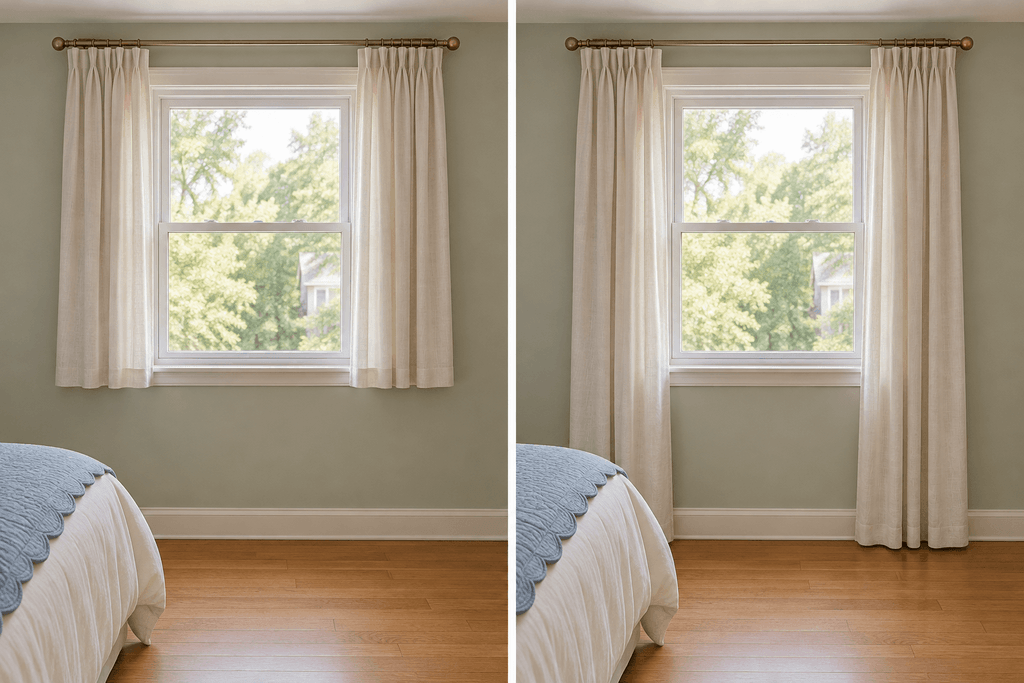
Floor-length curtains can create a continuous line down the wall. That does not make sill-length curtains a mistake.
Shorter curtains or a fitted shade may be better when a desk sits beneath the window, furniture traps the fabric or a heater requires clearance. Follow the heater’s instructions rather than draping fabric around it for appearance.
The problem is an endpoint that does not relate clearly to the floor, sill or furniture and a length that makes daily use awkward.
Measure From the Actual Hanging Point
Do not choose panel length from the rod’s height alone. Rings, clips, hooks, rod pockets and grommets affect where the fabric begins and ends.
Measure according to the heading system you will use, and check the product’s measuring instructions.
For a simplified example, if the panel’s length-measurement starting point is 90 inches above the floor, a 96-inch panel leaves six inches of extra length. It will need hemming, a different mounting position or deliberate pooling. It will not produce a slight break automatically.
An 84-inch panel measured from that same point ends six inches above the floor.
For a small bedroom used every day, a hem just clear of the floor is often convenient: it avoids dragging during cleaning and keeps fabric out of a narrow walkway. Pooling can suit a relaxed style, but consider pets, dust and nearby storage drawers before choosing it.
Check the floor at both ends of the window. An uneven floor can make equal-length panels sit differently. If the care instructions permit washing before hemming, account for any expected shrinkage.
4. The Fabric Takes Up Too Much Space When Open
Blackout curtains are not a small-bedroom decorating failure. They may be exactly what you need for morning light, streetlights or daytime sleep.
The useful question is how the curtains behave when open, not whether light passes through them when closed.
Bulky panels can be troublesome when they:
- Gather into a tight corner beside the window.
- Cover the glass even after being opened.
- Press against a nightstand or headboard.
- Become difficult to move behind furniture.
Before replacing them with sheers, try improving the space available for the gathered panels. If that is impossible, consider a less bulky curtain construction or a fitted blackout shade with decorative curtains.
Sheers can soften daylight, but do not assume they provide privacy at night. Check visibility from outside with the bedroom lights on.
Keep the function you need. Change the bulk or placement that is causing trouble.
5. The Curtain Pattern Competes With Every Other Pattern
Dark curtains can frame a window beautifully. Florals can work in a small bedroom. Neither automatically makes a room look smaller.
The treatment is more likely to feel busy when its pattern competes with patterned bedding, a detailed rug and a crowded wall nearby.
If you want the window area to blend into the room, choose curtains close in tone to the walls. If you want it to be a focal point, use contrast deliberately and simplify something around it.
For example:
- With a floral coverlet, try solid curtains that repeat one color from the bedding.
- With plain bedding, patterned curtains can supply the main decorative detail.
- With deep blue walls, related blue curtains can create continuity; ivory curtains can create a brighter contrast.
Neither approach requires everything to be beige or matching.
Before buying, view a fabric sample beside the wall in daylight and under your evening lighting. The same cream can look warm beside one paint color and gray beside another.
6. The Layers Have No Clear Job or Cannot Move Freely
A blind, sheer and blackout curtain can be a useful combination. The number of layers alone does not tell you whether the treatment is excessive.
Ask what each layer does.
A shade may control privacy, a sheer may soften daylight and an outer curtain may block light at night. If each is useful and operates freely, you do not need to remove one simply because the room is small.
Trouble starts when the hardware projects into the room, the fabric tangles or furniture prevents a layer from opening.
Test the treatment through an ordinary day:
- Open the curtains fully.
- Adjust the privacy layer.
- Operate the window.
- Close the treatment for the night.
Can you do those things without moving the nightstand, reaching awkwardly behind the headboard or trapping fabric in a drawer?
If the bed occupies the window wall, consider the curtain arrangement alongside the furniture placement. Our guide to where to put a bed in a small rectangular bedroom explores that layout decision.
If You Rent, Choose the Mounting Method Before the Look
A high, wide rod is only useful if you can install it appropriately. Start with your lease, existing fittings and the exact hardware instructions.
Existing brackets: You may be able to improve the treatment by changing panel length, heading style or the amount of fabric without making new holes. Check the existing hardware’s capacity and condition.
A tension rod inside the recess: This can suit a lightweight treatment where the recess and product specifications allow it. It generally keeps the mounting position within the opening, so it will not create the same framing as a rod extending across the wall.
Purpose-made adhesive curtain holders: Check the approved surfaces, rod dimensions, load rating, installation position and removal instructions for the exact product. Do not add individual hook ratings together and assume they establish a safe curtain-system capacity.
For example, Command’s curtain-hook instructions exclude textured walls and say not to hang the hooks over beds. They also specify preparation and waiting times. Those limits matter in a bedroom where the bed sits under the window.
Other mounting systems: A clamp-on or freestanding system may suit a particular frame or room, but verify its compatibility and the space it occupies. “No drill” does not mean suitable for every rental or window.
If the desired curtain arrangement cannot be mounted appropriately, choose a simpler treatment that fits the available conditions.
Check These Five Things Before Buying New Curtains
Start with the smallest change that addresses the actual problem:
- Daylight: How much glass remains covered when the curtains are fully open?
- Length: Does the hem look intentional and stay clear of furniture, required heater clearances and walking routes?
- Closed coverage: Do the panels provide the privacy and light control you need?
- Operation: Can you open the curtains, use the window and reach nearby storage easily?
- Mounting: Is the hardware appropriate for the surface, curtain system and installation position?
Take a photo with the curtains open and another with them closed. The problem may be obvious in one position and absent in the other.
If the glass is already mostly exposed and the treatment works comfortably, replacing the curtains may do little for the room. Check the furniture and circulation instead; our guide to small bedroom layout mistakes is the next place to look.
The best curtains for a small bedroom support the way you use it: daylight when you want it, privacy when you need it and fabric that does not fight the furniture.