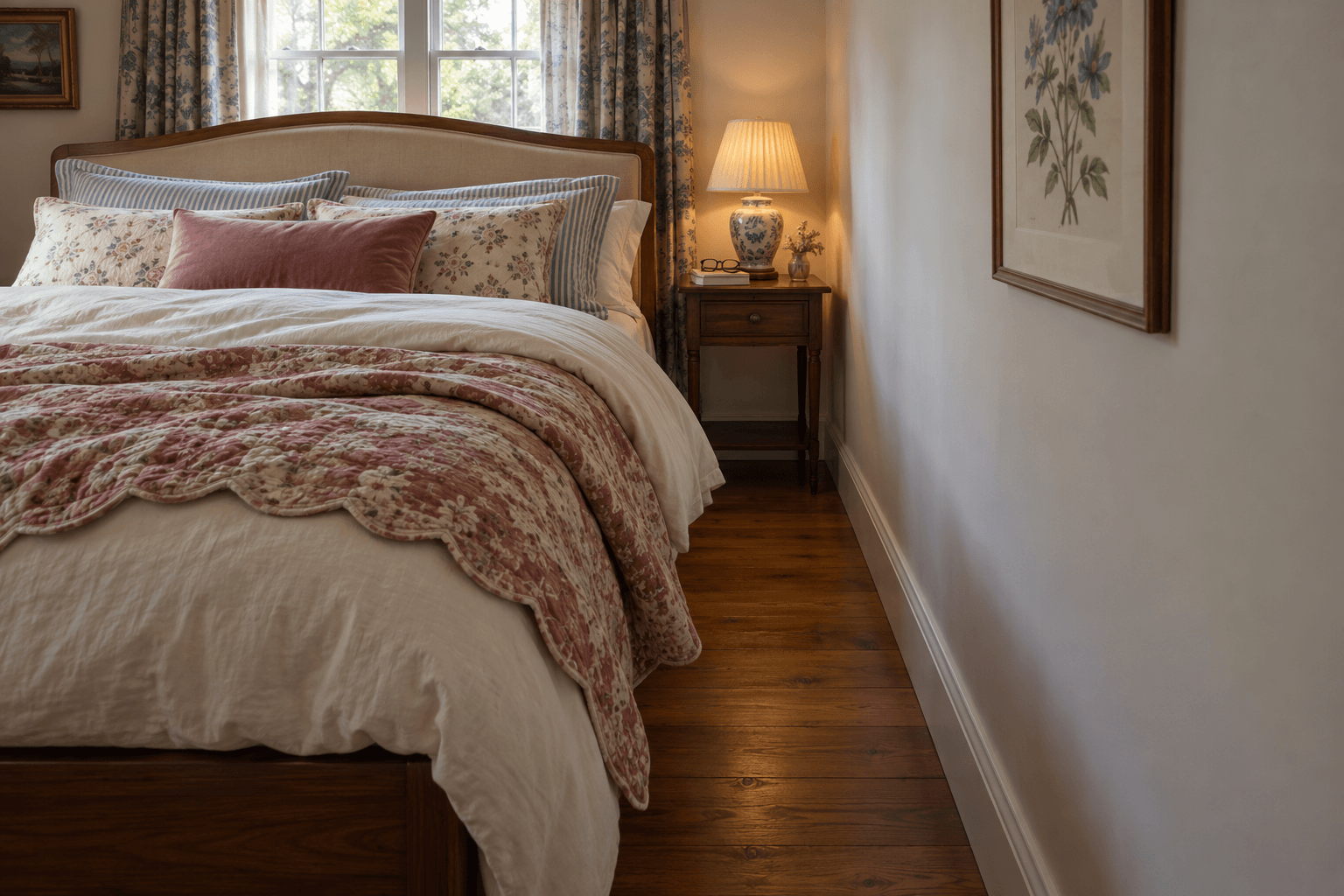
What To Do With The Narrow Space Beside Your Bed
Disclosure
This post may contain affiliate links. If you purchase through these links, I may earn a small commission at no extra cost to you. As an Amazon Associate I earn from qualifying purchases.
A bed can fit comfortably enough for sleeping and still leave an awkward strip of floor beside it. Add a bare wall, and that strip starts to look like a space you should do something with.
But what belongs there depends on what is missing. You might need somewhere to put your glasses, a way to make the wall feel finished, or extra storage. Those are different problems, and a narrow bookcase will not solve all of them.
The best use of the narrow space beside your bed is the one that preserves the access you need while solving a specific problem. Sometimes that means adding a small surface. Sometimes it means decorating the wall and leaving the floor alone.
This guide is about the space along the side of the bed, rather than a gap behind the headboard where pillows fall.
First, Decide Whether The Gap Is Already Doing A Job
Before calling it wasted space, notice how you use it over a normal day.
Do you walk through it to get into bed? Stand there to change the sheets? Reach the window, pull out under-bed storage, or get to a closet?
If so, the gap is already useful. Putting furniture there trades some of that access for another function.
The answer can also differ along the same side of the bed. A compact table near the headboard might leave the rest of the route open. A bookcase running alongside the mattress could affect almost every step.
Check the whole route, not just the corner where a new piece would sit. A generous gap near the foot of the bed does not cancel out a pinch point beside your pillow.
If the entire room is difficult to move through, start with the wider layout. Our guide to arranging furniture in a small narrow bedroom looks at that room-wide problem.
Measure What Would Be Left After Adding Furniture
Measure from the outermost part of the bed frame, not just the mattress. A projecting rail, upholstered side or corner post can reduce the usable gap.
Then check the narrowest point between the bed and the wall or existing furniture. Include baseboards when judging how far a piece will actually sit from the wall.
For furniture placed against the side wall, the basic calculation is:
Existing gap − furniture projection = remaining space beside the bed.
For example, imagine a 26-inch gap and a bookcase that projects 10 inches from the wall once installed. That leaves 16 inches at that point, before allowing for bedding that hangs into the space. These are illustrative measurements, not a recommended clearance.
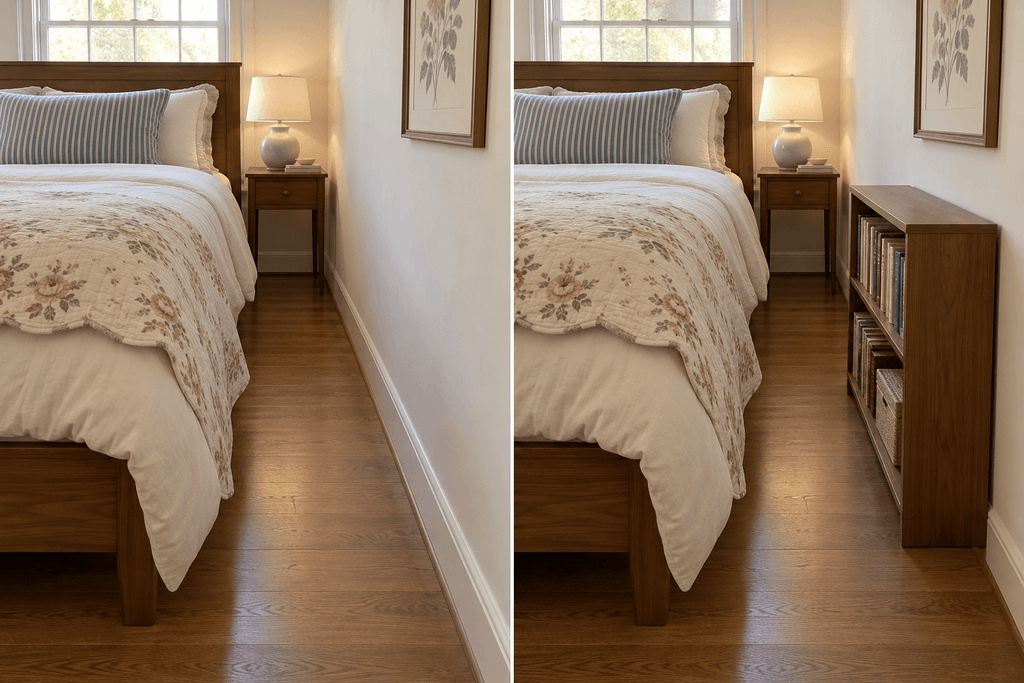
The furniture may fit. Whether you can comfortably use the remaining space is a separate question.
Also check what happens when something opens. A cabinet door, drawer or pull-out basket needs room beyond the closed footprint. Under-bed drawers need space to extend, plus somewhere for you to stand or crouch.
There is no single measurement here that guarantees a comfortable layout for every person. Mobility aids, balance, how you get out of bed and whether two people use the room all change what is workable.
If It Is Your Walkway, Keep The Floor Clear
When the strip is your regular way into bed, an empty floor is often the most useful arrangement.
A plant stand, basket or decorative stool can look harmless in a photograph but become something you step around every morning. A floor lamp also needs its base and cord accommodated, not just its slender pole.
Try the ordinary tasks before deciding the route has space to spare:
- Get in and out of bed on that side.
- Pull the bedding straight and reach the corners.
- Open nearby storage fully.
- Reach the window covering.
- Clean along the bed frame.
For two sleepers, consider both people’s routines. A layout that works for the person nearest the door may leave the other person climbing across the mattress.
Do not fill a usable walkway simply because the wall above it looks unfinished. You can address that wall separately.
If The Wall Looks Bare, Treat The Wall Separately
An empty wall beside a bed does not automatically need furniture beneath it.
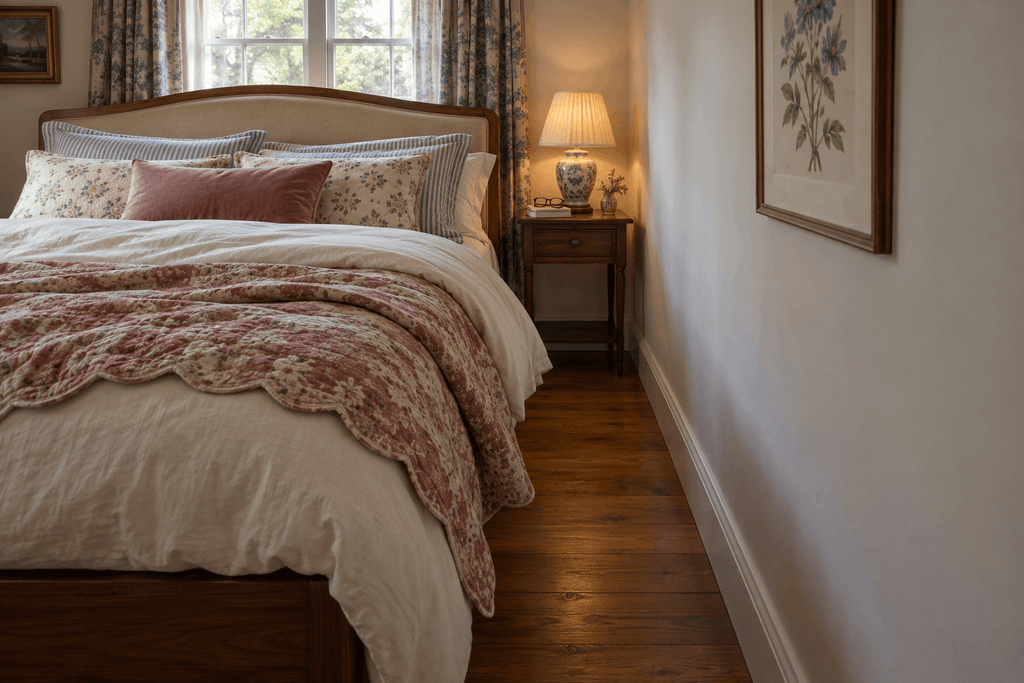
One appropriately scaled piece of art, a restrained arrangement of lightweight pictures, or a permitted paint treatment can give the wall a purpose while preserving the floor space.

Choose the position from the room’s actual sightlines. Look from the doorway and from the bed before making holes. A grouping that looks centered on an empty wall may feel misplaced once the headboard, pillows and curtains are part of the view.
For a rental, check what your lease permits. Match fixings to the wall surface and the item’s weight, and follow the mounting product’s placement restrictions.
Be more cautious with projecting shelves beside a pillow or shoulder. Even without legs, a shelf occupies space at body height. You still need to sit up, turn and pass it comfortably.
A floating shelf removes the legs; it does not remove the projection.
If you want color without mounting anything, bring it into the bedding or an existing window treatment first. A floral coverlet, textured quilt or richer pillow combination can make the bed feel deliberately styled without using the bedside gap.
If You Need A Bedside Surface, Start With What It Must Hold
“No room for a bedside table” is easier to solve when you name the items that need a home.
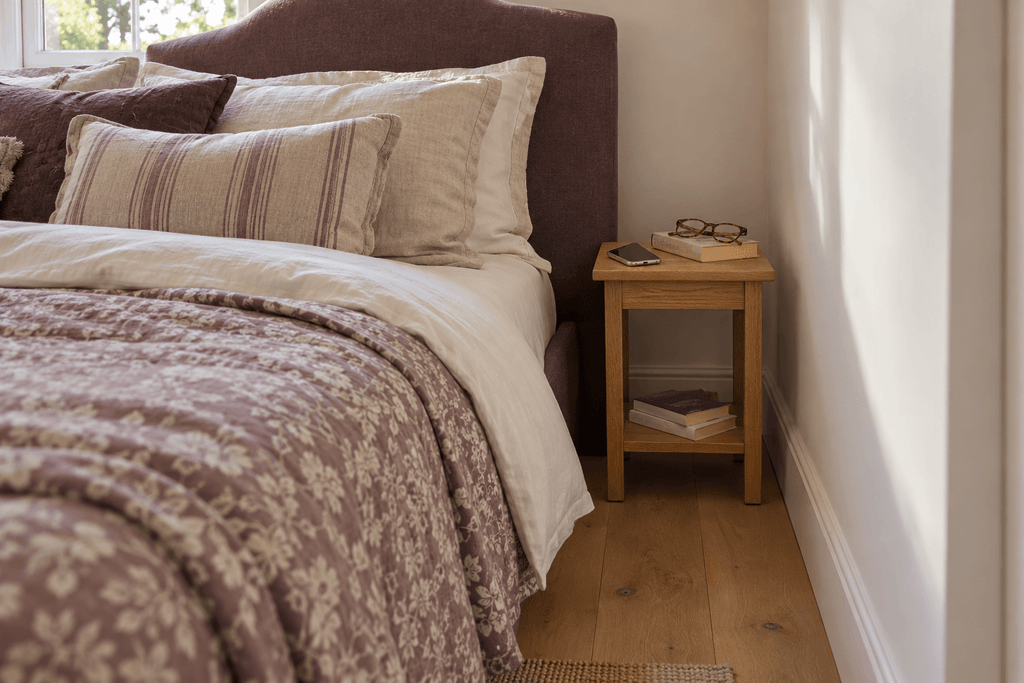
A phone and glasses need a different surface from a lamp, water bottle, book and evening medication. Arrange your usual items on a temporary surface and see how much space they actually take.
Then consider the form that suits the gap.
A Compact Freestanding Table
This can work near the head of the bed if its footprint leaves the route usable.
Check both dimensions. A table described as “narrow” may be slim across its front but surprisingly deep from the wall toward the bed.
Look for a stable base and edges you can pass comfortably. Check the height against your mattress so you can reach the surface without an awkward stretch.
A Bed-Frame Tray
A tray attached to the bed frame may suit a small collection of lightweight essentials.
Compatibility matters: the attachment must fit the frame’s shape and thickness, and the tray must stay within the manufacturer’s load limit. Include its projection when judging the walkway.
It is a poor choice if it moves when you turn in bed or puts a drink where bedding can easily catch it.
A Wall-Mounted Bedside Ledge
A shallow ledge can provide a fixed landing place if mounting is permitted and the wall can support it with suitable fixings.
Test the proposed height and reach before installation. Keep the edge away from where you rise, sit or brush past the bed.
Whichever option you choose, plan the charging cable too. A useful little surface becomes inconvenient if its cable crosses the walking route.
You do not need matching furniture on both sides. If one side is much tighter, different bedside solutions can be more practical than forcing in a pair.
If You Need Storage, Check How You Will Retrieve Things
A narrow bookcase can fit beside a bed and still be awkward to use.
Imagine taking something from its bottom shelf. Can you face the shelf, bend down and lift the item out? Or would you need to kneel on the mattress and reach across the gap?
A basket adds another requirement: it needs enough space to slide out, and somewhere to go while you use it.
Before choosing storage, identify the items it would hold. Books you reach for nightly may justify a small accessible shelf. Spare bedding that already has a home elsewhere probably does not justify making the bedside route harder to use.
With open shelving, account for the stored items as well as the frame. Books, handles or baskets that overhang the shelf increase its real projection.
Follow the furniture’s anchoring instructions.
Storage is only useful when you can retrieve and replace what it holds without a struggle.
If You Already Have Enough Storage, Finish The Room Without More Furniture
Consider a small bedroom with a queen bed, a working nightstand and enough closet space. A narrow strip of floor beside a plain wall might look neglected, even though nothing needs storing there.
In that situation, another cabinet adds capacity without addressing the real concern: the room looks unfinished.
Start with what is already visible.
Straighten the bedding and check how much it trails into the gap. Keep a generous, comfortable look if you like oversized bedding, but avoid leaving fabric where you repeatedly step.
Then choose one change that helps the room feel complete: artwork, a more cohesive bedding combination, or a better-positioned lamp on the existing nightstand.
Pause before adding another piece. A clear strip of floor can look intentional once the bed and wall have been considered together.
A Bedside Rug Can Be Enough
If the bare floor makes the gap feel unfinished, a bedside runner can add softness and color without introducing another piece of furniture. You can also position a larger rug partly beneath the bed so that an exposed section serves the bedside area.
Choose a rug that lies flat and stays securely in place on your flooring. Check that its edges do not curl, that nearby doors clear it, and that under-bed drawers still open easily. Avoid thick or fringed edges where you step out of bed.
The floor can remain open for walking while still feeling decorated. If a rug makes the route less comfortable or harder to use, leave the floor bare and use artwork instead.
When Repositioning The Bed Is Worth Testing
Sometimes the narrow gap is a symptom of how the bed sits in the room.
If one side has generous unused space and the other is difficult to access, a small shift may distribute the clearance more usefully. Check the consequences before moving it: closet doors, bedroom doors, windows, outlets and existing furniture may be the reason it sits there.
Pushing one side toward a wall can suit some solo sleepers, but it also changes sheet-changing, cleaning and access. For two sleepers, it may leave one person without a direct way out.
You do not have to rearrange the entire bedroom just to make an otherwise useful gap look decorated.
Test One Addition Before Buying
Once you have a specific solution in mind, mark its proposed footprint with a floor-safe method, such as removable tape tested in an inconspicuous spot. Include any overhang, handles and the extra space needed for opening or retrieval.
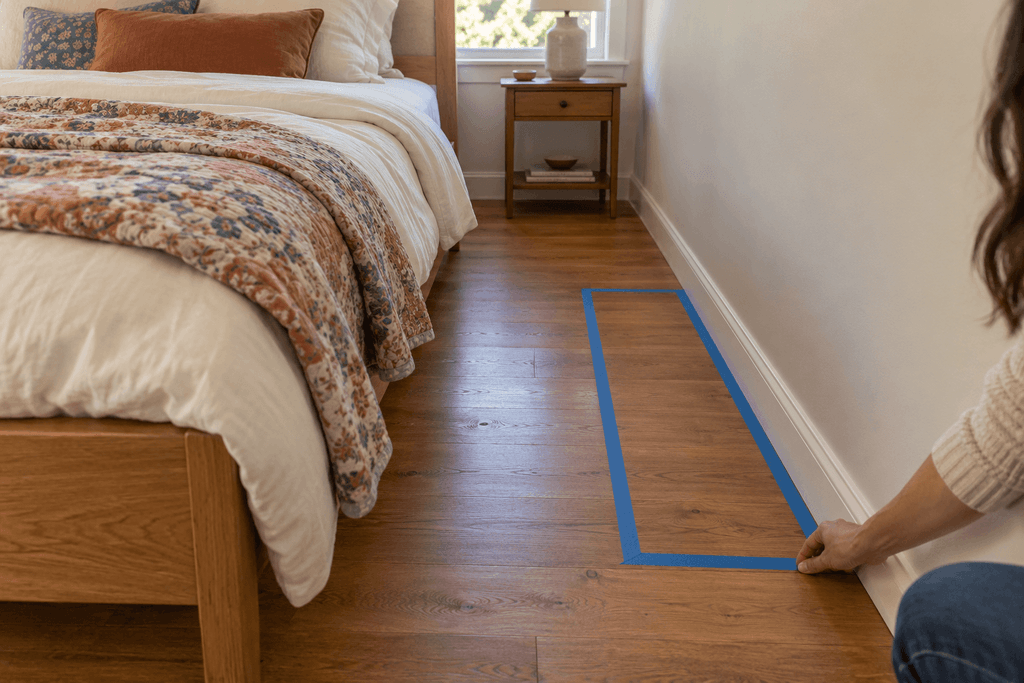
Walk through the route in both directions and perform the tasks you checked earlier. Keep the test area clear afterward.
A floor outline helps you judge the footprint. It does not prove that a tray will be stable, a wall will support a shelf or a drawer will be convenient to use; those need their own checks.
Consider what becomes easier after you add that furniture and what becomes harder.
If a bedside surface gives your glasses a reachable home while preserving access, it earns its place. If a bookcase makes getting into bed awkward while holding things you could store elsewhere, leave it out.
The narrow space beside your bed does not need to hold something to be well used.