Studio Apartment Entryway Ideas When the Front Door Opens Beside Your Bed
Disclosure
This post may contain affiliate links. If you purchase through these links, I may earn a small commission at no extra cost to you. As an Amazon Associate I earn from qualifying purchases.
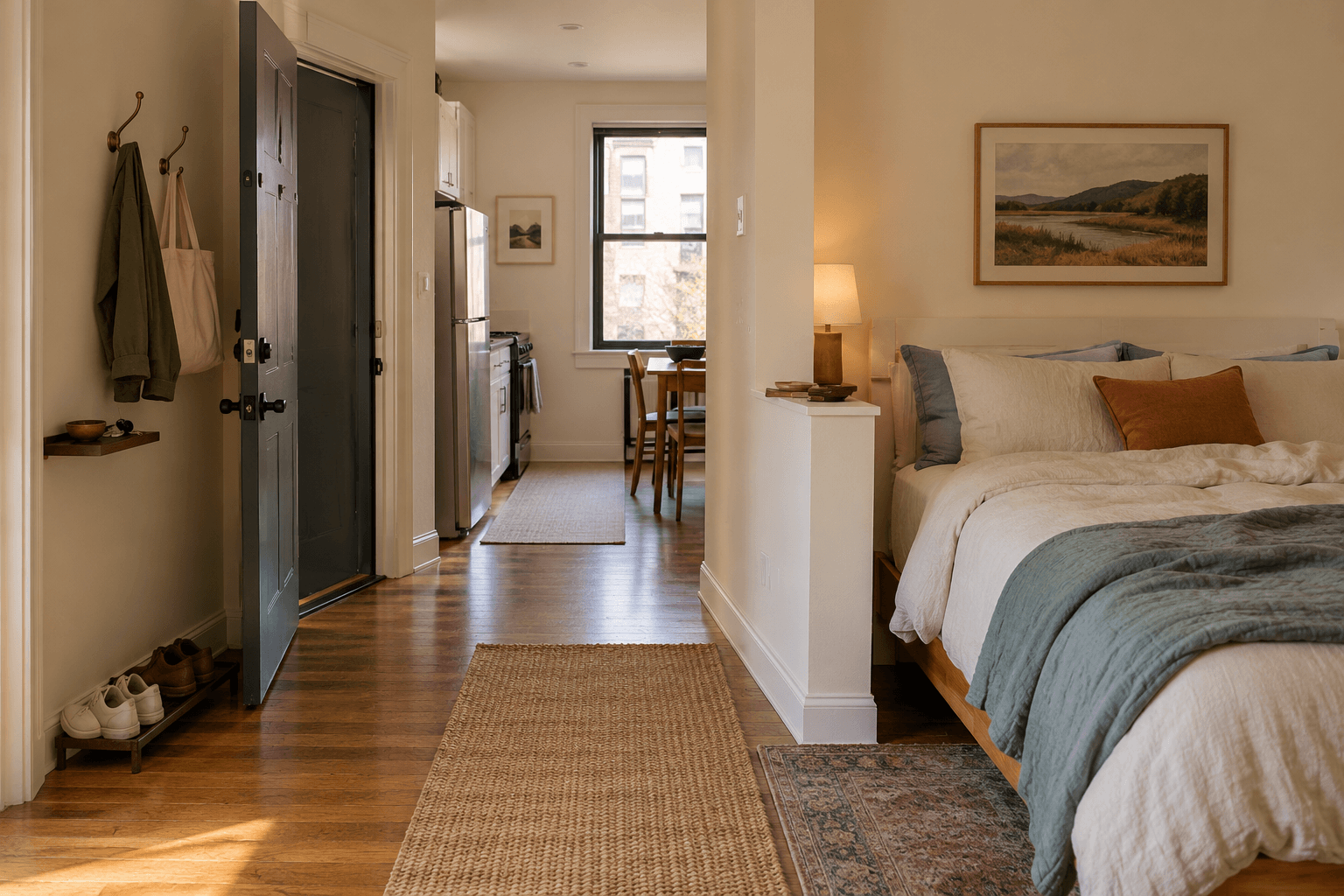
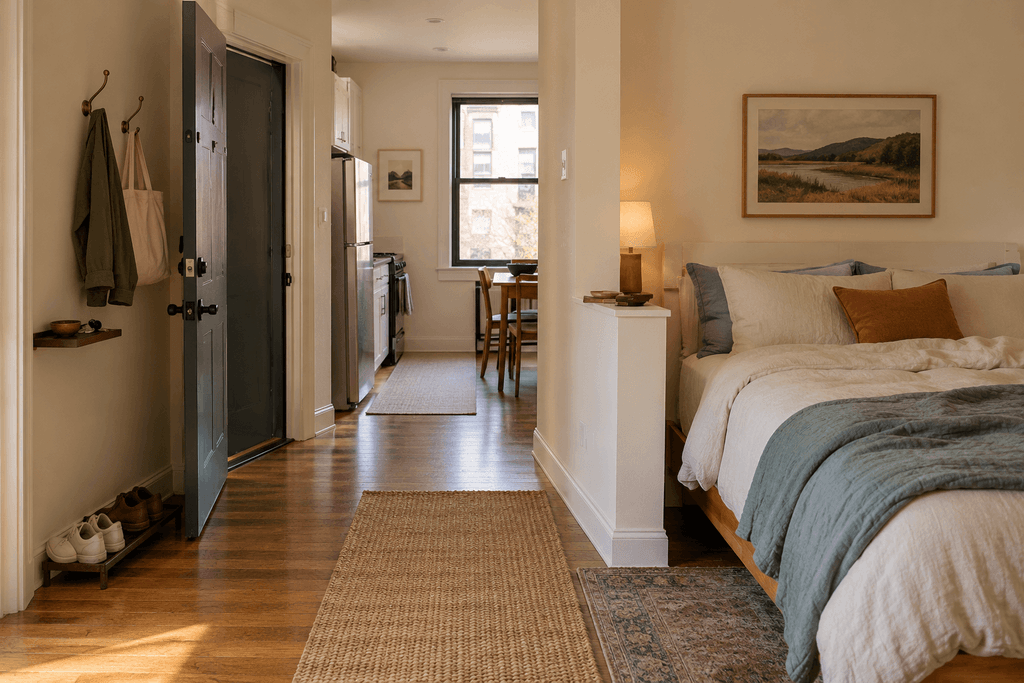
When your front door opens beside your bed, the entrance has to share space with the most private part of your apartment. Shoes collect near the bedding, bags land on the nearest chair, and visitors can see your sleeping area before they have stepped inside.
The most useful studio apartment entryway ideas address three things: a clear route into the room, somewhere convenient for everyday belongings, and whatever bed privacy the layout can reasonably support.
You may not have space for all three in separate zones. A narrow entrance might need a small landing spot without a divider. A wider one might accommodate a partial screen. Start with the space you can actually use before buying entryway furniture.
Start With the Door Swing and Your Walking Route
Open the front door fully and note where the door and handle reach. Then walk from the entrance to the bathroom, kitchen and bed.
Include the awkward movements: carrying groceries, taking off shoes, setting down a work bag and opening the nearest closet. These reveal problems that an empty floor plan can miss.
Measure:
- The entrance with the door open.
- The narrowest part of each everyday route.
- The projection of any furniture you are considering, including handles and feet.
- The extra space needed to open drawers, tilt a shoe-cabinet compartment or pull out a storage bin.
Measure the usable passage, not just the gap between the walls. A cabinet can fit against a wall while its open compartment blocks the route.
Keep exits, electrical panels, vents and required heater clearances unobstructed. Follow applicable building requirements and the instructions for your particular equipment; an illustrative furniture plan is not a substitute for them.
Finally, choose the problem that matters most. If shoes block the entrance, solve their storage first. If belongings already have a home but the bed feels exposed, focus on the sightline from the doorway.
Choose the Layout That Matches Where Your Bed Sits
The following are illustrative arrangements, not plans for a measured apartment. Their usefulness depends on your door positions, furniture dimensions, windows and available passage space.
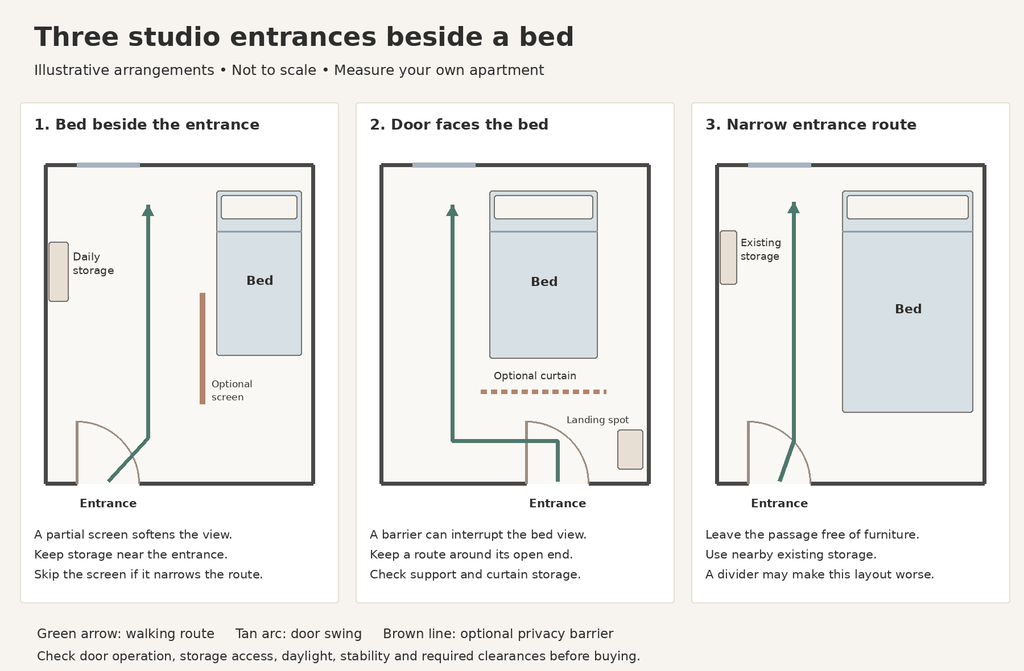
Layout 1: The Bed Runs Beside the Entrance
In this arrangement, the door opens near the long side of the bed. Walking into the apartment immediately puts you beside the sleeping area.
If there is enough space, a partial barrier between the entrance and the bed can soften that view. Position it outside the door swing and preserve the route into the room. It does not need to enclose the entire bed to give the entrance a more defined edge.
Keep the landing spot on the entrance side of the barrier. Otherwise, you may still walk into the sleeping area to put down your keys and bag.
A suitable setup might combine a modest screen with a small existing surface for keys. A shelf divider could provide storage too, but only when its depth, stability and anchoring requirements suit the apartment.
Skip the barrier if you have to squeeze around it. A clear entrance with a visible bed is more usable than a screened bed behind an obstacle.
Layout 2: The Front Door Faces the Foot of the Bed
Here, the bed sits directly in the view from the doorway.
Before adding furniture, test whether rotating or repositioning the bed improves that view. Check the consequences elsewhere: can the closet still open, can you reach the bed comfortably, and does the new position interfere with a window or heater?
If moving the bed creates more problems than it solves, a partial screen or retractable curtain may offer privacy without permanently enclosing the sleeping area.
Position a curtain beyond the entrance door’s moving area. Check how it will be supported, where the fabric gathers when open and whether it can move into a heater or walking route. Confirm mounting permission before installing hardware.
Keep the everyday landing spot near the entrance rather than automatically adding a bench at the foot of the bed. A bench still needs space for sitting, standing and opening any storage.
The useful change is interrupting the view of the bed while keeping the apartment accessible. You do not need a furnished hallway inside the studio.
Layout 3: There Is Only a Narrow Passage Between the Door and Bed
This is the layout where adding entryway furniture can do the most harm.
If the available gap is already your main walking route, avoid filling it with a console, bench or screen. Even a slim item can become inconvenient when its feet project outward or a bag hangs from it.
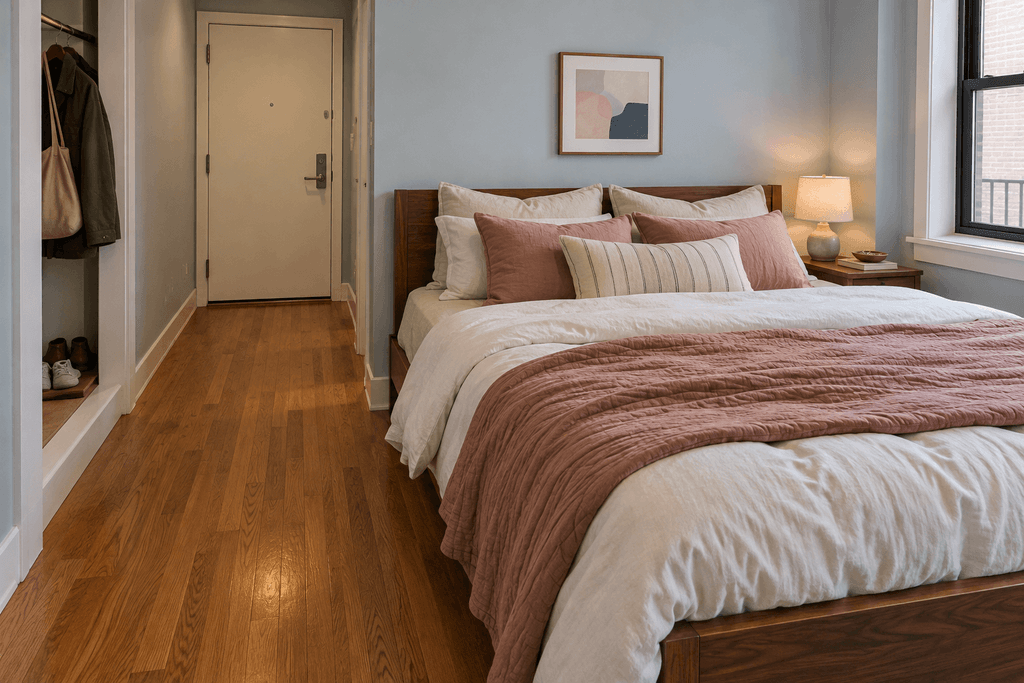
Instead, borrow storage from an existing location:
- Use a small tray on a nearby surface for keys.
- Reserve accessible closet space for your daily jacket and bag.
- Place suitable hooks on a permitted wall area where hanging items will not obstruct movement.
- Give current shoes a defined spot outside the main route.
Hooks are not automatically space-free. A loaded tote bag projects farther into the room than an empty hook.
With a studio apartment with no entryway, the best solution may be a convenient place to put things rather than a separate entrance zone. The bed can remain visible while the entrance becomes easier to use.
Give Keys, Shoes and Bags a Home Without Building a Second Closet
Look at what you actually bring through the door during an ordinary week.
Perhaps it is one bag, a jacket, keys and two pairs of shoes. That calls for a different setup from storing your entire shoe collection and every seasonal coat.
Assign an accessible location to each everyday item:
- Keys and small essentials: A contained spot on an existing surface or a suitable shallow shelf.
- Daily bag: A hook or storage compartment that supports it and remains convenient when loaded.
- Current shoes: A tray, low shelf or compact cabinet that fits your shoes and the available space.
- Daily outerwear: Existing closet space or suitable permitted hanging storage.
Before buying a shoe cabinet, check both its internal capacity and its open position. Before choosing wall storage, check the surface, load rating and installation instructions. Adhesive mounting should not be treated as suitable for every bag, wall finish or rental.
If drilling is not permitted, start with existing furniture and closet space. A freestanding storage piece is only useful if it fits the route and can be installed safely, including any required anchoring.
Move occasional belongings elsewhere. Our guide to how to organize a small bedroom explains how to organize around everyday use rather than simply finding a container for everything.
Choose a Privacy Barrier That Does Not Create Another Problem
A divider earns its space only if it improves privacy without making movement, daylight or storage access worse.
A Curtain: Useful When You Want Privacy Only Sometimes
A curtain can be opened during the day and closed when privacy matters. It still needs a suitable support system, room for gathered fabric and placement clear of heat sources and moving doors.
A tension system is not automatically suitable for a wide span or heavy fabric. Follow the product’s limits and confirm that the installation suits your rental.
A Folding Screen: Useful When There Is Space for Its Full Footprint
Check the screen in its stable, usable configuration not just its folded width. Angled panels and projecting feet can occupy more floor space than expected.
Consider where it will stand when privacy is not needed. A screen that has to be moved every time you enter the apartment adds another daily task.
Open Shelving: Useful When You Also Need Accessible Storage
Open shelving can interrupt the view and provide storage, but it may not fully hide the bed. Its contents remain visible from both sides, and bins need room to slide out.
Check depth, stability and the manufacturer’s anchoring requirements before using a bookcase as a room divider. Do not assume that a freestanding appearance means it can safely stand unsecured.
For managing visible belongings elsewhere in the sleeping area, see how to hide clutter in a small bedroom.
No Divider: Useful When Space or Daylight Is Too Limited
If the entrance already feels tight, a divider may reduce the room’s usefulness. It can also darken the entrance when the studio’s main window is beyond the bed.
You can define the entrance through the location of your everyday belongings without physically separating it. If the area needs better lighting, our guide to brightening a dark room without overhead lighting covers options for improving the light.
Test the Entrance Before Buying Anything
Mark the proposed furniture footprint with painter’s tape, testing the tape on an inconspicuous area first. Include feet, handles and the space used when doors or compartments open.
Then run this entrance test:
- Open the front door fully. Check for contact with the proposed furniture or storage.
- Enter carrying your usual bags. Can you move inside and close the door comfortably?
- Put away keys, shoes and your bag. Check whether their locations are convenient.
- Open nearby storage. Make sure the proposed arrangement allows access.
- Walk to the bathroom, kitchen and bed. Include the route you use at night.
- Check the view and daylight. Assess the entrance from the doorway and the room from the bed.
This checks the space, not a product’s stability or installation safety. You still need to verify those before buying.
If an arrangement only works with every compartment closed and no belongings in use, revise it. A workable entrance has to accommodate your arrival routine.
Frequently Asked Questions
How Do You Create an Entryway in a Studio Apartment With No Entryway?
Start with a clear route and convenient locations for keys, shoes and a daily bag. Add a shallow surface or privacy barrier only when there is enough usable space. Existing furniture can provide the landing spot without introducing another cabinet.
How Can You Hide a Bed From the Front Door?
First test repositioning the bed. If that harms access elsewhere, consider a suitable curtain, partial screen or securely installed shelf divider. Check the view from the doorway, the door swing, daylight and walking route before committing.
What If There Is No Room for a Console or Divider?
Use an existing surface for small essentials and accessible storage for shoes and bags. Keep projecting items out of the passage. A visible bed is a reasonable trade when screening it would make the apartment harder to enter or use.