How to Organize Deep Bathroom Cabinet Shelves Without Losing Things at the Back
Disclosure
This post may contain affiliate links. If you purchase through these links, I may earn a small commission at no extra cost to you. As an Amazon Associate I earn from qualifying purchases.
Deep bathroom shelves can hold plenty of supplies, yet still make everyday items frustrating to find. Face wash disappears behind spare shampoo, towels get pushed into a second row, and reaching the back means moving everything in front.
The key to organizing deep bathroom cabinet shelves is making their depth accessible. Keep frequently used items near the front, group supplies in containers you can bring toward you, and reserve harder-to-reach areas for things you rarely need.
Before buying more baskets, check what is making your current shelves awkward to use. Sometimes the answer is a smaller daily-use collection or a different shelf height not another organizer.
Measure the Shelf and the Cabinet Opening
Measure three things separately: the usable shelf space, the opening the organizer must pass through, and the room available outside the cabinet.
A bin can fit on the shelf but still be difficult to remove. Hinges, a center divider, or a door that doesn’t open fully may narrow its exit path. Record the organizer’s maximum outside dimensions, including projecting handles or rims.
A Bin That Fits the Shelf Can Still Fail the Opening
Suppose your shelf measures 24 inches wide and 18 inches deep, but one door gives you only a 10-inch clear opening. A bin measuring 11 inches wide by 16 inches deep fits the shelf footprint, yet won’t pull straight through that opening in its stored orientation.
You might be able to turn or tilt it, but don’t assume that will work with upright bottles inside. Test the route with a similarly sized box before buying. Also check where the loaded bin will go once removed; its storage location doesn’t provide a working surface automatically.
These are illustrative measurements, not a cabinet or organizer personally tested for this article.
Check Bottle Access Separately
A bin’s height isn’t the height of its contents. Measure your tallest bottle, including its cap or spray trigger, from the shelf surface. Then check whether you can grasp and remove it with the shelf above in place.
If you need to pull the bin out first, check that you can do so comfortably when loaded. Keep enough room to grip its handle without trapping your fingers against the shelf.
For installed pull-out drawers, follow the manufacturer’s clearance, mounting, load, and extension requirements. A removable bin and a fitted drawer are different solutions; neither can be selected from shelf depth alone.
Put Daily Essentials at the Front
Start by sorting supplies according to how often you use them.
- Daily: Toothpaste, deodorant, face wash, moisturizer, and other products in your regular routine.
- Occasional: Guest toiletries, travel supplies, or grooming products you use less frequently.
- Backups: Unopened replacements and spare supplies.
Give daily essentials the easiest shelf and the most accessible position. “Easiest” depends on your cabinet: it may be a middle shelf rather than the top or bottom.
Avoid storing frequently used products behind unrelated items. If your moisturizer sits behind a stack of towels, you have to disturb one category to use another.
Keep backups together so you can see what you already own. Check that they fit before buying more, rather than letting extra bottles expand into every available gap.
If products also crowd your basin, see how to organize a small bathroom with no counter space for ways to separate daily sink essentials from the rest of your supplies.
Use Removable Bins to Bring the Back Forward
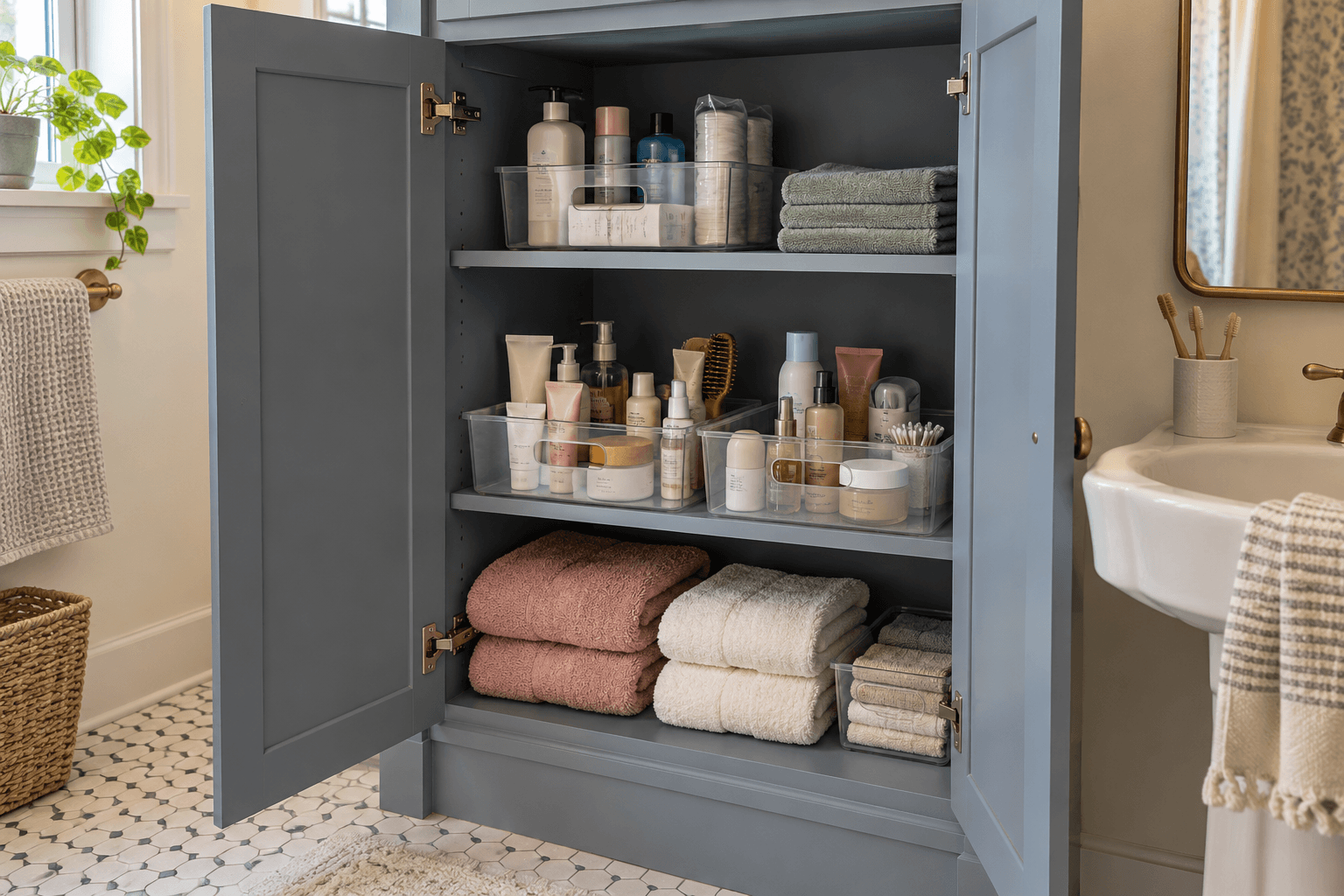
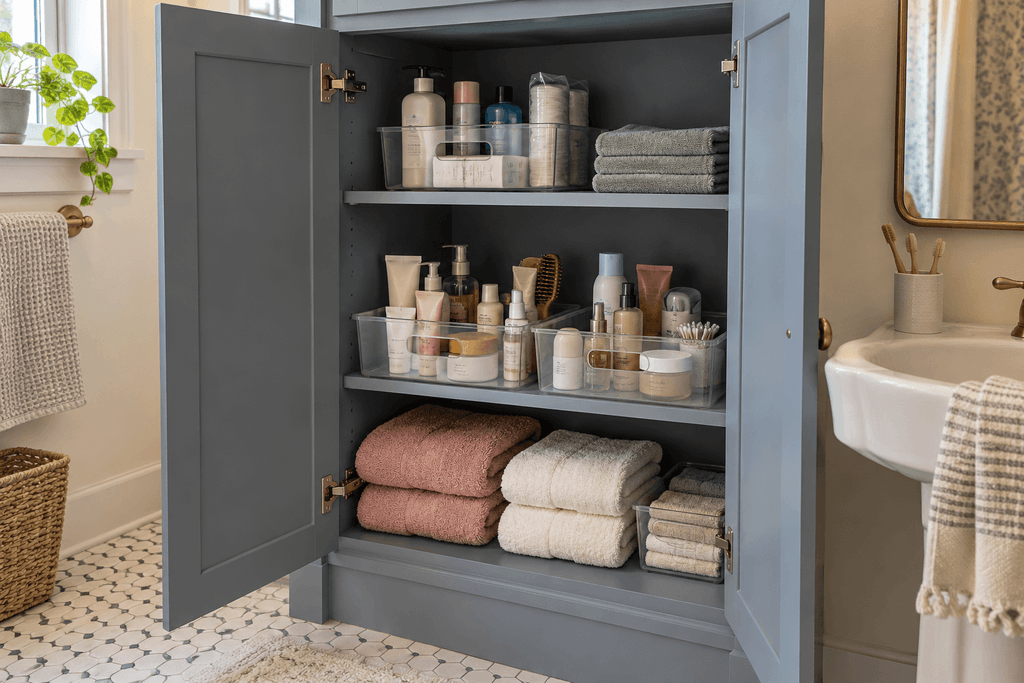
A handled bin can make a deep shelf easier to use because you move a whole category toward you instead of reaching between individual bottles.
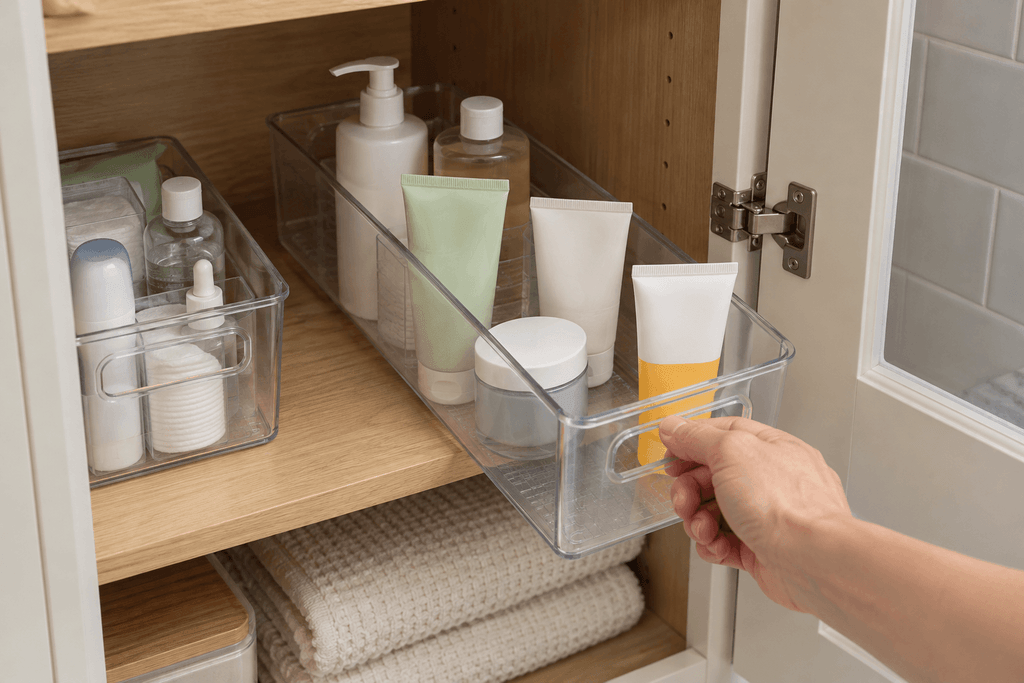
Choose a container that you can grip securely when loaded. A handle opening is useful only if you can reach it and lift or slide the bin comfortably.
For toiletries, look for a surface that is easy to wipe clean. Keep bottles upright and allow enough height to remove them without catching on the shelf above.
A deep bathroom storage bin works best when:
- Its contents belong to one clear category.
- You can see or identify what is inside.
- It remains manageable when filled.
- You can remove it without shifting several other containers.
A long bin packed with mixed products can recreate the same problem as the shelf itself. Use smaller compartments where necessary, or split heavy supplies between two containers.
Label the front if the contents aren’t immediately obvious. Specific labels such as “Hair Products” or “Refills” are more useful than “Bathroom.”
Choose One Deep Bin or Two Shorter Bins
There isn’t one arrangement that works for every deep cabinet.
Use One Deep Bin for a Single Category
A longer bin can work for backup toiletries, washcloths, or a contained grooming kit. Pulling it forward brings items at the back within reach.
Keep the front accessible and avoid filling it until it becomes difficult to lift. If you need to reach directly into the bin while it stays on the shelf, low sides may be more practical than a tall basket.
Use Two Shorter Bins for Daily Items and Backups
Place a daily-use bin in front and a backup bin behind it. This arrangement makes sense when the rear container is needed only occasionally.
The front bin should be easy to remove. You shouldn’t need to empty it or relocate loose bottles before reaching the back.
Keep both bins in the same general category where possible. Daily skincare in front of skincare refills creates a clearer system than skincare in front of unrelated cleaning supplies.
If both containers hold items you use every day, put them side by side where the shelf width allows. Front-and-back storage is less useful when you constantly need both.
Adjust Shelf Height Before Adding Another Layer
Tall gaps between shelves can waste usable space, but stacking organizers is not always the best fix.
If the cabinet has adjustable shelves, try repositioning them first. Give tall bottles the height they need and use a shorter gap for smaller products.
Leave enough room to lift items out. A shelf that barely clears a bottle’s cap may technically accommodate it while making retrieval awkward.
A shelf riser can create a second level for short items. Check that its feet stand securely and that supplies underneath remain easy to reach.
Stackable drawers may help with small grooming items, but confirm that the drawers open independently. Stacked baskets that must be lifted off one another are better suited to occasional supplies than a daily routine.
Use vertical space only when the extra layer remains accessible. More capacity isn’t an improvement if every morning starts with unstacking containers.
Know When Pull-Out Drawers and Turntables Help
Pull-Out Drawers
A sliding organizer can be helpful when lifting a loaded bin is uncomfortable or when the shelf is particularly difficult to reach.
Check how far the drawer extends. A short extension may still leave its rear contents beneath the shelf above.
Also account for hinges, cabinet lips, mounting surfaces, and the space needed in front of the cabinet. Renters should check permission before choosing an organizer that requires screws.
Select the organizer around the cabinet not the other way around.
Turntables
A turntable can make a group of bottles easier to browse by bringing rear items forward.
It needs enough room to rotate with the products loaded. Tall bottles must clear the shelf above, and the cabinet opening must allow you to retrieve them.
A circular organizer may leave unused corners on a rectangular shelf. That can be an acceptable trade-off if access improves, but it isn’t automatically the best choice for a narrow cabinet.
For towels, rectangular packages, and mixed supplies, straight-sided bins are often easier to arrange.
Store Towels in Manageable Stacks
Keep towels where you can remove one without pulling down the rest.
Fold them to suit the shelf depth rather than pushing a large stack toward the back. Try a few folds before deciding whether you need a container.
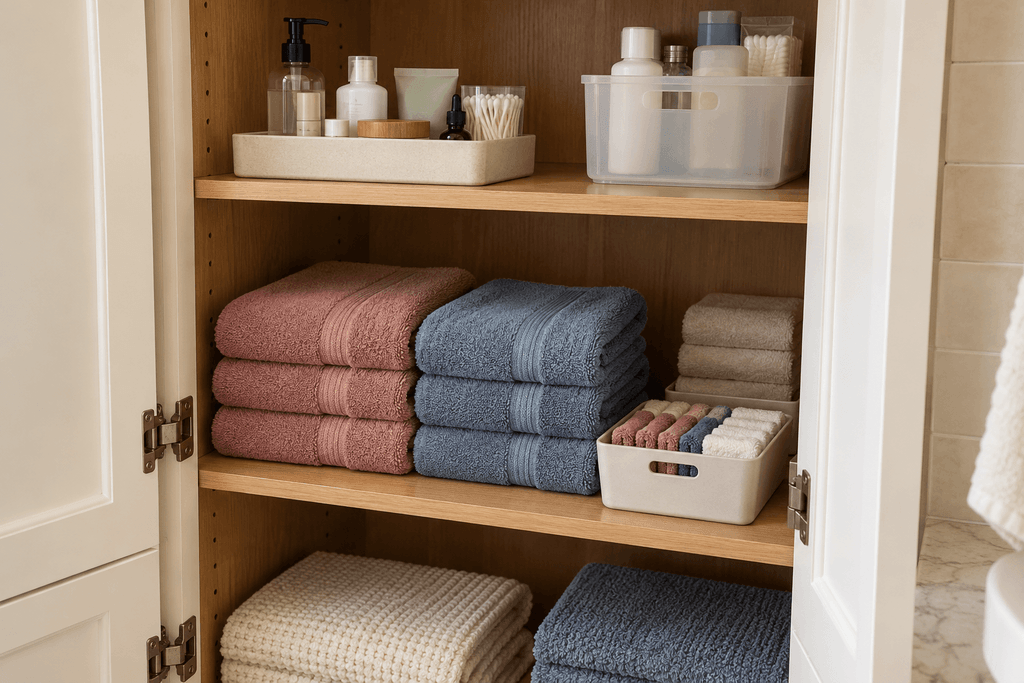
Short stacks are easier to handle than a tall pile packed tightly beneath the next shelf. Separate hand towels from bath towels if searching through mixed sizes keeps disturbing the arrangement.
For washcloths, a small removable bin can keep them together. Place it where you can see the contents or pull it forward easily.
If you use the back of the shelf for guest towels, treat it as occasional storage. Don’t hide the towels you reach for every day behind a front row.
You don’t need a second row simply because there is room for one. Some spare depth can make the front contents easier to handle.
Treat Under-Sink Storage as a Separate Case
A deep cupboard with uninterrupted shelves is different from a vanity cabinet containing drainpipes and water supply lines.
Under the sink, measure the usable areas beside and in front of the plumbing. A full-depth organizer may not fit, even when the overall cabinet dimensions look suitable.
Choose containers you can remove to access the plumbing, and avoid fitting shelves or bins tightly around pipes. Check that cabinet doors and organizer drawers still open properly.
If there are signs of a leak, address that before adding storage.
Three Deep-Shelf Arrangements to Try
A Shelf Mainly Used for Toiletries
Place frequently used products in an accessible front bin. Group unopened replacements in a separate container behind it or beside it.
Use a smaller compartment for items that otherwise disappear between bottles. Keep enough room to remove the daily-use bin in one movement.
A Shelf for Towels and Washcloths
Arrange bath towels in a short front-facing stack. Put hand towels beside them and washcloths in a compact bin.
Use the rear space for occasional guest supplies only if they remain retrievable. Avoid a hidden second row of everyday towels.
A Cabinet With Mixed Supplies
Give each category its own removable container: hair products, skincare refills, or guest toiletries.
Place frequently used categories on the easiest shelf. Keep heavier containers lower where you can handle them comfortably, rather than lifting them from above your head.
Follow storage instructions for individual products. Cleaning supplies and medicines may need a different location, especially where children can access the cabinet.
Test the System Before Buying More Organizers
est one shelf using the items you normally need. Retrieve your face wash, take out a towel, remove a loaded bin, and return everything.
Notice what you must move first. Reaching occasional refills behind an easily removable daily-use bin may be an acceptable trade-off. Moving towels and two unrelated containers to get your everyday moisturizer is a reason to change the arrangement.
Also check where a removed bin rests while you use it. If the only option is balancing it on a narrow sink rim, keep it on the shelf for individual retrieval where practical, reduce its size, or choose another setup.
When you put everything back, can you close the door and identify the rear supplies? If not, adjust the grouping or labeling. Repeat the approach on another shelf only after the first one works through your routine.
An organized deep shelf doesn’t have to use every inch. Spare depth can be useful if it lets you retrieve and return the front contents comfortably.