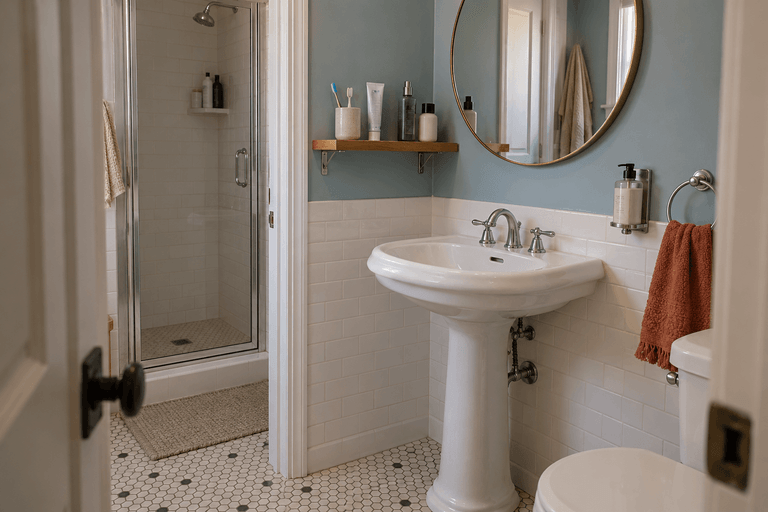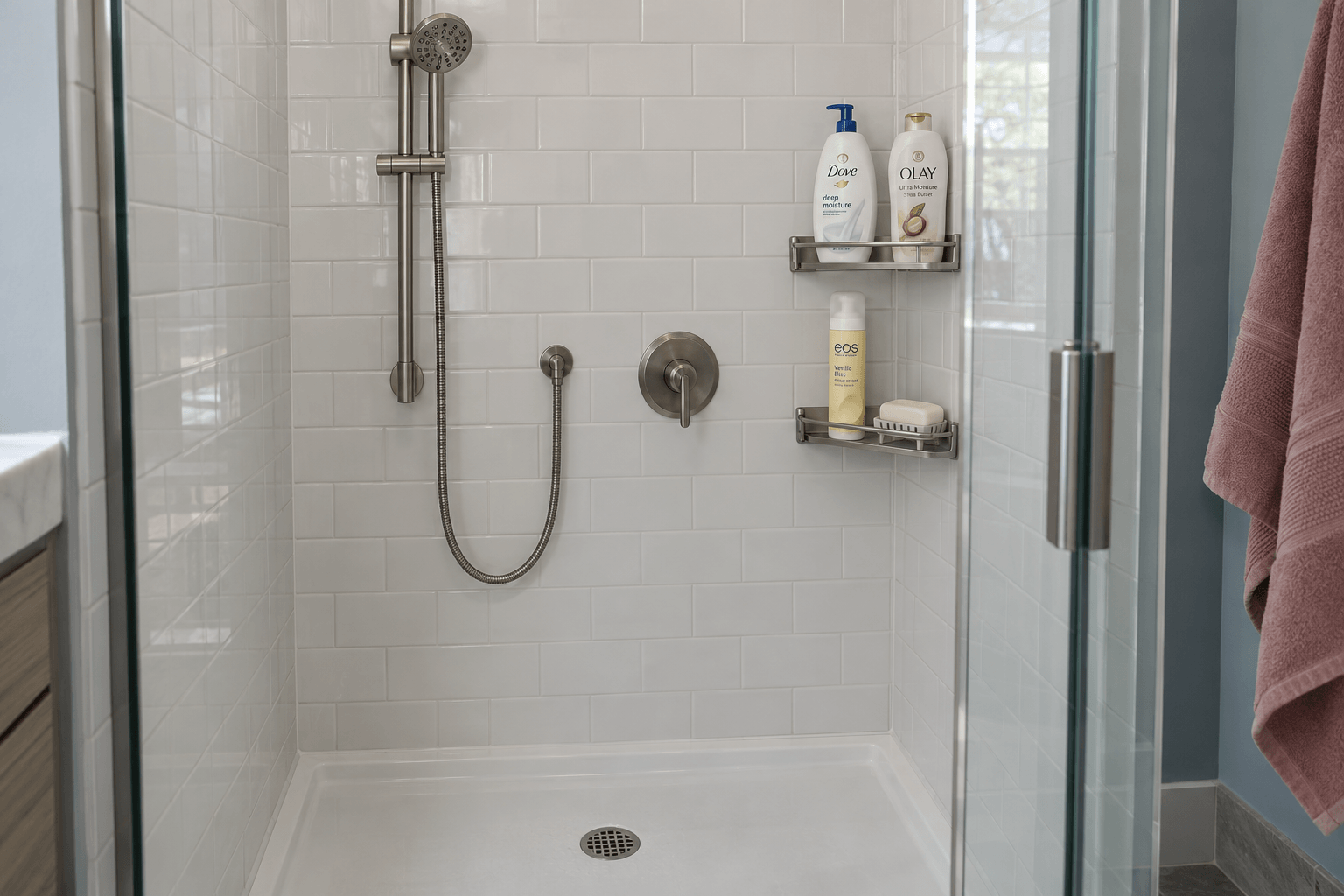
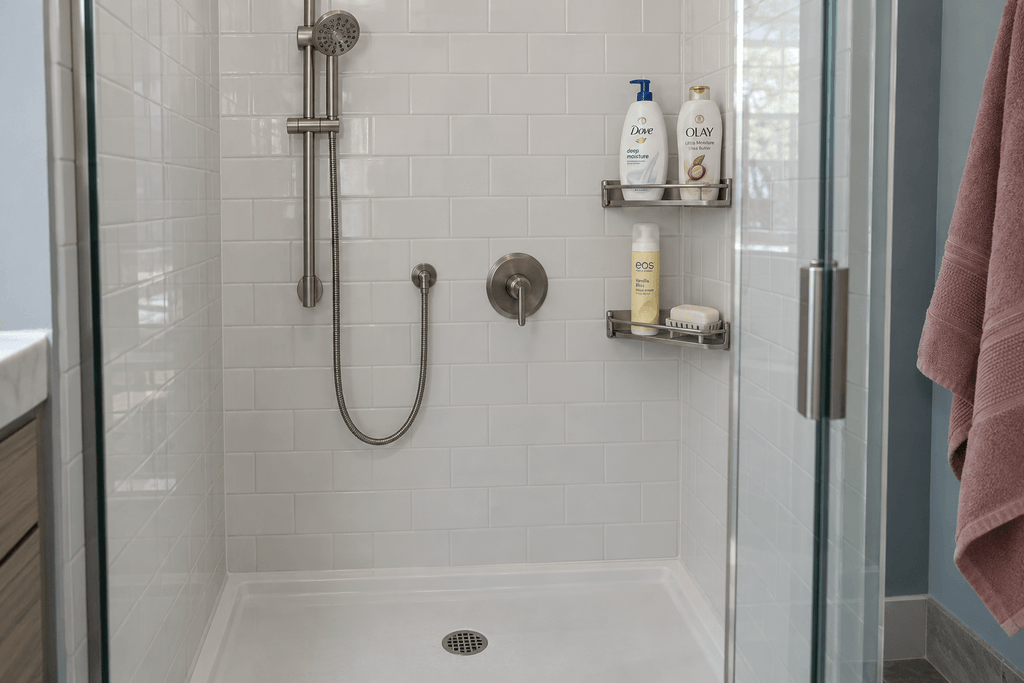
Shower Storage for Small Showers With a Handheld Showerhead
Disclosure
This post may contain affiliate links. If you purchase through these links, I may earn a small commission at no extra cost to you. As an Amazon Associate I earn from qualifying purchases.
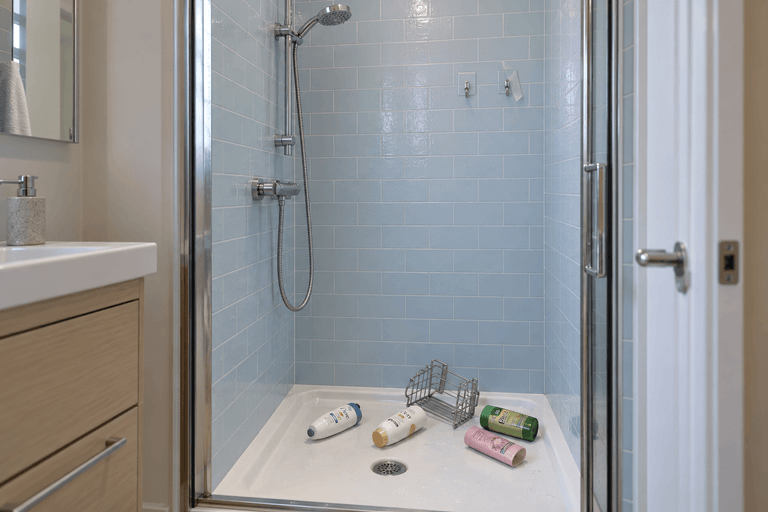
A shower caddy can clear the handheld hose and still make a small shower awkward. Its baskets project into the space where you stand, a bottle catches your elbow, or the hose snags when you lift the showerhead.
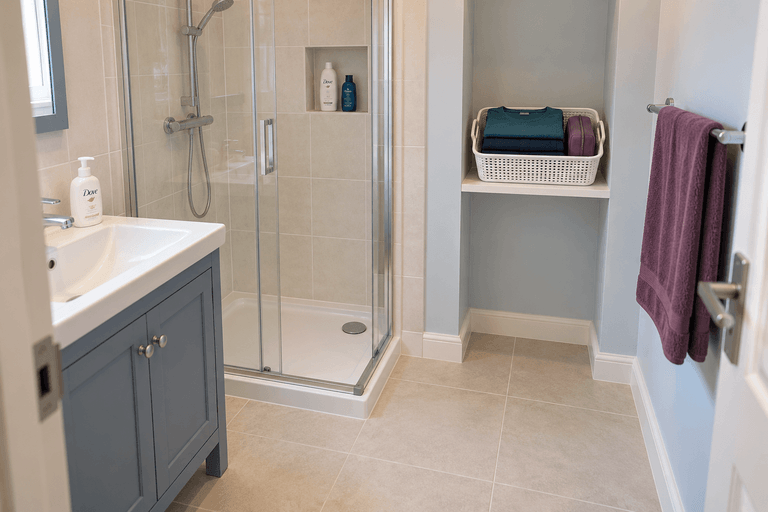
Good storage for a small shower keeps everyday bottles accessible while leaving room to stand, turn and use the handheld. Depending on your fixtures, that may mean a handheld-compatible hanging caddy, a shallow shelf on another wall or a small corner arrangement.
Start with the space you use during a shower. Then choose storage around it.
Keep Only Your Working Collection in the Shower
Before measuring for another organizer, separate the products used regularly from unopened replacements, occasional treatments and products nobody reaches for.
Keep the working collection in the shower and find suitable storage elsewhere for the rest. This does not mean everyone must share one shampoo. A household with different hair-care routines needs more capacity than one person using three products.
The difference is between supplies that need to be within reach during a shower and those that can live elsewhere. Choose capacity around your routine before deciding how many shelves to add.
Find the Space You Need to Keep Clear
With the water off and the floor dry, look at where you normally stand, turn and reach. Notice the entrance, controls, handheld holder and the space occupied by the door or curtain.
A wall that looks empty may be where your shoulder moves. A corner that accommodates a storage tower may be where your feet normally go.
For each possible position, check:
- Projection: How far the organizer and its contents extend into the shower.
- Retrieval: The space your hand and bottle need when you take something out.
- Movement: Whether you can turn, use the handheld and operate the enclosure comfortably.
Include hooks, hanging washcloths and bottle pumps. They can extend beyond the shelf dimensions shown in a listing.
There is no single shelf-depth limit that suits every small shower. A shallow shelf on the wrong wall can be more intrusive than a deeper basket in a corner you do not use.
Find Where the Hose Gets Caught
With the shower off and the floor dry, look at the arrangement before moving anything. If the caddy is loose or unstable, remove its contents and address the mounting problem before testing it.
Start with the handheld resting in its holder. Where does the hose leave the handle, and where does it connect to the shower? Follow that route past the shelves, frame, bottles and hanging accessories.
Then lift and return the handheld as you normally would. Does the hose catch only during that movement, or is it already trapped while the head is docked?
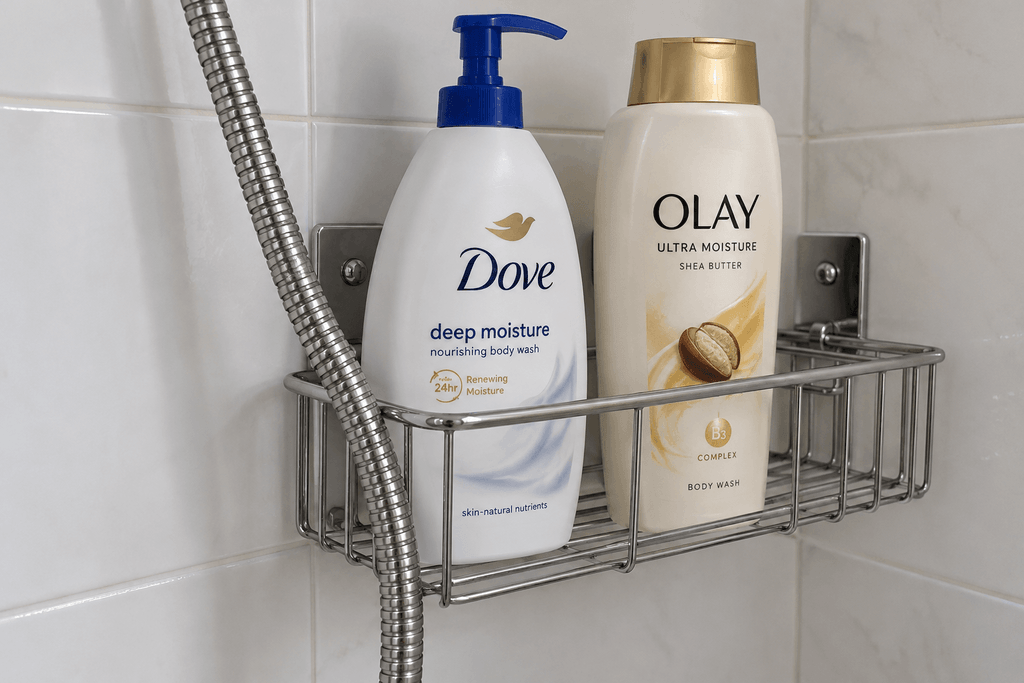
Different problems need different fixes:
- It catches a hanging washcloth or accessory: Relocating that item may clear the route.
- It catches a shelf edge or crossbar: The caddy’s structure may conflict with the hose.
- The holder is difficult to reach: More hose space alone will not solve access to the handheld.
- The caddy shifts when you move the hose: Stop and check the support system and installation instructions.
- It works when docked but catches during use: A clear resting position has not provided enough freedom of movement.
Avoid forcing the hose around a basket or pulling against the caddy to release it. The aim is ordinary use without having to untangle the setup each time.
Check Your Actual Reach
A setup that works for rinsing your hair may become awkward when you use the handheld to rinse the lower shower walls.
Gently check the movements you normally make, within the hose’s available reach and the shower manufacturer’s instructions. Notice whether the hose snags, develops a tight bend or pulls against its connections.
A gap that accommodates the stationary hose is not proof that the shower works comfortably.
Leave the Holder and Controls Accessible
Handhelds may sit at the shower arm, beside a fixed head or on a vertical slide bar. Storage must leave your particular holder and controls usable as well as keeping the hose clear.
Check that you can lift and return the handheld, use the normal angle or height adjustments and operate the controls without moving bottles. If several people share the shower, include the holder positions they use.
Do not attach storage to a hose, holder or slide bar unless the exact product is designed for that mounting point and its requirements are met.
Keep Storage Beneath the Showerhead Only When It Leaves Usable Space
A hanging caddy can keep the floor clear when the shower provides the support it requires. In a small enclosure, check both the hose route and how far the loaded baskets project toward you. A design that clears the hose is still unsuitable if it crowds the place where you wash.
Two useful designs to investigate are split baskets that leave an open route through the middle and adjustable shelves that can move away from the hose or other fixtures.
Check the exact model rather than assuming another size in the same range has the same compatibility.
Look Beyond the Center Opening
A product photo showing a hose between two baskets answers only part of the question.
Check where the frame’s crossbars sit, how far the shelves project and whether the hose can move out of its resting route. Also consider what happens when the baskets contain your bottles.
Before buying, establish:
- Support: Where the caddy attaches and what that mounting point must provide.
- Stabilization: Whether it requires a lower fixing, suction cup or another support.
- Installed size: Its width, depth and height in the configuration you need.
- Fixture access: Whether its frame avoids the holder, controls and connections.
- Movement: Whether you can use and return the handheld without threading it around storage.
There is no single clearance measurement that establishes compatibility with every shower. Use the product’s instructions and your fixture arrangement. If a critical measurement is missing, ask the manufacturer rather than estimating it from a styled image.
Move Storage to Another Part of the Small Shower When Needed
A different hanging caddy is not always the answer. If the showerhead area is crowded with a handheld bracket, fixed head, diverter and hose, moving bottles to another location may be simpler.
Choose the alternative around the available mounting surface and usable shower space.
A Wall-Mounted Shelf Beside the Fixtures
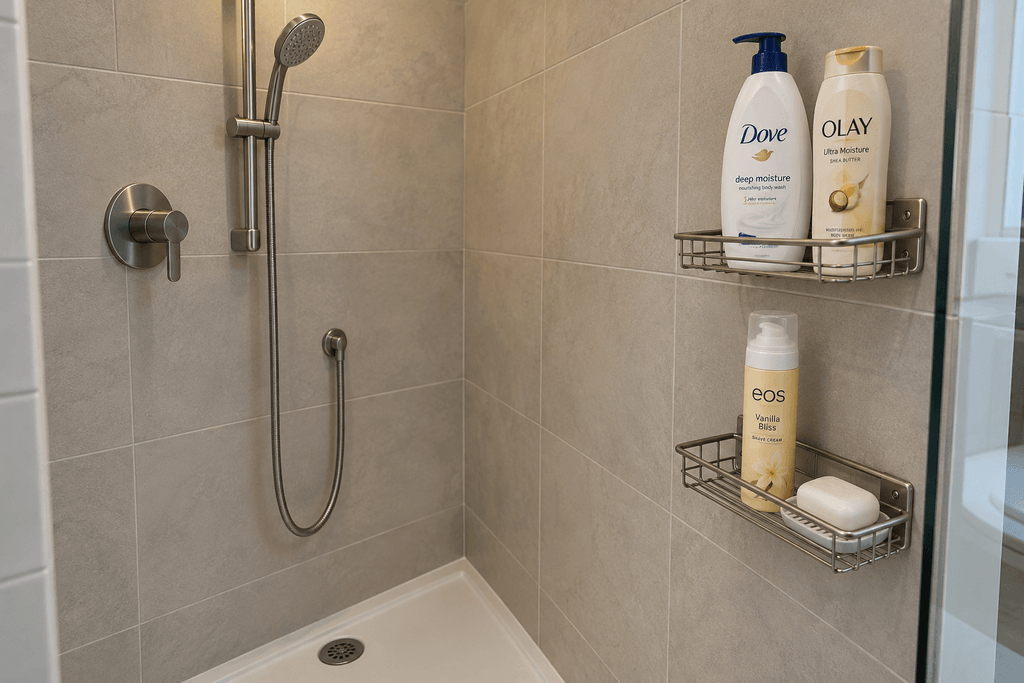
A shelf on an appropriate side wall can separate storage from the hose’s main route.
Check the exact mounting system’s approved surfaces, load limits, preparation and removal instructions. Do not assume suction or adhesive fittings work on every tile, grout line or wall finish.
Also consider the shelf’s projection. Moving bottles away from the hose is not an improvement if the shelf now occupies the space where you turn or raise your arms.
If installation requires drilling through the shower surface, renters need permission and an appropriate installation method for the wall system.
A Basket Designed for a Shower Slide Bar
A purpose-made bar-mounted basket may work when its specified bar dimensions and mounting conditions match your shower.
Check that it leaves the handheld holder’s required travel clear. Include the loaded bottles: they can project above or beyond the basket and create a conflict that the empty organizer does not.
A slide bar and a curtain rod are different mounting points. Do not substitute one because the basket appears to clamp around it.
An Over-Screen or Over-Door Organizer
This can move storage to another part of the enclosure, provided the organizer is compatible with the screen or door.
Verify the hook dimensions, permitted support and any restrictions for the glass or frame. Then check normal door movement, seals, bottle access and the organizer’s projection into the shower.
Do not assume a product suitable for one framed enclosure belongs on a different glass panel.
A Corner System
A corner shelf, freestanding unit or tension-pole system may keep bottles away from the showerhead. But “corner” does not automatically mean space-saving. Check the front edge of the shelves against your feet, elbows and normal reach. One or two shelves may hold your working collection without adding a full-height system.
Each introduces a different condition to check: suitable mounting surfaces, a stable base or an approved floor-to-ceiling installation range. Include shelf projection, cleaning access and your standing space.
Moving the support point changes the fit problem; it does not remove it.
Check Bottle Access Before Buying More Capacity
An organizer can leave the hose clear and still make the bottles awkward to use.
Measure your tallest everyday container, including the pump or cap. Check whether you can grasp it, lift it over the basket rim and return it beneath the shelf above.
If you normally operate a pump while its bottle remains in the caddy, confirm that the product is suitable for that use and remains secure. A published storage load is not permission to push down on any shelf.
Keep the shower collection focused on products you actually use there. Unopened replacements and occasional supplies do not necessarily need a place beside the showerhead.
Our guide to organizing deep bathroom cabinet shelves explains how to keep backup toiletries accessible outside the shower. If sink essentials are competing for the same storage, see how to organize a small bathroom with no counter space.
More basket space is useful only when the added bottles remain accessible and do not recreate the obstruction.
Try Allowed Adjustments Before Replacing the Caddy
Start with the least complicated change that addresses the actual conflict.
Remove unnecessary hanging accessories, move a bottle that projects into the hose route or reposition adjustable baskets where the instructions allow. After adjusting, secure any required locks or fittings before reloading.
Then repeat the movement that caused the problem.
For example, if a washcloth hanging from the center hook catches the hose, moving that washcloth may be enough. If the hose catches a fixed crossbar every time you return the handheld, reorganizing the bottles will not change the frame.
These are illustrative situations, not installations personally tested for this article.
Avoid bending the caddy, removing structural parts or adding improvised ties to force a fit. Do not hang an organizer from another fixture simply because its original support point is inconvenient.
If the fixture itself is loose, leaking or damaged, address that separately rather than using storage adjustments to compensate.
Check the Complete Small-Shower Setup
Before buying, compare the organizer’s maximum installed dimensions with the proposed location. An outline or similarly sized template held in position from outside the dry shower can reveal obvious crowding. Remove it before using the shower. It cannot establish mounting strength, loaded stability or hose compatibility.
Once a suitable organizer is installed according to its instructions, check it with your everyday bottles:
- Can you enter, stand and turn comfortably?
- Can you operate the controls without reaching around bottles?
- Can you lift, use and return the handheld without snagging the hose?
- Can you retrieve the tallest bottle?
- Can the door or curtain move normally?
- Can you reach the surfaces that need cleaning?
If moving a hanging accessory resolves the problem, you may not need another caddy. If a fixed basket or crossbar keeps obstructing the handheld, consider a different design or location.
Good storage for a small shower gives everyday products a place without making the shower harder to use. If an organizer clears the hose but crowds your body, the storage problem has only moved.