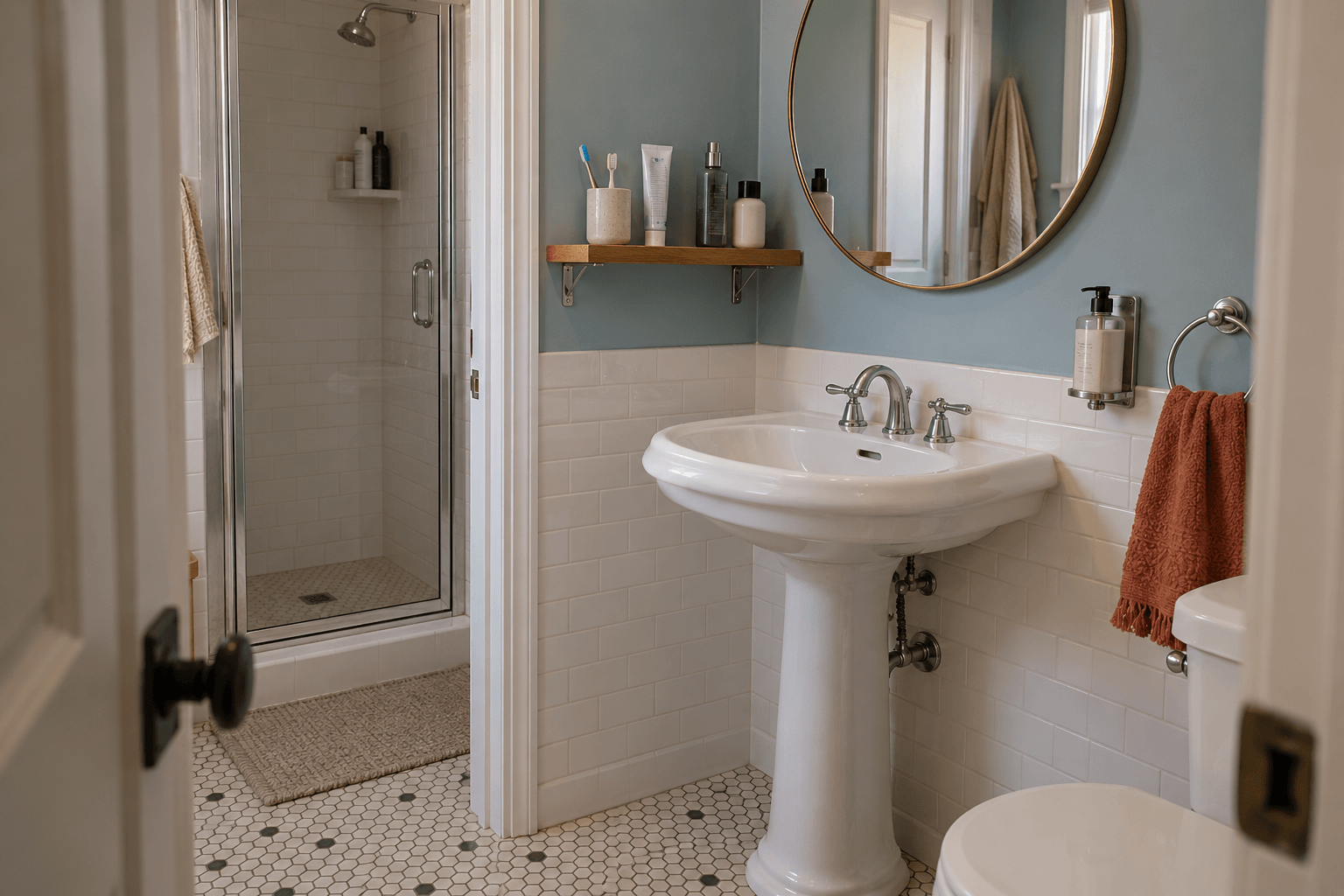
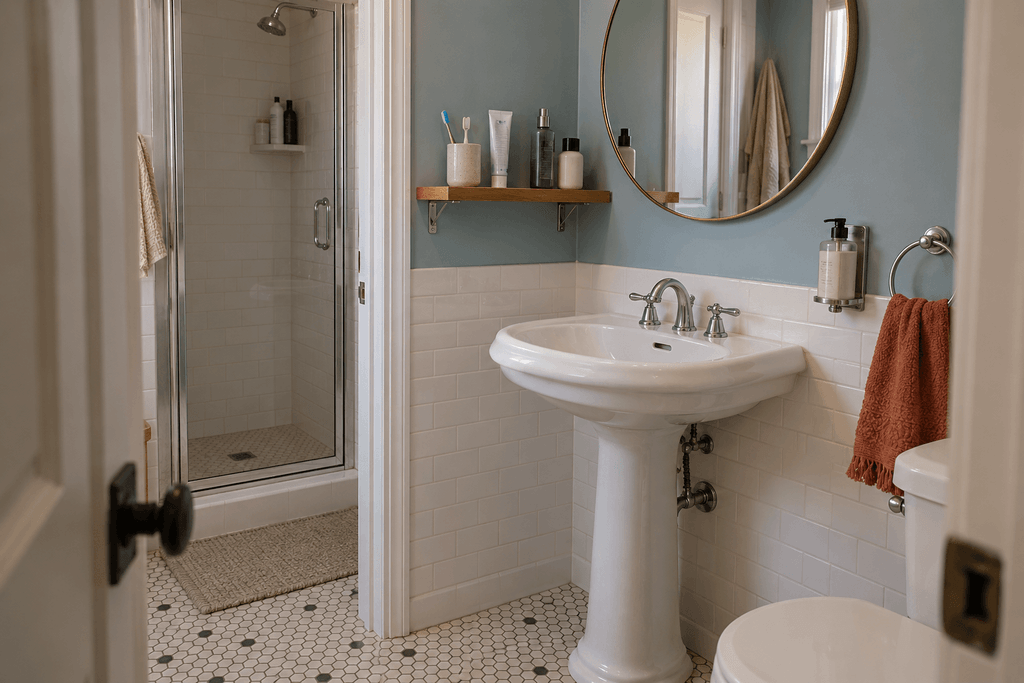
How to Organize a Small Bathroom With No Counter Space
Disclosure
This post may contain affiliate links. If you purchase through these links, I may earn a small commission at no extra cost to you. As an Amazon Associate I earn from qualifying purchases.
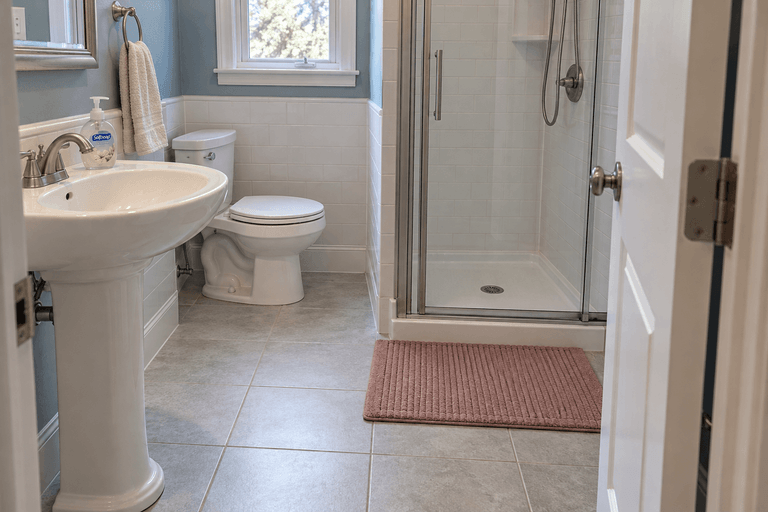
A bathroom can have a perfectly usable sink and still give you nowhere to put your toothbrush, moisturizer, or makeup bag. With a pedestal sink or a tiny vanity, the few inches around the basin quickly become a balancing act.
Small bathroom organization with no counter space starts with giving daily essentials an accessible home and deciding where you will set things while using them. Those are two different needs. A basket tucked into a cupboard may solve storage, but it won’t necessarily make getting ready easier.
You don’t need to squeeze a cabinet into every gap. Start with what you use, then choose storage that leaves enough room to wash your hands, open the door, and clean around the sink.
Start With the Items You Actually Use Every Day
Empty the sink area and separate your supplies into three groups:
- Daily essentials: Hand soap, toothbrush, toothpaste, and the skincare products you regularly use.
- Getting-ready supplies: Makeup, brushes, combs, and hair tools.
- Backups and occasional items: Unopened bottles, spare toiletries, and products you rarely reach for.
Keep the first group near the sink. Give the second group a kit or compartment you can bring out when needed. Store backups farther away.
That last step is important. If your bathroom has almost no storage, spare shampoo doesn’t need the most accessible spot in the room. A designated shelf in a nearby closet can work for unopened toiletries; keep their packaging instructions in mind.
Before buying an organizer, check whether you’re trying to store things you don’t use. An expired product or a bottle you dislike is still clutter when it sits in a matching basket.
Map Storage and Working Space Separately
Before buying anything, walk through your routine. For each group, name both its home between uses and the surface or location you need while using it.
| Routine | Home between uses | What must work during use |
|---|---|---|
| Washing hands | Soap in a stable holder within reach of the sink | You can operate the faucet without knocking it over |
| Brushing teeth | Accessible, cleanable holder or daily-use compartment | You can retrieve and return supplies without moving other bottles |
| Applying skincare | Small daily-use bin or reachable shelf | A stable place for the products you have open |
| Applying makeup | Portable kit on an existing shelf or in another room | A dry working surface, mirror, and adequate light |
| Using a hair tool | Storage appropriate to the tool’s instructions | A suitable dry location and somewhere to cool it as directed |
| Replacing an empty bottle | Identifiable backup location | You can find the replacement without emptying several containers |
This is a planning guide, not a requirement to add six organizers. Several routines can share a shelf or kit. The point is to spot missing working space before a new basket hides the problem.
For example, moving makeup into a pouch clears the sink, but if you have nowhere to set the pouch when applying it, the routine is still awkward. A bedroom desk already used for getting ready may solve that more directly than another bathroom cabinet.
Choose Storage That Fits Your Sink
For a Pedestal or Wall-Mounted Sink
Look beside the sink before looking underneath it. A shallow shelf or wall cabinet on an adjacent wall can put toiletries within reach without crowding the basin.
A freestanding unit may work if there is genuinely room for it. Check the pedestal, exposed pipes, baseboards, and the space where you stand. Furniture that technically fits beneath the sink may still interfere with your feet or make cleaning awkward.
For pedestal sink storage, prioritize easy access over filling the entire empty area. A small daily-use shelf and a grooming caddy stored elsewhere can be more useful than a bulky surround.
For a Tiny Vanity
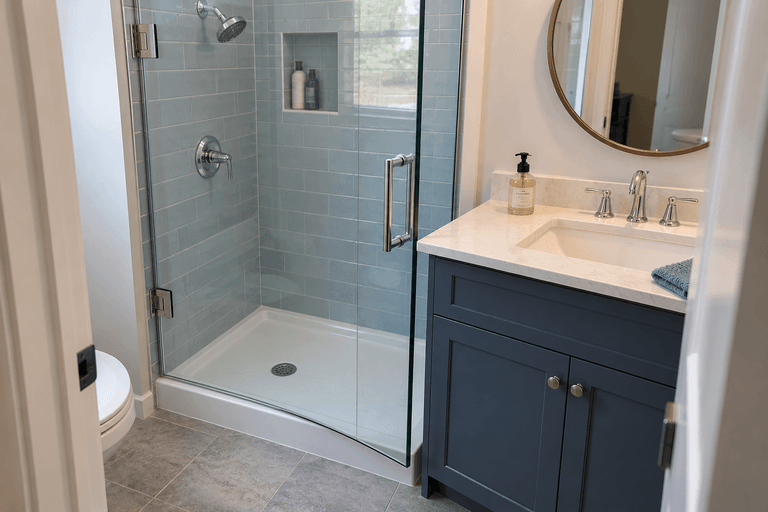
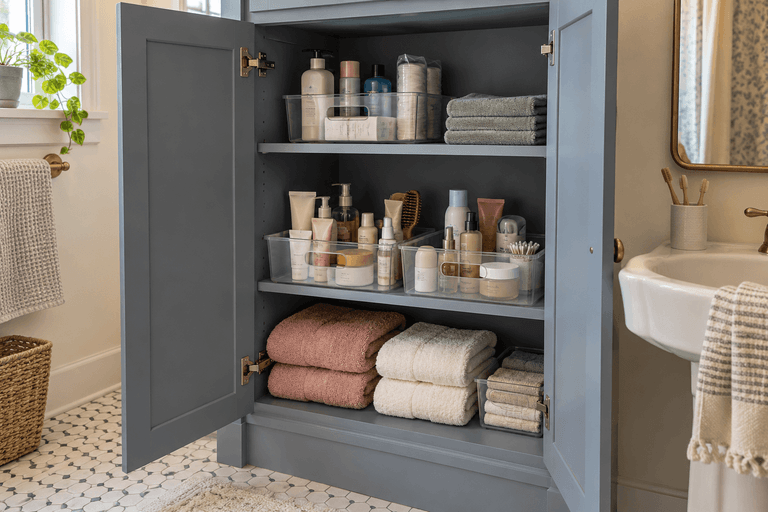
Use the cabinet for the supplies you reach for most. A removable bin near the front is a simple starting point, particularly when plumbing prevents a full-width organizer from fitting.
Measure around pipes and hinges, not just the cabinet opening. Check that a drawer can extend and that a bin can lift out without catching on the drain.
Avoid stacking daily products behind other containers. If retrieving face wash requires moving three baskets, the system will probably send it straight back onto the sink.
For a Bathroom With Almost No Spare Floor Space
Look for a suitable wall or door location. Keep storage shallow where people walk, turn, or lean toward the mirror.
An over-the-door organizer needs more than an available door. Its hooks must fit, the door must close properly, and loaded pockets must clear nearby fixtures throughout the door’s swing.
Read more about organizing a small bathroom with no drawers.
Give Daily Toiletries One Accessible Home
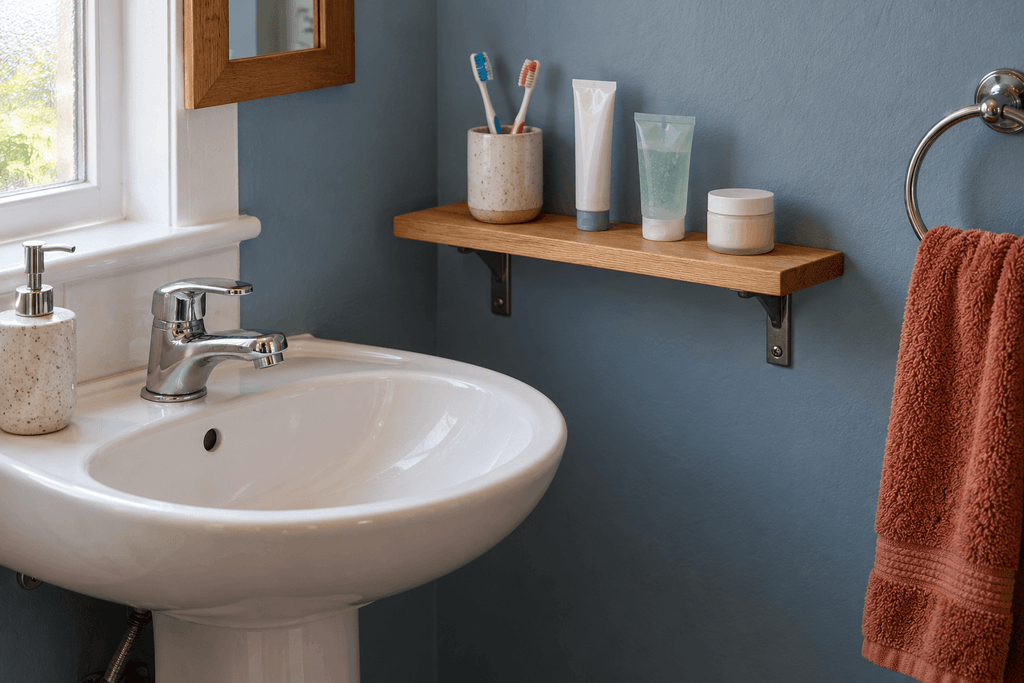
Choose one main location for your daily routine instead of scattering supplies across several organizers.
A shallow shelf beside the mirror works when mounting is permitted. A wall cabinet can conceal products if its doors open without interfering with the mirror or nearby fixtures. If neither is practical, use a small caddy on an existing shelf or inside the vanity.
Test the location before committing: stand at the sink and reach for the items. You should be able to retrieve them without leaning across the basin or stepping into an awkward corner.
Choose a toothbrush holder that allows water to drain and is easy to clean. Keep its location out of direct splashes rather than treating the sink rim as permanent storage.
Leave enough space to lift each bottle out. A shelf packed tightly with products may look organized, but it makes an everyday routine unnecessarily fiddly.
A Shelf-Fit Example
Suppose a shelf has 12 inches of usable width. Your toothbrush cup takes 3 inches, your skincare bottle takes 2.5 inches, and your soap dispenser takes 3.5 inches. Together they occupy 9 inches, leaving 3 inches total for separation and handling—not 3 inches around each item.
That arithmetic is only a first check. Trace the actual bases on paper, arrange them on the proposed shelf footprint, and check bottle overhang and pump operation. Then assess the shelf’s projection where you stand and lean toward the sink. A layout that fits on paper can still put a bottle in your way.
These are illustrative dimensions, not a tested installation or recommended universal shelf size.
Create a Getting-Ready Kit and Somewhere to Use It
A portable kit is useful for bathroom storage without counter space because it keeps supplies together without leaving everything on display.
Choose a washable caddy or pouch that holds your actual routine. Separate small items so you don’t have to empty the whole container to find a lip balm or hair tie.
But decide where the kit will go while you use it.
If there is a stable shelf beside the sink, make sure it can accommodate the supplies you bring out. If there isn’t, consider doing makeup at a bedroom desk or another suitable dry surface with a mirror and adequate light.
A designated getting-ready spot outside the bathroom can also reduce pressure on a shared bathroom. You can wash your face at the sink, then move the rest of your routine elsewhere.
Avoid balancing a tray across the basin or using the toilet lid as a default work surface. The goal is a dependable routine, not another temporary pile.
Keep electrical hair tools away from water and follow their instructions. Let hot tools cool as directed before putting them into storage.
Add Narrow Floor Storage Only If It Leaves Room to Move
A slim cart can be useful beside a vanity, but “slim” is a product description not proof that it fits your bathroom.
Measure the gap at its narrowest point, including trim and projecting fixtures. Identify which product dimension runs across that gap; a listing may call it width or depth.
Then check how you will use it:
- Can you pull it out without moving something else?
- Can you reach the lower shelves?
- Does it clear the door and vanity drawers?
- Can you still stand comfortably at the sink?
- Can you clean behind it?
If a cart works, use its easiest-to-reach shelf for daily supplies and lower shelves for less frequent items. Keep bottles upright and within the shelf edges.
If it makes you turn sideways to use the sink, leave it out. Moving backups elsewhere is a better solution than sacrificing usable floor space.
Store Shower Products Where You Use Them
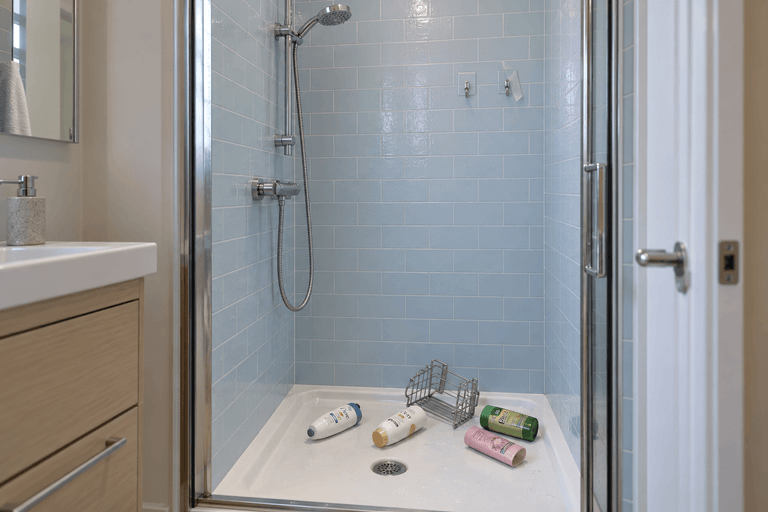
Shampoo, conditioner, and body wash don’t need to occupy the sink area when you use them in the shower.
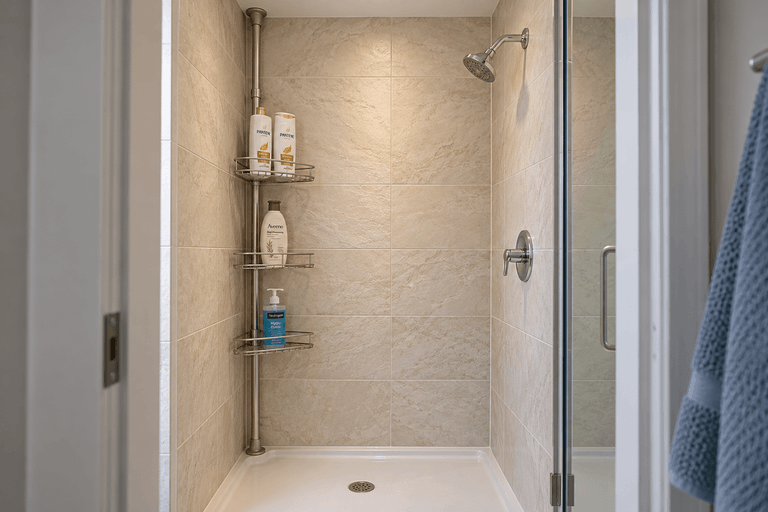
A hanging caddy, suitable mounted basket, or tension unit may help. Choose the type around your actual shower fixtures and available space.
Check that it doesn’t interfere with controls, the shower door, or where you stand. Follow the manufacturer’s installation guidance rather than assuming every showerhead or surface can support the same organizer.
Choose storage that drains and can be cleaned. Keep only the bottles currently in use there; refills can stay in your backup location.
Read storage options for a small shower with no shelves
Check the Mounting Requirements Before Choosing Renter-Friendly Storage
“No drilling” doesn’t automatically mean suitable for every rental.
For adhesive accessories, check the exact product’s approved surfaces, preparation steps, load limit, and removal instructions. Bathroom products may have different requirements from ordinary wall hooks.
Don’t replace supplied adhesive with unrelated strips and assume the original load rating still applies. Remember that bottles, containers, and their contents all contribute to the load.
For drilled shelves or cabinets, get permission where your lease requires it and use mounting appropriate to the wall and product. If you cannot establish a suitable mounting location, choose another storage method.
Three Small-Bathroom Setups to Copy
Pedestal Sink With an Available Side Wall
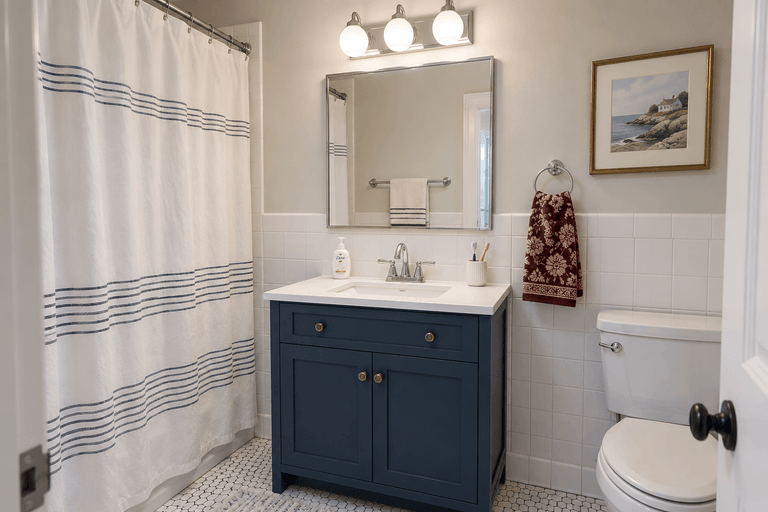
Place a shallow, appropriately mounted shelf beside the sink for daily toiletries. Keep hand soap in a suitable holder and store makeup in a portable kit on a nearby shelf or in another room.
Put backup bottles outside the bathroom. Leave the pedestal and surrounding floor accessible for cleaning.
This arrangement suits a bathroom where the main missing feature is a place for daily essentials.
Tiny Vanity With a Usable Cabinet
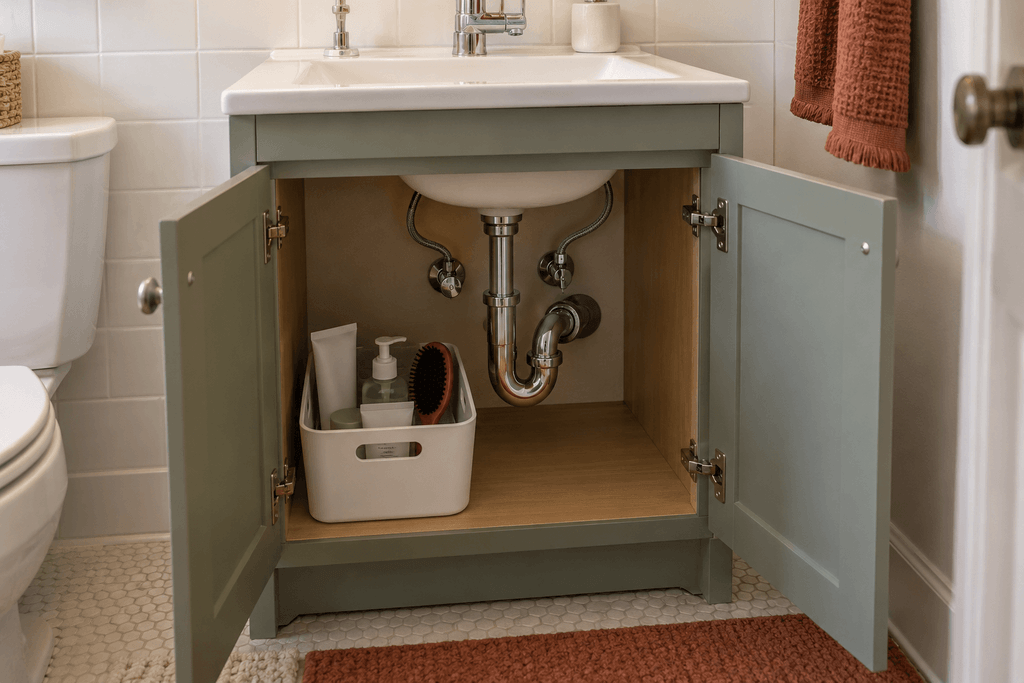
Place a removable daily-use bin near the front of the cabinet. Give grooming supplies a separate compartment, and move shower products into the shower.
Keep the sink edge clear enough to use and wipe down. Check that the cabinet storage remains accessible around plumbing.
Learn how to organize deep bathroom cabinet shelves.
Bathroom With No Spare Floor Space
Use a suitable shallow wall cabinet or door organizer if the room and mounting conditions allow it. Keep only daily supplies in the bathroom, and store a portable grooming kit elsewhere.
If no safe, practical storage location exists near the sink, don’t force one. A nearby dry getting-ready area may serve you better than furniture wedged into the walkway.
Check the Setup Through One Complete Routine
Put the actual daily supplies in the proposed locations, using existing stable storage before buying or mounting anything. Wash your hands, retrieve your skincare, bring out your grooming kit, and put it away.
Check what you have to move. If opening the kit requires clearing the shelf first, separate its working space from its storage space. If a new unit blocks your feet or the cabinet door, change the location rather than accepting that inconvenience as the price of storage.
Afterward, check whether you can wipe the sink, remove the bin, and reach the plumbing. A setup that works for getting ready should also leave the bathroom maintainable.
Start with one daily-use location and one place to use your grooming supplies. Add storage only for a specific problem that remains. The aim is a bathroom you can use and clean comfortably, even when the basin has almost no surrounding counter.
One Comment
Comments are closed.