Why IKEA Small Bedrooms Look Bigger Than They Are
You look at an IKEA bedroom and see a bed, clothes storage, somewhere to work, and enough space to move around. Then you look at your own room and wonder why adding a laundry basket seems to use up the last available corner.
So, why do IKEA small bedrooms look bigger than they are? In the examples below, furniture serves several purposes, storage fits into otherwise unused space, and the visible belongings form a coordinated display. Mirrors and lighting also influence the impression of the room.
Some of those choices can free up floor space. Others simply make the same space look less crowded. Knowing the difference helps you decide which IKEA small bedroom ideas are worth copying and which might look good in a photograph but be awkward in your home.
1. The Furniture Works With the Room’s Awkward Corners
A small bedroom becomes harder to use when the furniture ignores its shape. An alcove, a door that opens into a corner, or an awkward gap beside the bed can rule out an otherwise sensible arrangement.
In IKEA’s makeover of Olly and Sophie’s bedroom, an alcove behind the door was too tight for a wardrobe with swinging doors. The stylist used open clothes storage there instead.
The useful lesson is to check how furniture operates, rather than judging only whether its dimensions fit.
A wardrobe can fit against a wall while its doors block your route to the bed. A desk can fit into a corner while leaving nowhere to pull out the chair. Those problems will remain even if the furniture is attractive.
Before moving or buying anything, mark its footprint with painter’s tape. Then account for the space it needs when opened or used. Walk through your usual routine: entering the room, getting dressed, sitting down, and reaching the bed.
Choose furniture proportioned to your room and storage needs a smaller piece isn’t helpful if it holds too little and forces you to add several more.
A better small bedroom layout starts with access. Finding a home for every piece comes after that.
2. The Bed Provides More Than Somewhere to Sleep
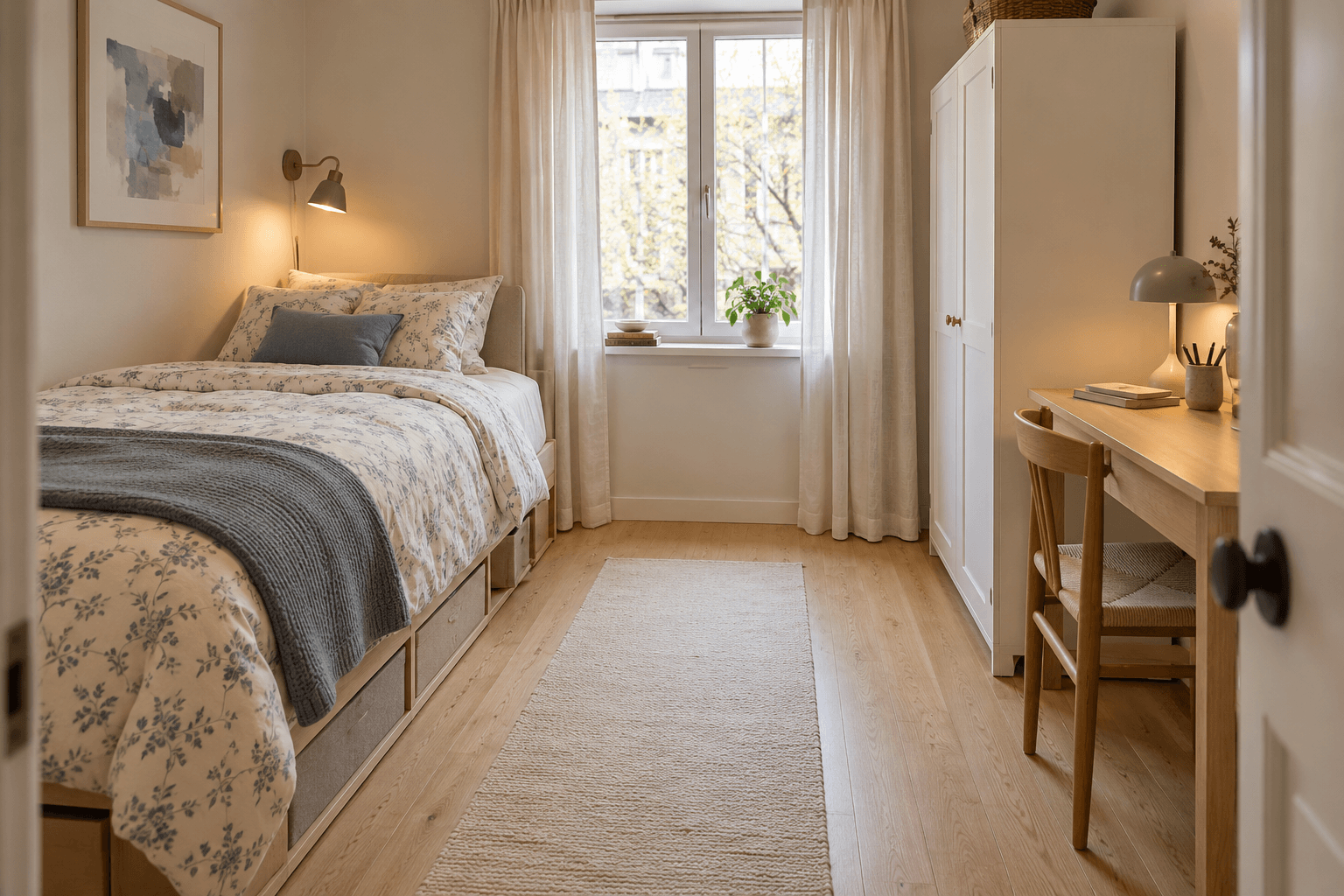
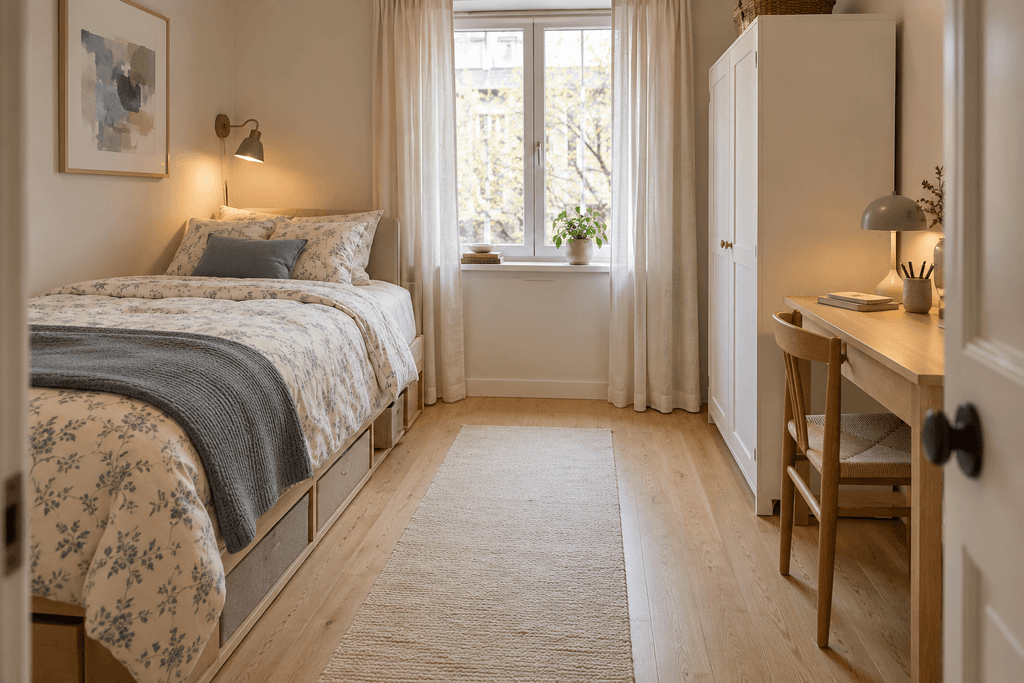
The bed occupies a substantial part of a small bedroom. Using the space beneath it can reduce the need for another storage piece.
The same IKEA makeover uses a lift-up storage bed. In a separate small, calm and organized bedroom example, IKEA shows a pull-out bedside storage unit that tucks beneath the bed.
These are two different approaches to small bedroom storage. One offers hidden capacity; the other lets a bedside surface move out of the way.
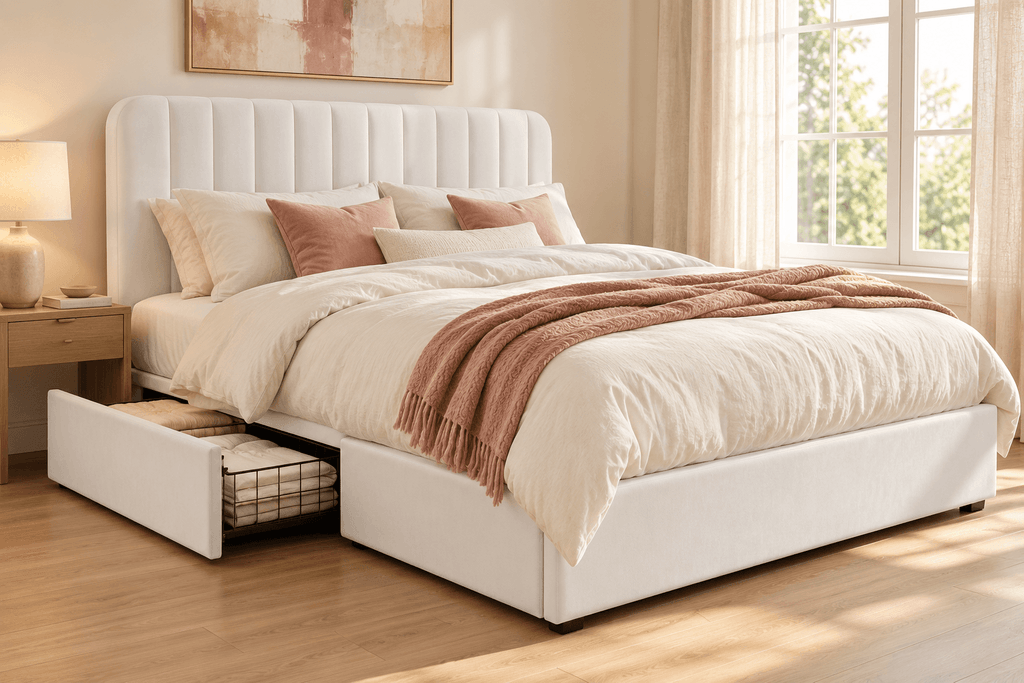
Neither is automatically the right choice for your room. Underbed drawers need room to extend. A rolling container needs a clear route out. A lift-up base needs enough clearance to open and must be manageable for the person using it.
Start by checking your existing bed. Could suitable containers hold spare bedding or seasonal clothing? Would that empty enough space elsewhere to remove a freestanding unit?
Moving possessions under the bed only frees floor space if it reduces what needs to stand around it. Otherwise, you have gained storage capacity, which may still be useful, but the layout stays the same.
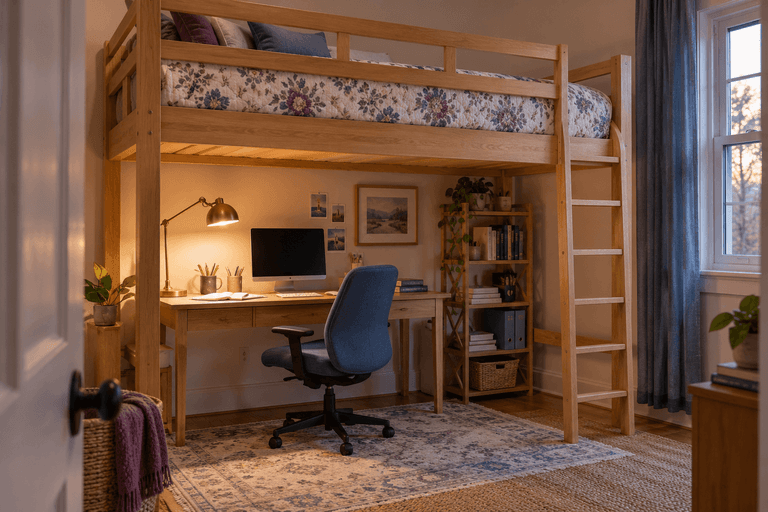
3. One Wall Can Handle Storage And a Workspace
Several individual pieces can create a crowded arrangement: a clothes rack here, a desk there, and a shelf squeezed between them.
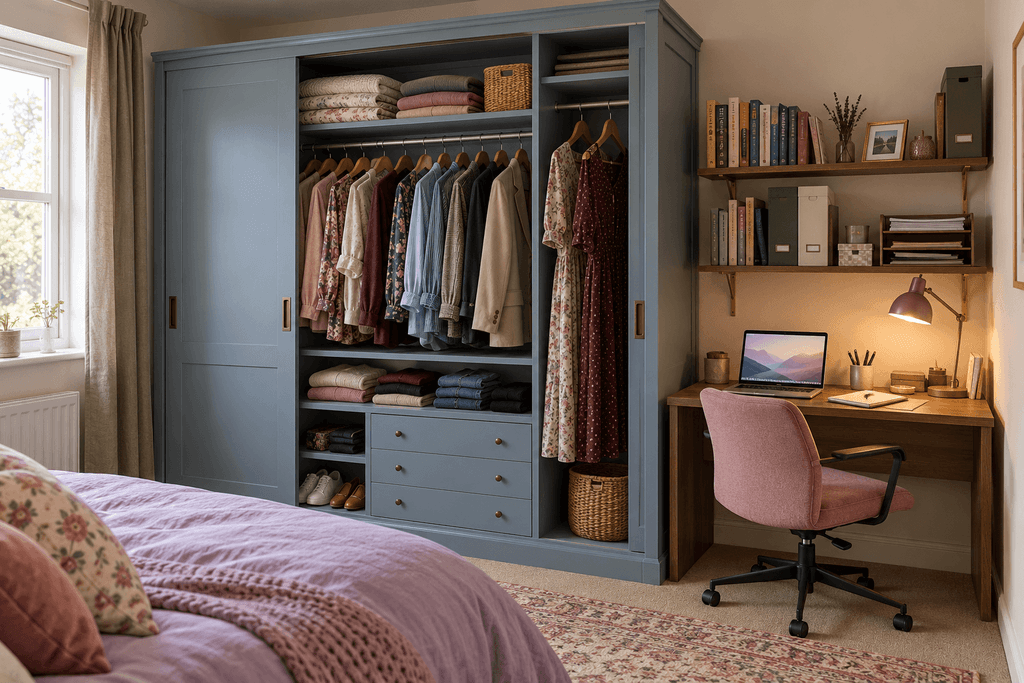
IKEA’s organized bedroom example combines clothes storage and a work surface along one wall. It demonstrates how related functions can share an area instead of spreading across the room.
You do not need to replace everything with a fitted system to apply that idea. First, ask whether your existing desk and storage could sit together more sensibly. Keep frequently used items within reach and reserve harder-to-reach space for things you rarely need.
The limit is depth. Shelving still projects into the room, and a chair still needs somewhere to go when someone is sitting in it. Storage above a desk can also become inconvenient if accessing it requires clearing the work surface every time.
For renters, mounting requirements belong in the decision from the beginning. Check your lease and the furniture’s installation instructions before choosing a wall-mounted arrangement.
4. The Belongings On Show Are Carefully Contained
Open storage is easy to admire when its contents are arranged neatly. Living with it can be a different experience.
In IKEA’s neutral bedroom example, coordinated boxes contain belongings while selected objects remain on display. That gives the shelves a more consistent appearance than a collection of unrelated packaging and loose items.
This is a useful difference when choosing from the various IKEA small bedroom storage ideas: capacity tells you how much a unit holds; visibility tells you how much of that collection you will see every day.
Look at what you actually need to store. Clothing, toiletries, charging cables, paperwork, and spare bedding do not all need the same solution. Some items are easy to keep on open shelves. Others are better suited to drawers, doors, or containers.
Before buying matching boxes, group your belongings and measure them. Attractive containers that do not fit your possessions can become another layer of clutter.
You also do not need to fill every shelf with decorations. Leaving some space available makes the arrangement easier to maintain when ordinary life adds a book, a bag, or tomorrow’s clothes.
5. Mirrors And Lighting Help the Room Read Differently
IKEA’s organized bedroom includes a mirror reflecting a window. Its bedroom lighting guide also recommends planning light around activities such as reading and getting dressed.
When considering how to make a small bedroom look bigger, pay attention to what a mirror would reflect. A clear part of the room or a window creates a different view from an overflowing rack or a crowded doorway.
Test the position before fixing it in place. Check the reflection from the doorway and from the bed, rather than only from where you stand to get dressed.
For lighting, start with the task you struggle to see. Can you read comfortably in bed? Can you find clothes without lighting the whole room? Is the desk usable after sunset?
Choose a lamp and position that solve that problem without obstructing your route. A wall lamp may save bedside surface space where mounting is permitted; a compact table lamp may suit a room where it is not.
A mirror can change the view, and lighting can improve visibility. Neither fixes furniture that blocks a door or leaves too little room to move.
6. The Colors Work Together Without Everything Being White
IKEA’s makeover of Olly and Sophie’s bedroom offers a useful counterexample to the idea that small bedrooms must be white: its stylist recommends bright colors against a dark base as one possible combination.
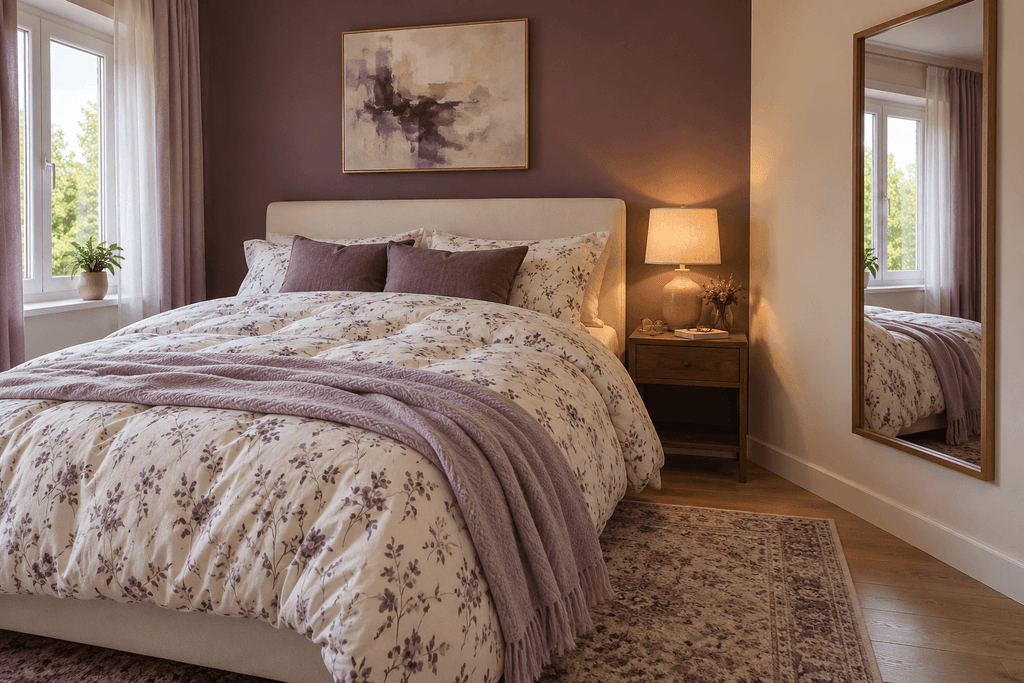
For your own room, the more practical starting point is coordination. Choose a few colors already present in your bedding, artwork, or furniture and repeat them where it makes sense.
For example, floral bedding could supply the colors for a plain curtain and a storage basket. You can keep the pattern while giving the rest of the room a consistent direction.
Avoid turning this into a shopping requirement. Replacing every visible object to achieve a perfectly matched room is expensive and unnecessary. Begin with the largest surfaces and the belongings you can organize using what you already own.
What to Check Before Copying an IKEA Bedroom
A room photograph can show an arrangement clearly without showing every step of using it. Before copying one, check:
- Furniture dimensions: Include the full frame, handles, and projecting parts.
- Opening space: Allow for doors, drawers, and pull-out storage in use.
- Bed access: Consider changing the sheets and getting in and out.
- Chair space: Check the position with someone seated, not just with the chair tucked away.
- Your belongings: Assess whether the storage holds your actual clothes and everyday items.
- Power and mounting: Check outlet locations, cord routes, and installation requirements.
- Cleaning access: Consider how you will reach beneath and behind the furniture.
The best idea to borrow is the one that solves a problem you already have. A layout can be beautiful and still be wrong for your room or routine.
Start With the Part of Your Bedroom That is Hardest to Use
Choose one blocked route, one collection of belongings without a proper home, or one task with poor lighting.
Try a change using what you have: move a piece, regroup stored items, or reposition a lamp. Live with it long enough to find out whether getting dressed, working, and making the bed become easier.
That is the useful takeaway from these IKEA small bedroom ideas. A room feels more workable when its furniture and storage support the way you use it. The photograph can inspire the change; your daily routine decides whether it works.