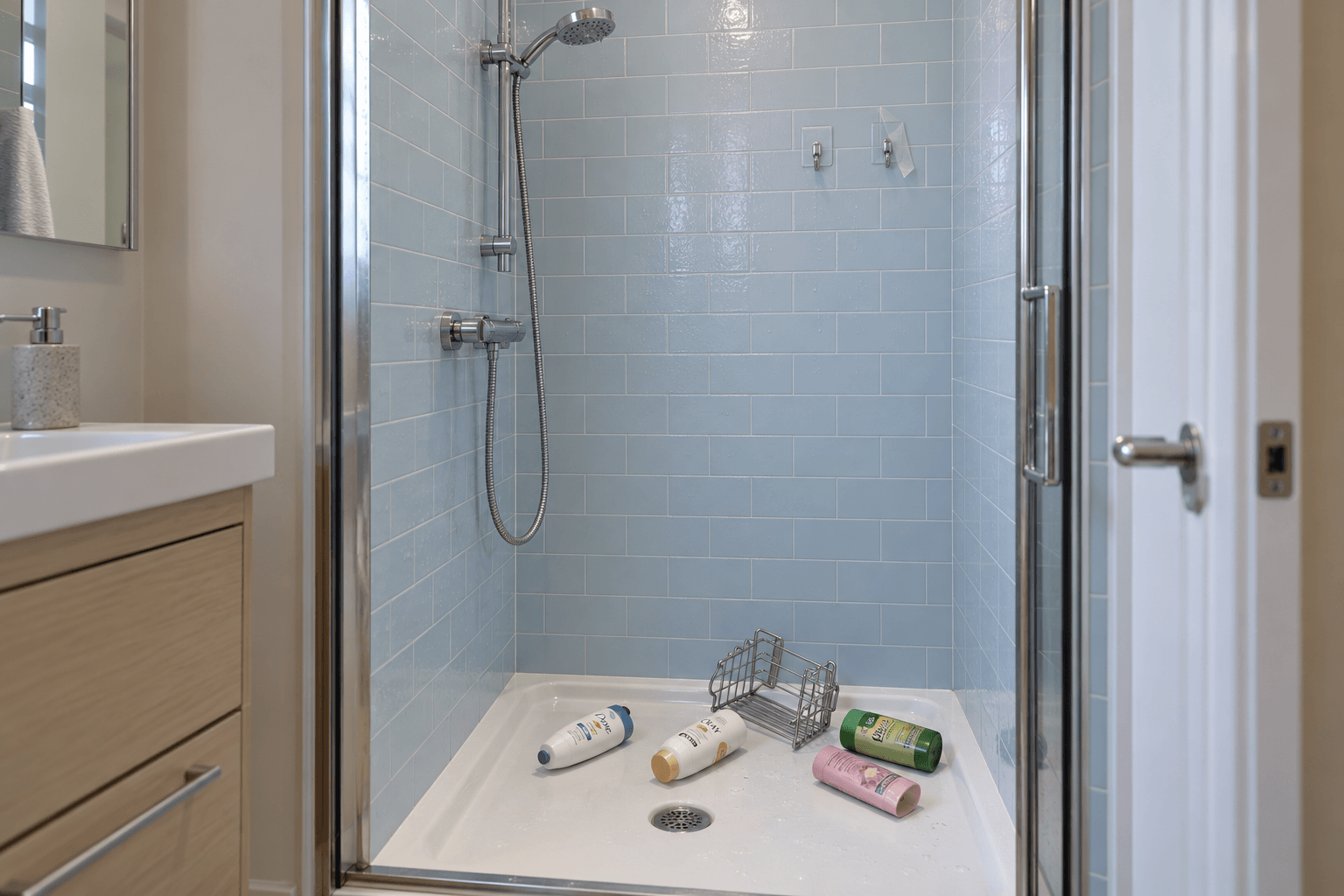
Why Your Adhesive Shower Shelf Keeps Falling And When To Change The Mount
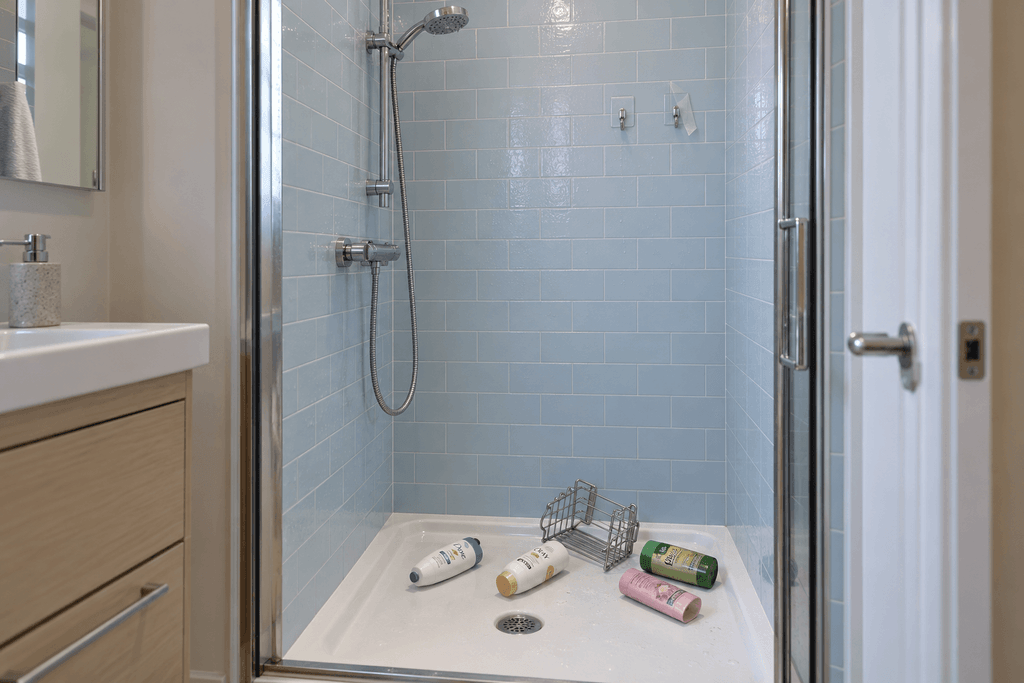
Disclosure
This post may contain affiliate links. If you purchase through these links, I may earn a small commission at no extra cost to you. As an Amazon Associate I earn from qualifying purchases.
An adhesive shower shelf seems like an easy answer to a small bathroom: bottles off the floor, no drilling and nothing bulky standing in the corner. Until the shelf falls and putting it back becomes another bathroom chore.
If your adhesive shower shelf keeps falling, unload it and check what actually failed before buying stronger adhesive. The problem could be an unsuitable wall surface, installation requirements, the way the shelf is loaded or damaged mounting hardware. Replacing the adhesive only addresses some of those problems.
The useful question is whether this particular shelf can be installed correctly on this particular wall and still hold what you need within its stated limits.
First, Check What Actually Came Off
Remove the bottles and keep the shelf out of use while you inspect it. If part of the mount is still attached, follow its removal instructions rather than pulling the remaining piece away from the wall.
Look at the wall, adhesive pad or glue, bracket and basket separately:
- The adhesive pad peeled away from the wall: Check surface compatibility and the installation instructions before replacing it.
- The adhesive stayed on the wall but separated from the bracket: Check how that bracket attaches and whether its parts can be replaced.
- The wall mount stayed attached but the basket came off: Inspect the basket’s clips, hooks or locking connection.
- A bracket or basket connection cracked, bent or broke: New adhesive will not repair that damaged part.
These are starting points, not a way to diagnose the exact cause from one photograph. A lifted corner, for example, does not establish whether the issue was the wall, the load or the installation.
Take a few photos before removing everything. Include the shelf model, the failed connection and the wall surface. Those details make a manufacturer support request more useful than simply reporting that the shelf fell.
Check Whether The Mount Belongs On Your Shower Wall
Find the instructions for the exact shelf, including the approved surfaces and whether it is intended for use inside a shower. A product described as suitable for a bathroom may have more specific restrictions for a wet shower wall.
Also identify the mounting system. Suction cups, adhesive pads and glue-mounted brackets have different requirements. Advice for restoring a suction seal does not automatically apply to an adhesive pad.
Check the actual contact area. Does the pad sit entirely on an approved surface, or does it cross a recessed grout line? Is the tile flat where the mount sits? Does the wall have a coating or finish excluded by the instructions?
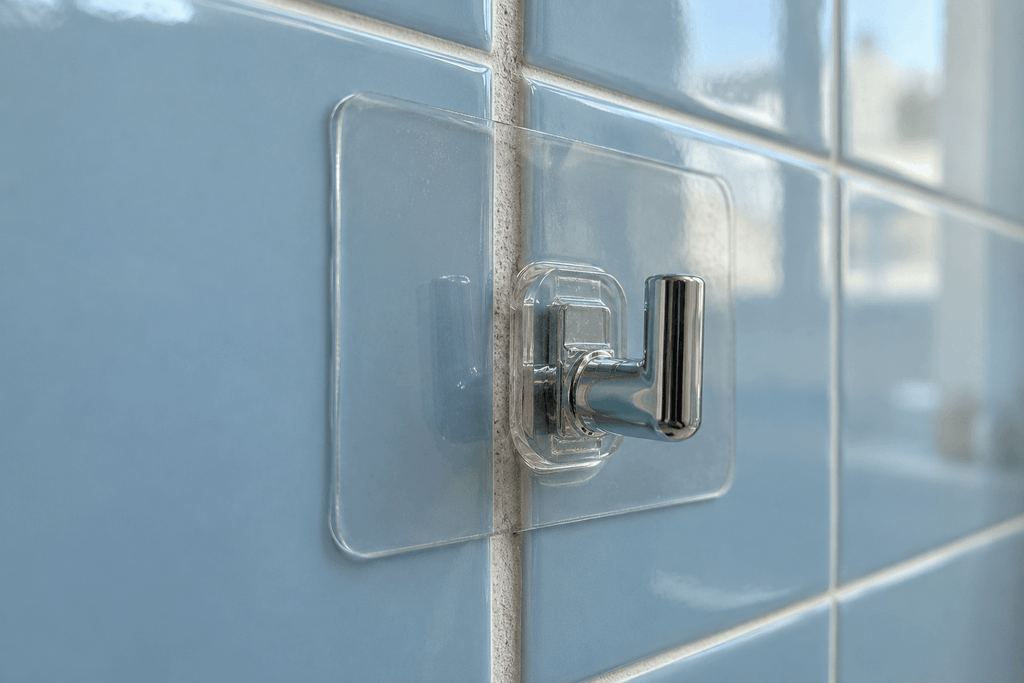
Command, for example, advises against heavily textured surfaces because its strips may not make full contact. That does not establish a rule for every adhesive system. ShowerGem lists certain textured tiles among its compatible surfaces, while excluding materials including laminate, wallboard and vinyl. Check your exact material against the specific manufacturer’s list.
If surface compatibility is the obstacle, our guide to shower storage for textured tile covers alternative mounting approaches. Repeatedly replacing a pad is unlikely to be a useful plan if that pad was never intended for the wall.
Review The Installation Before Trying Again
If the shelf and surface are compatible, work through the original installation instructions. This is a check, not an assumption that you installed it badly.
Pay attention to:
- The approved cleaning method and any prohibited cleaners.
- Whether the surface must be completely dry before application.
- The required pad position, glue quantity or bracket preparation.
- Any pressure and application-time requirements.
- How long the mount must remain unloaded, and whether it must stay dry during that period.
There is no universal “wait 24 hours” rule for adhesive shower shelves. For example, the tesa MOON White shower basket using its Power.Kit system specifies a 12-hour curing period. ShowerGem specifies 24 hours before attaching its caddy. Those instructions belong to those systems; they are not interchangeable.
Cleaning advice also needs to match both the mounting product and the wall finish. Do not assume that an abrasive cleaner, solvent or online adhesive-removal trick is suitable for your shower panel or tile coating.
If you no longer have the packaging, look for a model number on the order confirmation or product label. If you cannot identify the shelf or obtain clear instructions, you cannot confidently establish its approved surface, replacement adhesive or installation procedure.
Check The Bottles And How You Use The Shelf
A shelf should suit your normal routine, including freshly refilled bottles. A setup that only works when the shampoo is nearly empty is not a practical fit.
Check the stated load limit and what it includes. Then weigh the items you actually intend to store. Include full shampoo and conditioner bottles, body wash, soap dishes and anything hanging from the shelf’s hooks.
A liquid volume on a bottle is not its total weight. Weigh the filled containers rather than using fluid ounces as though they were weight ounces.
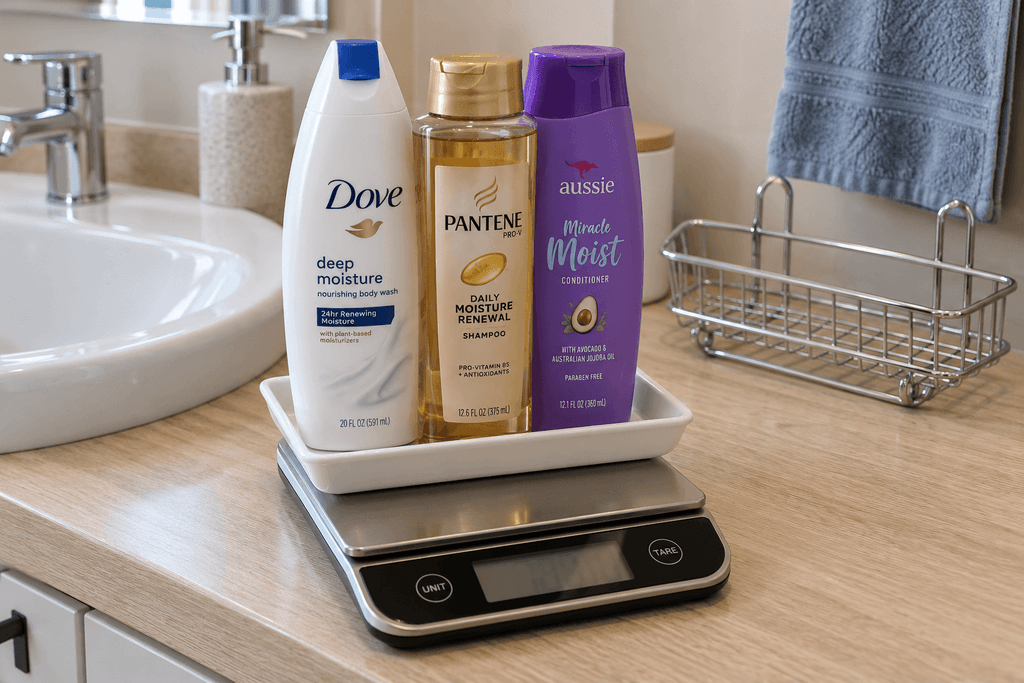
Look beyond the total, too. Are the heaviest items concentrated at one end? Have you added hanging storage that the shelf instructions do not cover? Does a bottle catch on another item when you lift it out?
Pressing a pump while its bottle sits on the shelf adds a push beyond the bottle’s resting weight. Check whether the manufacturer permits this. If it does not, lift the bottle off before dispensing or choose a storage setup that suits how you use your products.
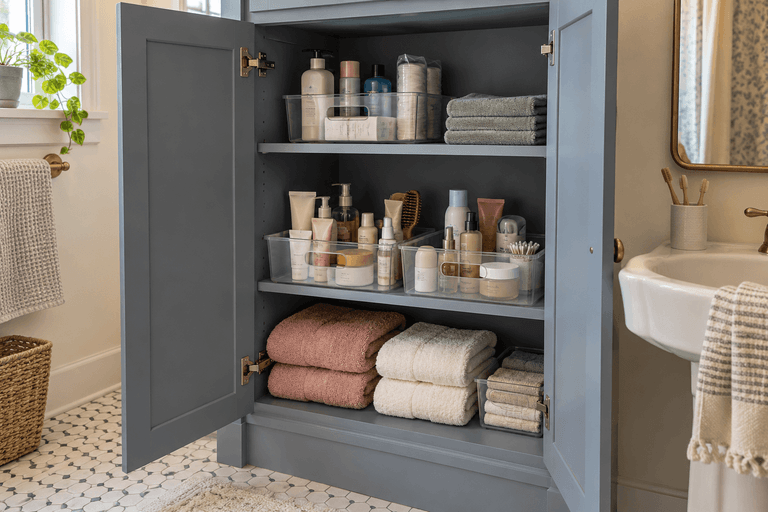
For a small shower, start with the toiletries you use during a normal wash. Move refills and occasional treatments elsewhere. Our guide to organizing deep bathroom cabinet shelves explains how to keep those backups accessible without crowding the shower shelf.
What If The Shelf Held For Months Before Falling?
A shelf that worked initially still needs checking before it goes back up. Past performance does not show that its current adhesive and hardware are sound.
Think through what changed:
- Did larger or additional bottles move onto it?
- Was the basket removed for cleaning and reattached differently?
- Did anything strike, snag or pull on it?
- Is the bracket damaged, or is an adhesive edge lifting?
- Has the wall finish loosened or come away with the mount?
These clues can help narrow the problem, but timing alone does not prove that steam, age or a particular cleaner caused the failure.
If the surface and load appear to meet the instructions and you cannot explain the failure, contact the manufacturer with your photos. Ask whether the hardware can be reused and which replacement mounting parts are approved. Do not reload a partly detached shelf to see how much longer it lasts.
Can You Reuse Shower Caddy Adhesive?
Separate the reusable shelf from its adhesive. Being able to reuse the basket does not mean the old pad or glue can be used again.
For example, standard Command strips are single-use. Command directs users to fit the correct replacement strip type and size for the product. ShowerGem similarly requires fresh glue when moving its mounting system.
For another brand, check its own instructions rather than transferring either rule to it.
Before ordering replacement adhesive, confirm:
- It is approved for your exact shelf or bracket.
- It is compatible with the shower wall material.
- It is intended for the wet conditions where you will use it.
- The remaining hardware is undamaged and approved for reuse.
A replacement pad that looks the same size is not enough to establish compatibility. Nor does adding more strips automatically increase capacity; Command specifically warns against assuming that it does.
Avoid layering fresh tape over old adhesive or adding glue around a lifting pad unless the manufacturer explicitly instructs it. That creates a different installation from the one covered by the product directions and can complicate removal.
When Reinstalling Makes Sense and When To Stop
Reinstallation makes sense when you can identify an approved setup: the right surface, sound hardware, the correct fresh mounting material and a load within the product’s instructions. You also need to be able to complete the required preparation and waiting period.
Change the plan if the wall is excluded, the bracket is damaged, approved replacements are unavailable or your everyday toiletries exceed what the shelf can hold.
If it falls again after a correctly completed installation, stop repeating the same repair. Ask the manufacturer to assess the failure or move to another suitable mounting method. Another fall is useful information, not a reason to keep trying increasingly strong adhesives.
Choose An Alternative That Still Fits Your Small Shower
Changing the mount does not necessarily mean adding a large floor unit. Look at the supports your shower actually offers.
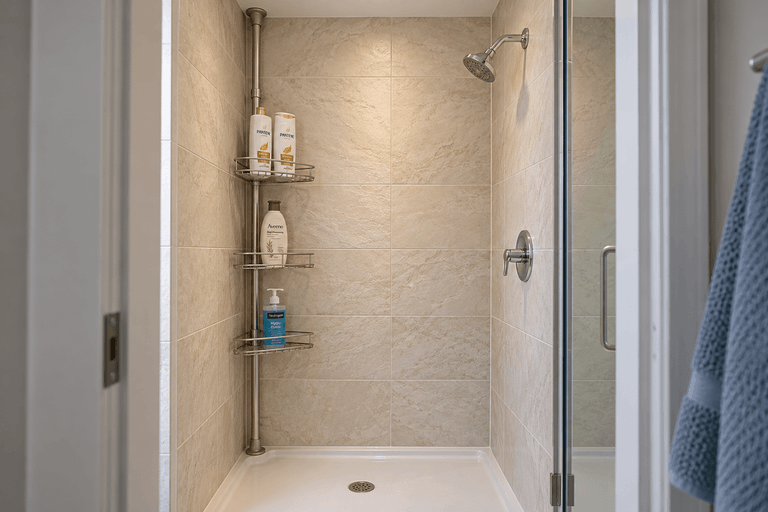
A hanging caddy may work when the product is approved for the support you have and can be stabilized as instructed. Check that it does not interfere with shower controls, a handheld hose or a moving door. Do not assume an exposed pipe or shower arm can support any loaded basket.
A tension caddy needs suitable upper and lower contact surfaces and the correct height range. Check the manufacturer’s restrictions before pressing it against a ceiling, tray or other shower surface.
A portable toiletries basket can work when there is a stable, reachable place to set it during use and a suitable place for it afterward. It is less helpful if it has to sit in the standing area or blocks the shower exit.
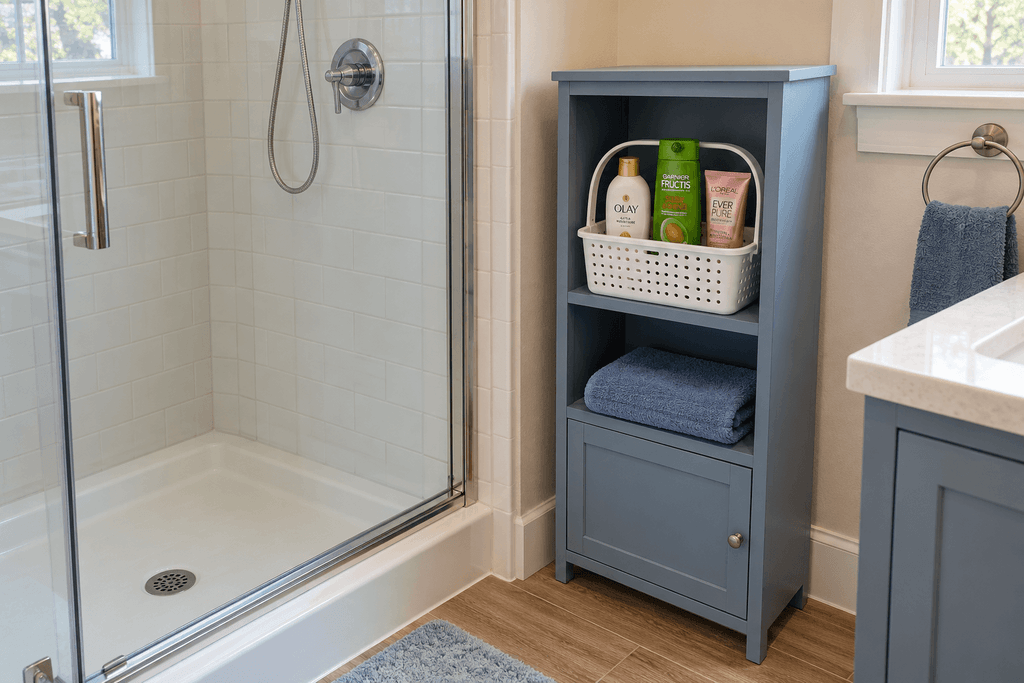
If the shower itself cannot accommodate more storage, consider a daily-use kit stored nearby. Our guide to organizing a small bathroom with no counter space can help you find a usable home outside the shower.
The best fix is a shelf and mounting system that fit your wall, your available space and your normal bottle load. Once those agree, you can decide whether replacing the adhesive is a sensible repair or whether it is time to stop putting the same shelf back up.