Where To Put A Bath Mat In A Small Bathroom When Everything Is Close Together
Disclosure
This post may contain affiliate links. If you purchase through these links, I may earn a small commission at no extra cost to you. As an Amazon Associate I earn from qualifying purchases.
A bath mat looks simple until the bathroom door pushes it against the pedestal sink, the shower door catches its edge or the only available position puts it halfway beneath the toilet.
Bath mat placement in a small bathroom starts where your feet actually land after bathing. From there, check that the mat lies flat, works with the floor and leaves doors and fixtures usable. A mat centered neatly on the room is not much help if you must step across wet tile to reach it.
This guide covers mats used on the bathroom floor outside the shower or tub, not suction mats designed for use inside them.
Start Where Your Feet Actually Land
Look at the part of the shower or tub you normally exit. With the water off and the floor dry, check the ordinary movement of stepping out, including opening the enclosure if there is one.
The mat should provide a reachable landing area without requiring you to stretch sideways or aim for a tiny patch between fixtures.
Do not assume it must run along the entire tub or sit in the center of the shower door. A tub’s usable exit may be toward one end; a sliding enclosure may open on only one side.
Once you have identified that location, check the surrounding floor. Can a mat sit there fully spread out? Does it touch a door, curl against a cabinet or interfere with the way you stand?
Choose useful coverage before decorative balance. Then decide what size and shape can provide it.
When The Shower Faces The Vanity
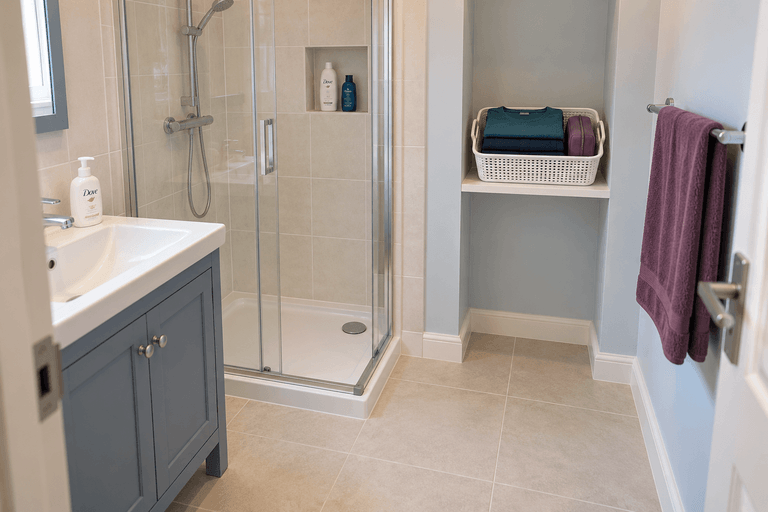
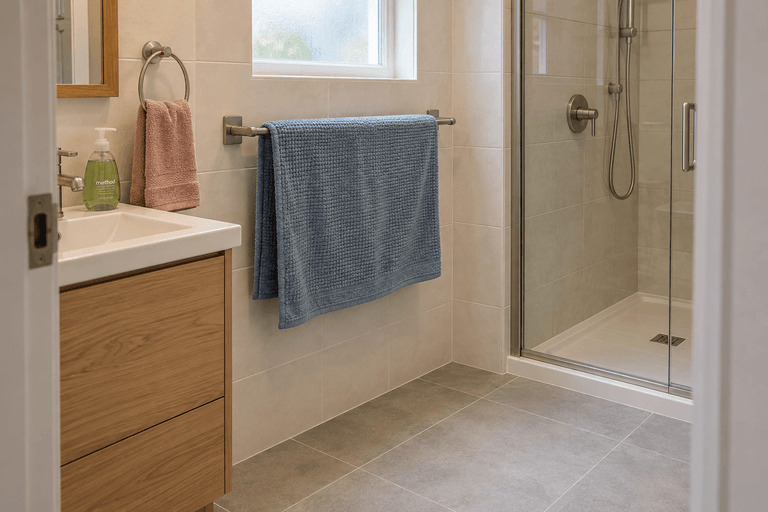
In a compact bathroom, the shower exit and the place where you stand at the sink may face each other across a narrow strip of floor.
One mat can sometimes serve both positions. But it must reach the actual shower exit and the sink standing area without bunching against the vanity or obstructing either door.
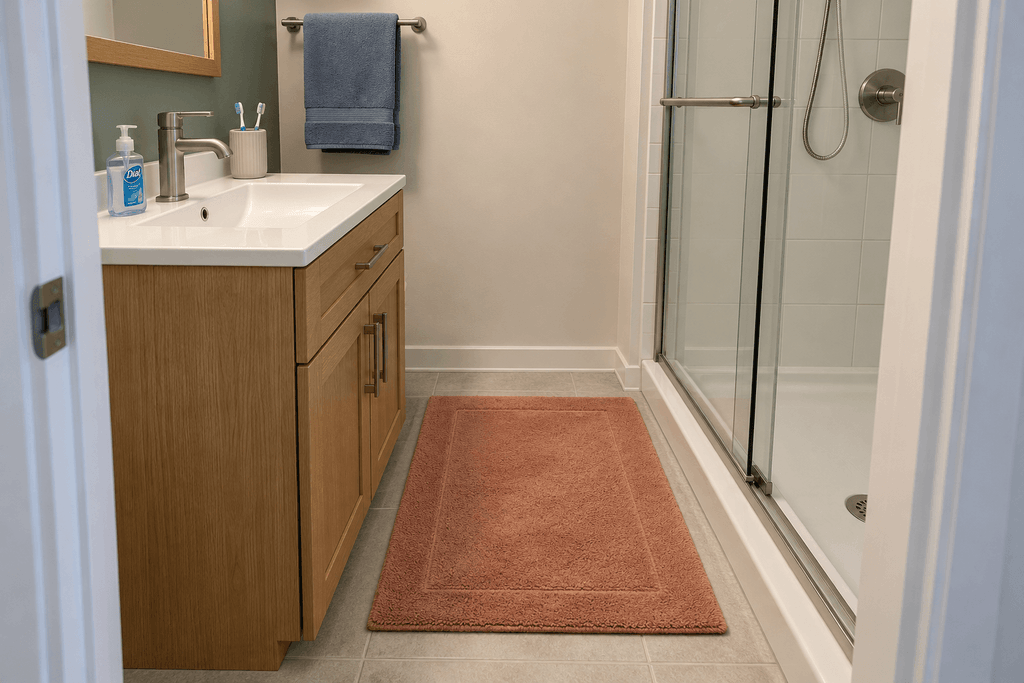
Start with the shower landing position. Then see whether that same mat also sits comfortably beneath your feet at the basin.
If centering it between the two fixtures leaves bare tile exactly where you step out, it is serving the composition better than the routine. Move it toward the bathing exit rather than stretching to reach it.
Two mats are not automatically better. If their edges overlap, or you have to shift one to make room for the other, use one suitable mat and reconsider whether the vanity needs a separate rug.
If toiletries and organizers also crowd the sink area, our guide to organizing a small bathroom with no counter space addresses that separate storage problem.
When The Bathroom Door Catches The Mat
First establish whether the problem is height or position.
A plush mat may sit in an otherwise useful location but be too thick for the door to pass over. In that situation, a lower-profile alternative may help provided the complete mat, including any permitted underlay, clears the door without brushing or dragging.
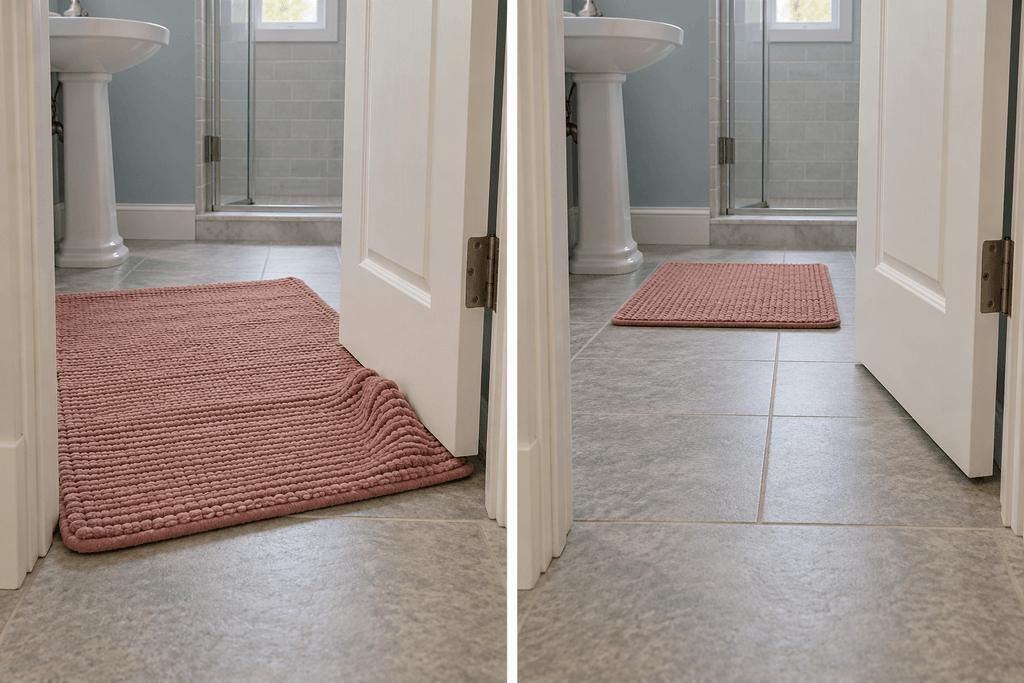
A mat can also extend into the door’s sweep where it does not belong. Changing its orientation or footprint may address that problem. A thinner version of the same oversized mat may not.
Check the door through its full normal movement. Watch the mat’s edge as well as its center: a hem that flips up can become the point where the door catches.
For an illustrative example, suppose the gap beneath a door is 3/8 inch and the proposed mat is 1/2 inch thick. That mat cannot clear the gap as specified. A thinner product is only a candidate; uneven flooring, edge thickness and any required pad still need checking.
Do not judge fit by compressing the pile with your hand. The door should operate without you holding the mat down or pushing it away.
Repeatedly moving the mat just to open the door is a compromise, not a successful permanent position.
When The Shower Door Swings Over The Mat
The shower door and bathroom door may create different conflicts. Check them separately.
A hinged enclosure can swing across the place where you intend to put the mat. Its lower seal or sweep may catch even when the glass itself appears high enough.
With the floor dry, check the enclosure’s normal opening and closing path. Do not wedge the mat beneath the door, interfere with its seal or prevent it from opening normally.
Moving the mat farther from the enclosure may clear the swing but leave an inconvenient gap at the exit. If you must reach past that gap, the new position has not solved the whole problem.
A smaller footprint or lower-profile mat may work, depending on the actual clearance. If no position accommodates both the exit and door movement, the setup needs closer assessment rather than another decorative placement rule.
Do not alter the door, sweep or threshold simply to make a chosen rug fit.
When The Toilet Is Beside The Shower Exit
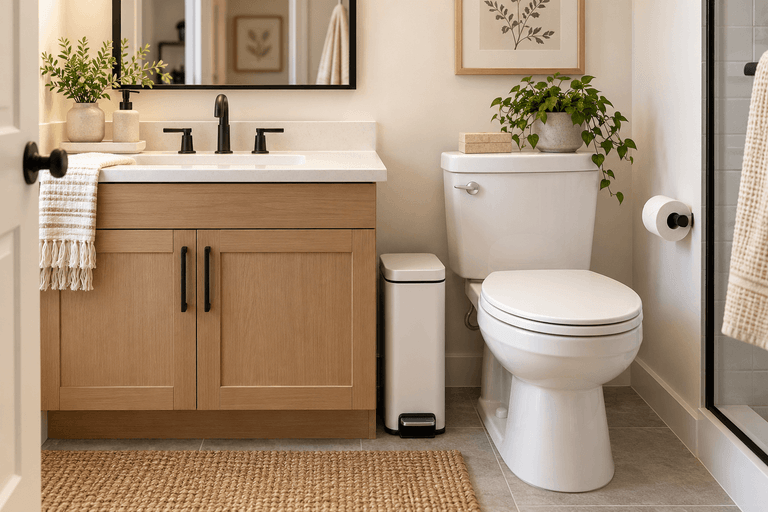
A toilet beside the shower can leave an irregular landing area.
Avoid choosing a large rectangle and folding one corner around the toilet base. The mat needs to lie flat in its intended position, with its edges clear of the fixture.
Check where your feet land after bathing and where you place them while using the toilet. A mat in this shared area may receive more everyday traffic than one beside a separate shower.
You may be able to rotate a smaller rectangle or use another suitable shape. But a contour mat designed to fit around a toilet does not automatically provide the right coverage for the shower exit.
Do not reduce the mat until it technically fits but leaves you trying to land both feet on a narrow strip.
If every position presses into the toilet base, blocks the exit or shifts underfoot, the available space may not support the mat you have. Reassess the shape and dimensions rather than forcing it into the gap.
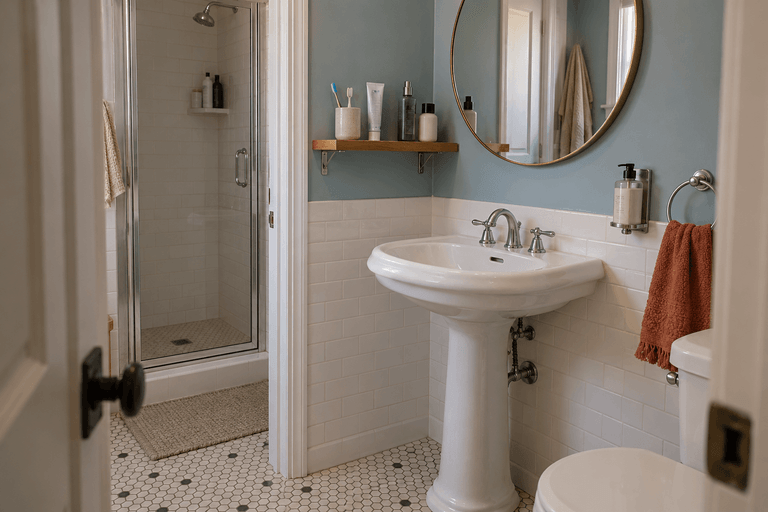
When A Pedestal Sink Limits The Available Space
A pedestal sink leaves visible floor around its base, but that does not make all of that floor usable for a mat.
Look at the space beside the pedestal and the position of your feet while washing your hands. Include the bathroom door’s sweep.
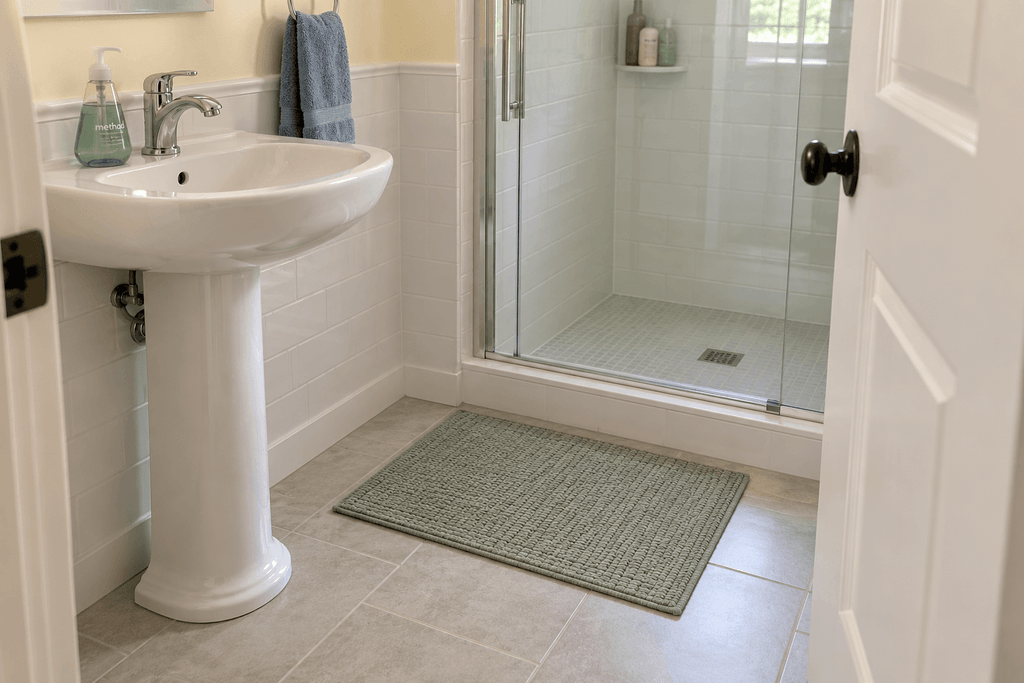
A smaller mat placed beside the pedestal may work when it also sits within comfortable reach of the bathing exit. Try a different orientation before assuming you need a specially shaped product.
Avoid wrapping or bunching a rectangular mat around the base. A curved or cutout design is useful only if its actual outline suits the sink, landing area and door movement.
The mat must fit the way you use the bathroom, not merely the gap beside the sink.
When The Bathroom Opens Onto A Busy Walkway
In my own apartment, the bath mat has usually sat outside the shared bathroom door. The purpose is practical: to limit water being tracked through the rest of the house.
But that doorway connects the living room, kitchen and bedrooms. People passing through repeatedly dislodge the mat, and it gets dirty faster. Sometimes someone steps on it and carries particles back into the bathroom.
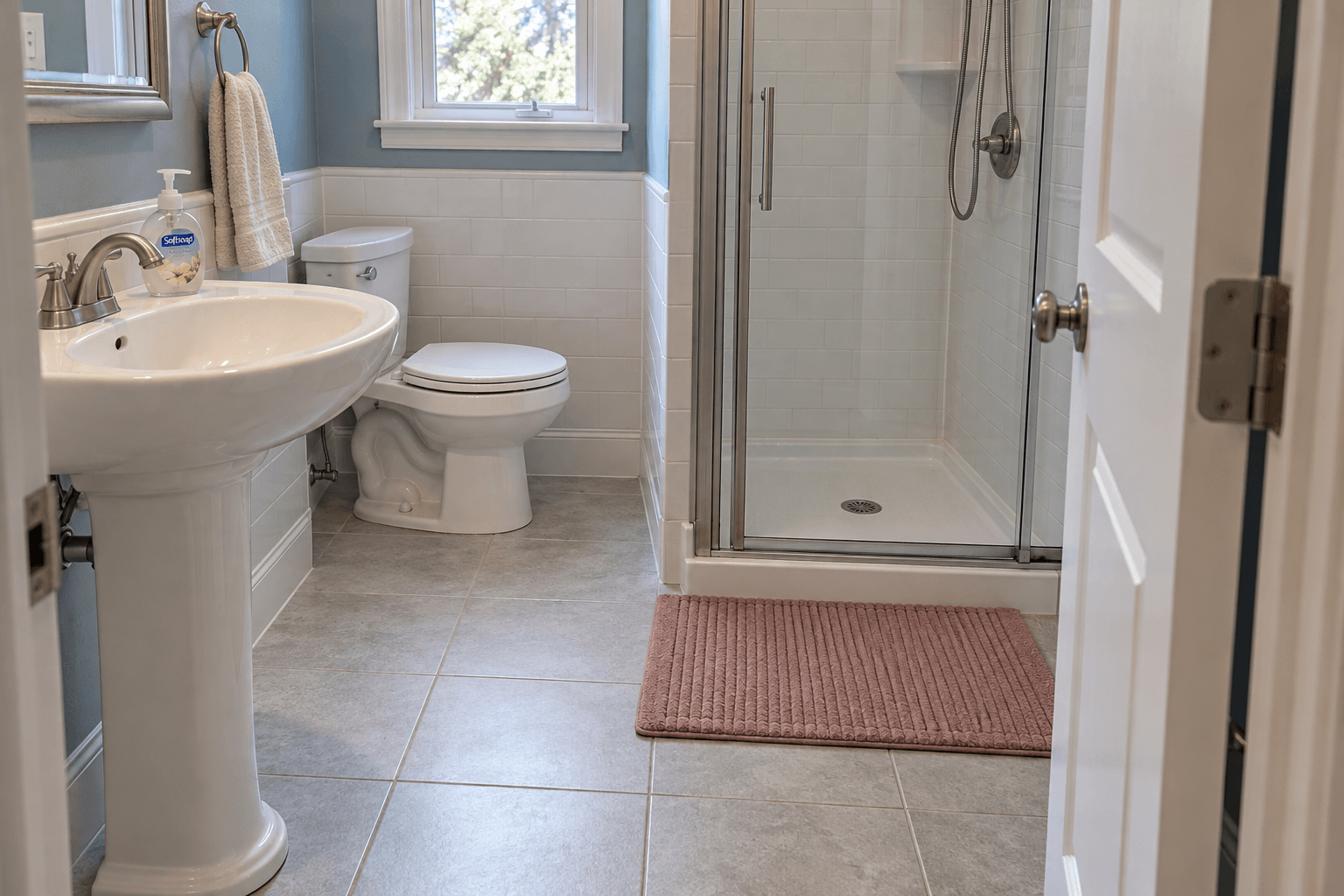
Moving it inside is not straightforward either. It’s a tiny bathroom and the door and pedestal sink restrict the available position, so the current mat would need maneuvering to let the door open.
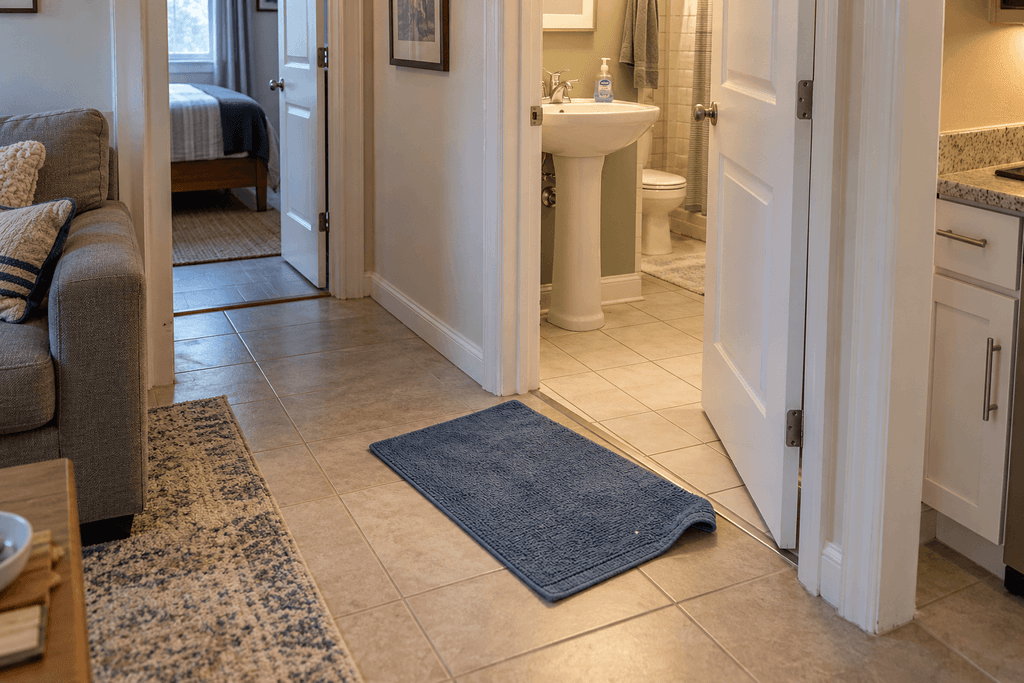
That experience highlights a placement conflict: the mat is serving wet feet at the bathroom exit while also sitting in a household traffic route.
One option I plan to assess is a smaller, low-profile mat inside, beside the pedestal and clear of the door’s sweep. I have not tested that change yet. It would need to provide a reachable landing area, lie flat and leave both the door and sink usable.
If you have a similar layout, do not assume a stronger backing alone will solve it. Better grip may address movement, but it does not change the traffic passing over the surface.
Assess whether an inside position can separate the bathing routine from the shared walkway. If none works, acknowledge the compromise: a mat put down for bathing and removed afterward may be practical for some households, but only if placing and retrieving it does not obstruct access or introduce awkward handling.
One Mat, Two Mats Or A Runner?
Choose the number of mats around separate useful positions, not because a matching set contains three pieces.
One Mat
One mat may be enough when the bathing exit and sink standing area share the same small floor zone.
It should cover the priority landing position without bending against fixtures. It does not have to reach every part of the bathroom.
Two Mats
Two mats can make sense when the shower exit and vanity are genuinely separate and each has room for a flat, stable mat.
Keep their edges from overlapping. If the mats repeatedly slide together, the arrangement needs adjusting rather than straightening every day.
A Runner
A runner may suit a long bathroom with a clear strip beside a tub or vanity. It still needs to clear doors and provide coverage where you actually step out.
Check its full length against toilet access, vents and other floor features. A runner that fills almost every gap may be harder to lift, clean beneath and dry afterward.
More floor coverage is not automatically more useful coverage.
Test The Position Before Buying
Measure the available location after opening the doors and accounting for nearby fixtures.
Record:
- Usable length and width: The area where the mat can lie completely flat.
- Door clearance: Include the bathroom door and shower door where relevant.
- The actual landing position: Not just the empty floor between fixtures.
- The mat’s complete thickness: Including any underlay the manufacturer permits.
- Floor and backing compatibility: Follow both the flooring and mat instructions.
A paper template can help compare footprints on a dry floor. Remove it before normal bathroom use; it is not a surface to test with wet feet.
A template establishes only the outline. It does not prove grip, edge behavior, door clearance through the pile or comfort underfoot.
Once you have the actual mat, follow its placement instructions. For example, Gorilla Grip’s bath-rug instructions specify a clean, dry, smooth floor. Do not assume a “non-slip” label means any mat can be put over standing water or used on every floor finish.
Check that the edges remain flat, the doors operate and the mat stays in its intended position during ordinary use. If it shifts or curls, address that rather than treating daily repositioning as normal.
Do not stack mats or add an unspecified pad simply to make the arrangement grip. Any separate underlay needs to be suitable for the mat, floor and wet-area use.
If nearby floor storage is narrowing the available area, moving occasional supplies into an existing cabinet may help. Our guide to organizing deep bathroom cabinet shelves explains how to keep those supplies retrievable.
Where The Wet Mat Goes Afterward
A good floor position during use does not automatically provide a good drying position afterward.
Check the mat’s care instructions before choosing a rail, rack or drying method. A flexible textile mat, a backed rug and a rigid stone mat should not be treated as interchangeable.
Lift the mat as appropriate to check the floor beneath it, and address moisture according to the product and flooring guidance. Do not put a damp mat away in a closed storage basket.
If the mat needs to leave the floor between uses, give it an appropriate drying location that does not obstruct the doorway or require balancing over fixtures.
The right bath mat position gives you a practical place to step, leaves the room usable and works with a drying routine you can maintain. A mat that looks centered but keeps catching, bunching or migrating into the walkway needs a different arrangement.