Where to Store Folding Chairs in a Small Apartment—and How to Check They’ll Fit
Disclosure
This post may contain affiliate links. If you purchase through these links, I may earn a small commission at no extra cost to you. As an Amazon Associate I earn from qualifying purchases.
Folding chairs solve an occasional seating problem, but they still need somewhere to live after your guests leave. A chair tucked behind the sofa can become difficult to retrieve. One under the bed can catch on a support leg. A stack in the closet can make everyday storage harder to use.
The best folding chair storage for a small apartment is a location where the chairs fit, remain stable and can be removed without rearranging the room. Depending on your furniture, that might be an under-bed space, a dedicated closet section or suitable permitted wall storage.
Start with the folded chairs you actually own. A chair described as “compact” may still be too thick, long or awkwardly shaped for the gap you have in mind.
Measure the Folded Chairs Before Choosing a Storage Spot
Fold each chair completely according to its instructions. Measure the outside dimensions, including projecting feet, hinges, handles and upholstery.
Record:
- Folded length: The longest dimension of the closed chair.
- Folded width: Its widest point.
- Folded thickness: How far it projects when lying flat or standing upright.
- Group dimensions: The space occupied by all the chairs in their intended stored arrangement.
Do not substitute open-chair dimensions or packaging measurements for folded dimensions. If a manufacturer does not publish the folded size, measure the chair itself or ask for confirmation.
Then check how you will handle it. You need access to a suitable grip and enough room to lift, slide or turn the chair without scraping furniture.
The storage space and the route into it are separate checks. Measuring one does not establish the other.
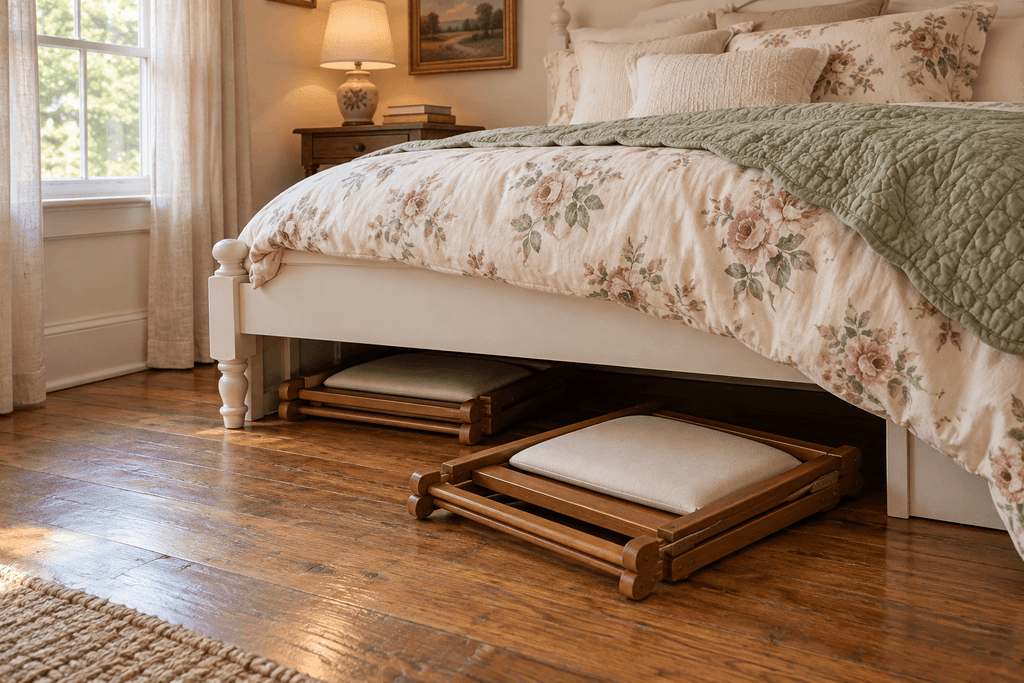
Under the Bed: Check the Opening, Supports and Pull-Out Route
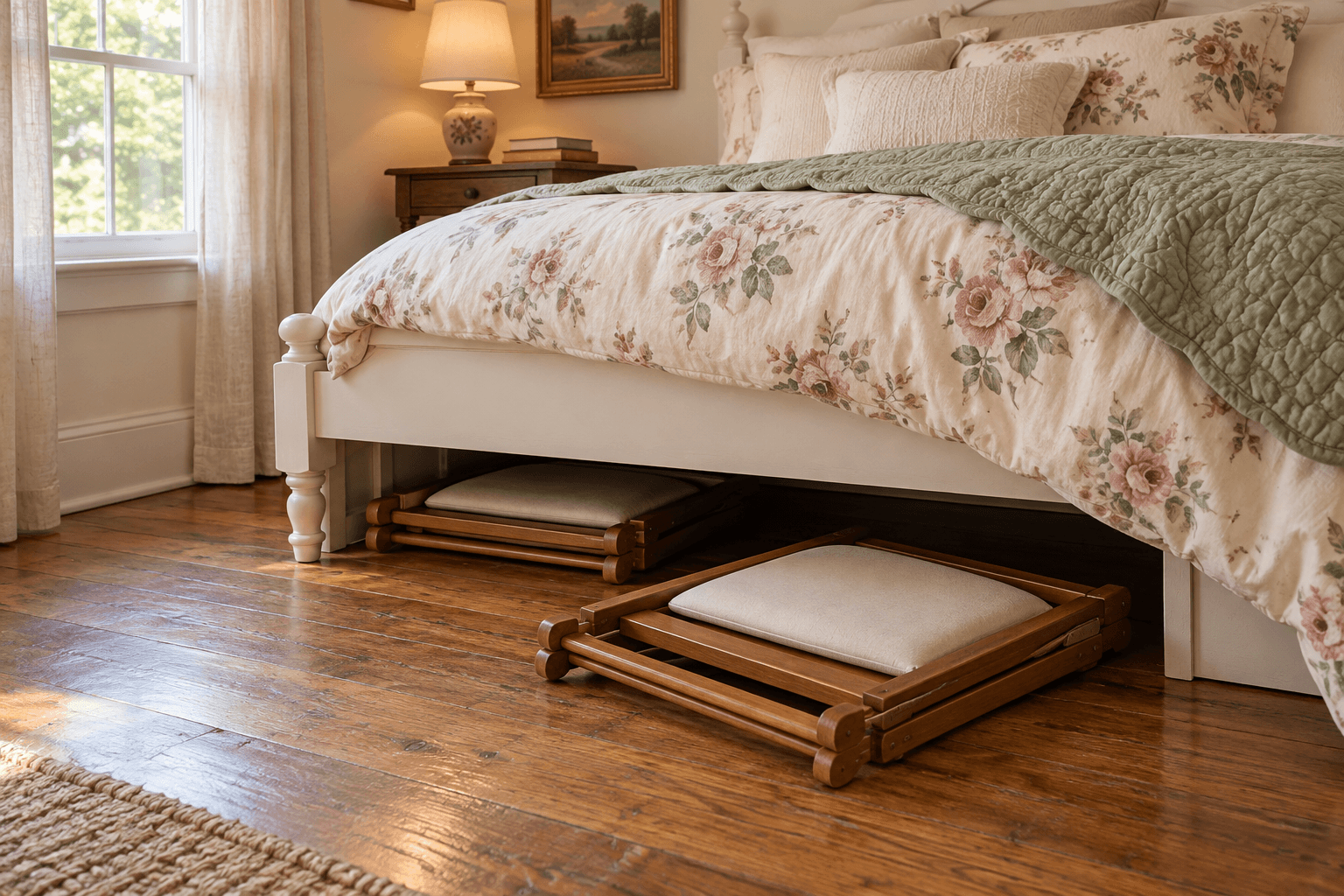
Under-bed storage can work well for chairs that fold relatively flat, provided the bed structure and surrounding room allow access.
Measure the opening beneath the side rail, then check farther inside. Center legs, crossbars, slats, existing bins and other obstructions may divide the space into smaller sections.
For flat storage, check three things:
- Whether the folded chair passes beneath the lowest obstruction along its route.
- Whether an unobstructed area accommodates its full length and width.
- Whether you can slide it out far enough to grip and lift it.
Do not assume the bed’s advertised clearance applies everywhere beneath it.
A Worked Example: The Interior Fits, but the Entrance Does Not
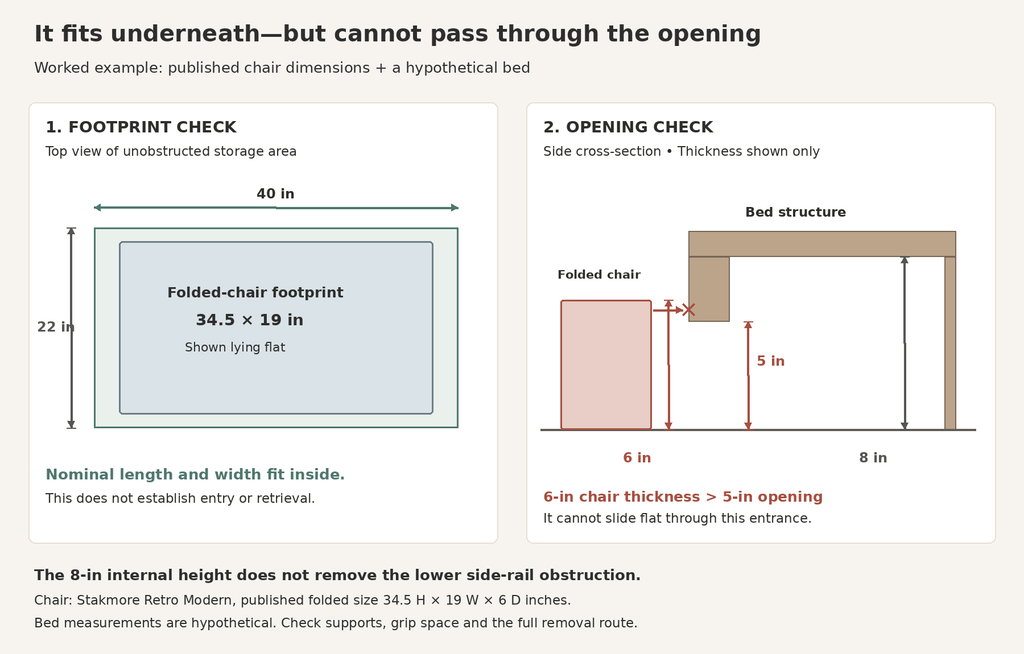
Stakmore publishes folded dimensions of 34.5 inches high × 19 inches wide × 6 inches deep for a Retro Modern folding chair. Laying the folded chair flat gives a nominal footprint of 34.5 × 19 inches and a thickness of 6 inches.
Now imagine a hypothetical bed with:
- An unobstructed internal storage area measuring 40 × 22 inches.
- An internal height of 8 inches.
- A side-rail opening only 5 inches high.
The nominal chair dimensions fit inside that area, but the 6-inch thickness exceeds the 5-inch opening. It cannot slide flat through that entrance. The larger space farther inside does not solve the entry problem.
A different access point might change the result, but it needs a separate check. These measurements describe an illustrative comparison, not a tested installation.
Make Retrieval Part of the Plan
Check the floor beside the bed as well as the space beneath it. Can you pull the chair toward you without hitting a dresser, nightstand or wall?
Follow the chair’s instructions when handling it. Use appropriate protection where needed to prevent repeated scraping, and keep any protective layer from catching in the folding mechanism.
If removal requires lifting the bed or moving heavy furniture every time, consider another location.
In a Closet: Reserve a Slot Without Blocking Everyday Storage
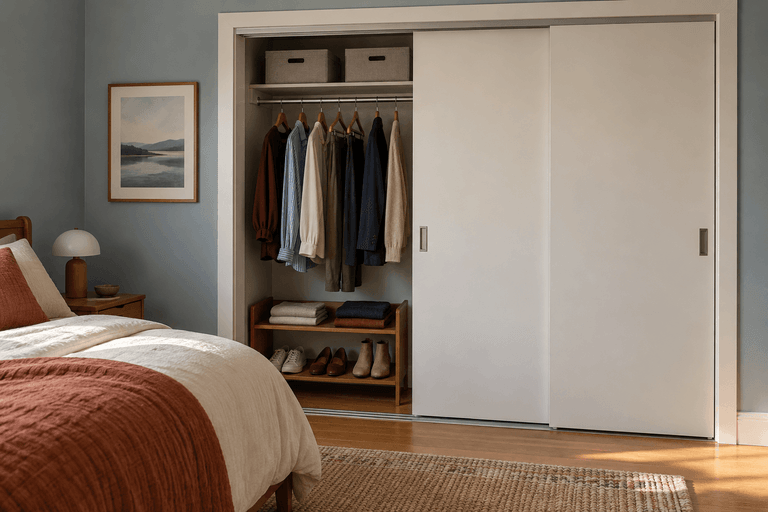
A closet can hold chairs upright in a suitable dedicated section or flat in a supported storage area. Neither arrangement should make your everyday clothes, shoes or cleaning tools difficult to reach.
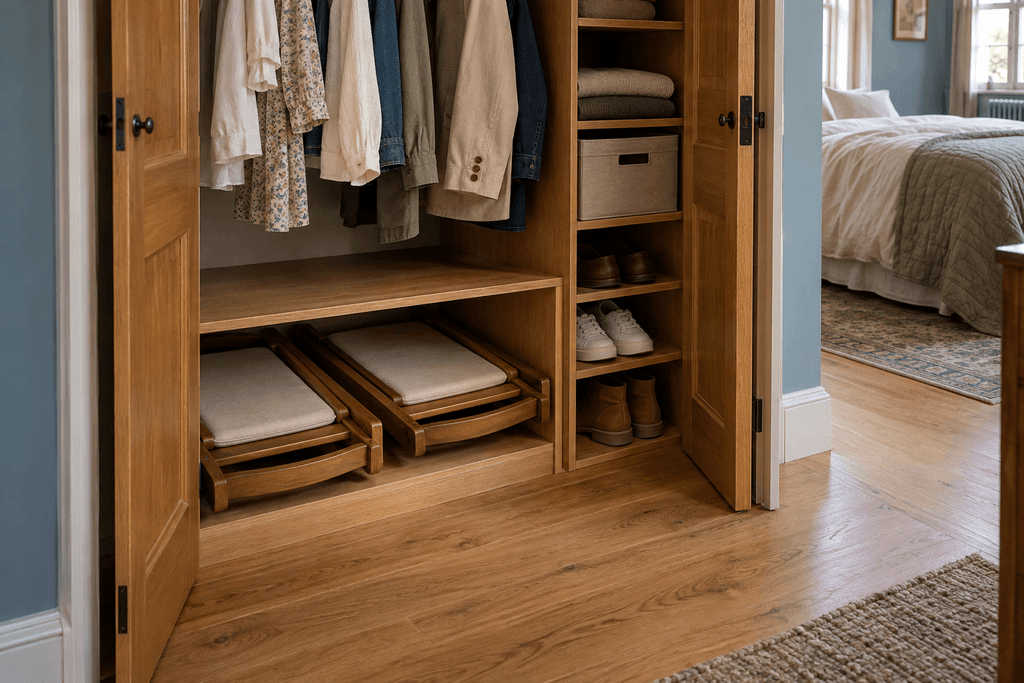
Check the closet with its doors in place. Account for the frame, tracks, handles, shelves and hanging garments not just the empty interior.
Do not leave a loose group of chairs balanced where they can slide or fall. Choose a stable storage arrangement suitable for the chairs and their weight, following the relevant manufacturer’s guidance.
A Worked Example: The Chair Fits Inside, but Straight Removal Fails
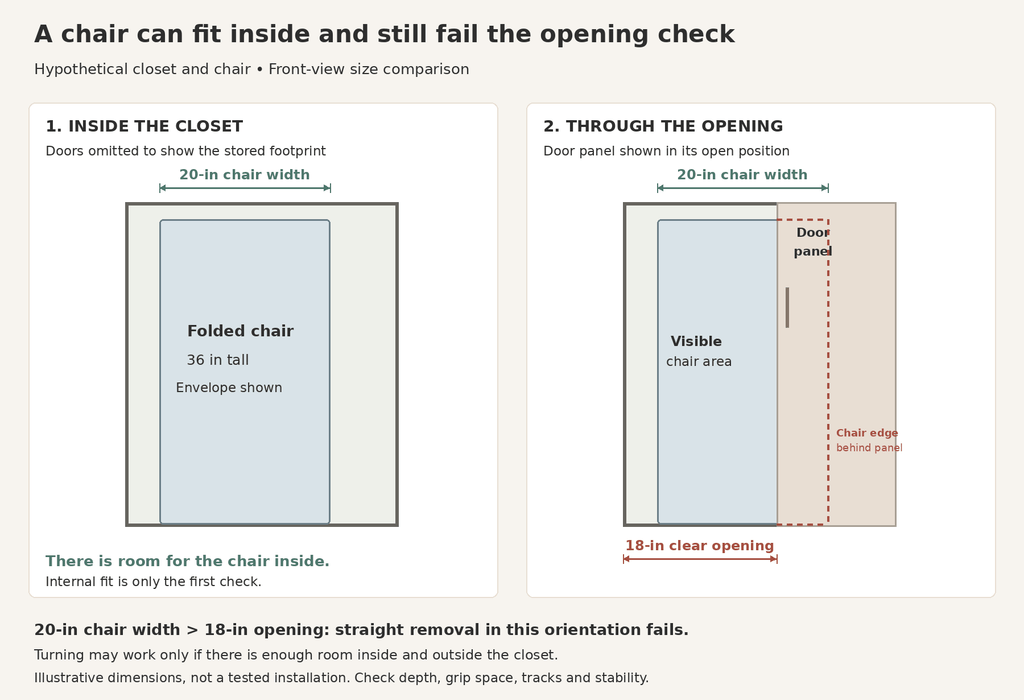
Consider a hypothetical folded chair measuring 36 inches long × 20 inches wide × 5 inches thick.
Suppose it has a suitable upright storage position inside a closet, but the door exposes only an 18-inch-wide opening. With its 20-inch width facing that opening, the chair cannot move straight out in that orientation.
Turning it might work, but only if there is space inside and outside the closet to complete the movement. A shelf, hanging clothes or the door panel itself may prevent that turn.
The solution could be a different orientation or location. Do not assume the chair is permanently trapped or that it will come out easily without checking the route.
Behind Furniture: A Hidden Gap Is Not Automatically Usable Storage
Behind a sofa or another suitable piece of furniture may be an option when the folded chairs can be stored securely and retrieved from an accessible end.
Check what already occupies that gap. It might contain outlets, cords, vents or a heat source. Preserve required equipment clearances and access, and do not trap or compress electrical cords.
Also check whether the furniture is stable and whether the chairs could tip or slide into the room. Avoid using furniture that needs to be moved regularly as the only means of keeping chairs in place.
A hidden location is less useful if every gathering begins with dragging the sofa forward. For occasional seating, retrieval can be less convenient than everyday storage, but it should still be manageable.
If concealing the chairs becomes the main goal, remember that hiding clutter in a small bedroom should not mean making belongings difficult to use.
On the Wall: Check Permission, Chair Design and Mounting Requirements
Wall storage can free floor space when the chair and mounting system are suitable for that arrangement.
Before choosing it, confirm:
- The chair can be supported securely in its folded position.
- The hardware is intended for the proposed use and load.
- The wall type and installation meet the hardware instructions.
- Your rental permits the installation.
- You can lift and remove the chair comfortably.
Do not assume a chair’s handle is a suitable hanging point or that adhesive hooks can support bulky furniture. Check the specific chair and hardware.
Account for the chair’s full projection from the wall. An empty hook occupies little space; a folded chair can still interfere with a door or walking route.
Choose another location if safe mounting or manageable lifting is not possible. Floor space saved is not the only consideration.
Storing Two or More Chairs Changes the Calculation
A single chair’s folded thickness does not reliably establish the size of a group.
Some designs nest; others are separated by upholstery, hinges or projecting frames. Chairs placed side by side occupy a different footprint from chairs stacked flat.
Measure the actual group in the orientation you intend to use.
For example, imagine that two chairs together measure 9.5 inches thick in their stored arrangement. They cannot fit flat beneath an 8-inch obstruction, even if each chair fits individually.
Putting them in separate under-bed sections might work, but that requires enough footprint and a usable retrieval route for each. This is a hypothetical example, not a published stacking specification.
Check whether removing one chair disturbs the others. If it does, adjust the storage arrangement rather than accepting a loose stack that can shift unexpectedly.
Use This Fit-and-Retrieval Check Before Buying Storage
Complete these checks for each possible location:
- Stored size: What are the folded dimensions of the chair or actual group?
- Entry opening: What is the narrowest point along the route into storage?
- Internal obstructions: Are there supports, shelves, tracks or other belongings in the way?
- Removal movement: Can you grip, slide, lift or turn the chair as needed?
- Stability: What keeps the stored chairs from sliding, falling or unfolding?
- Everyday access: Do they interfere with doors, walking routes or frequently used storage?
- Return routine: Can you put them back without moving unrelated belongings?
A cardboard outline can help check a proposed footprint, but it does not confirm three-dimensional fit, stability or safe mounting. Verify those separately.
If you already own the chairs, test the actual retrieval movement carefully before buying a rack, container or larger storage unit.
What if None of the Storage Spots Works?
Avoid buying a bulky piece of furniture simply to hide occasional chairs. Compare its daily footprint with how often you need the extra seating.
Other options include:
- Keeping fewer extra chairs.
- Using suitable everyday chairs from another room when guests visit.
- Borrowing or renting additional seating for infrequent larger gatherings.
- Choosing a different folding-chair design when replacement is already necessary.
Do not rush to replace usable chairs based on “fold-flat” marketing alone. Verify the new chair’s folded dimensions against a specific storage location first.
The useful storage spot is the one that gives the chairs somewhere to go and lets them come back out. Start with those two checks before adding another organizer.