How to Organize a Small Closet With Sliding Doors
Disclosure
This post may contain affiliate links. If you purchase through these links, I may earn a small commission at no extra cost to you. As an Amazon Associate I earn from qualifying purchases.
A closet organizer can fit perfectly inside your closet and still be frustrating to use. The drawer catches behind a sliding panel. A basket needs to be turned sideways before you can remove it. Your everyday clothes end up behind the section you keep closed.
With sliding doors, the usable storage space depends on what you can reach through the opening, not just the closet’s interior dimensions.
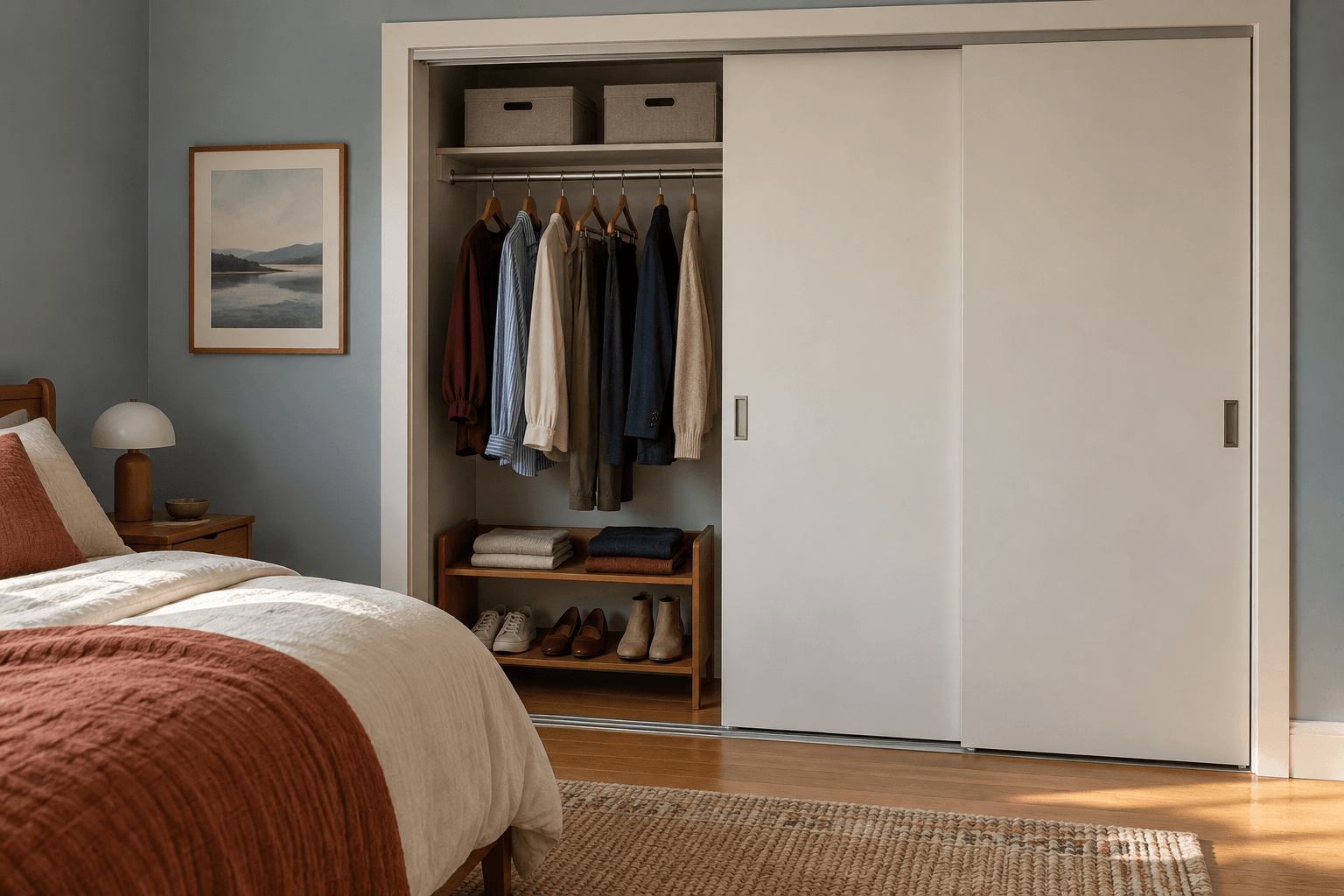
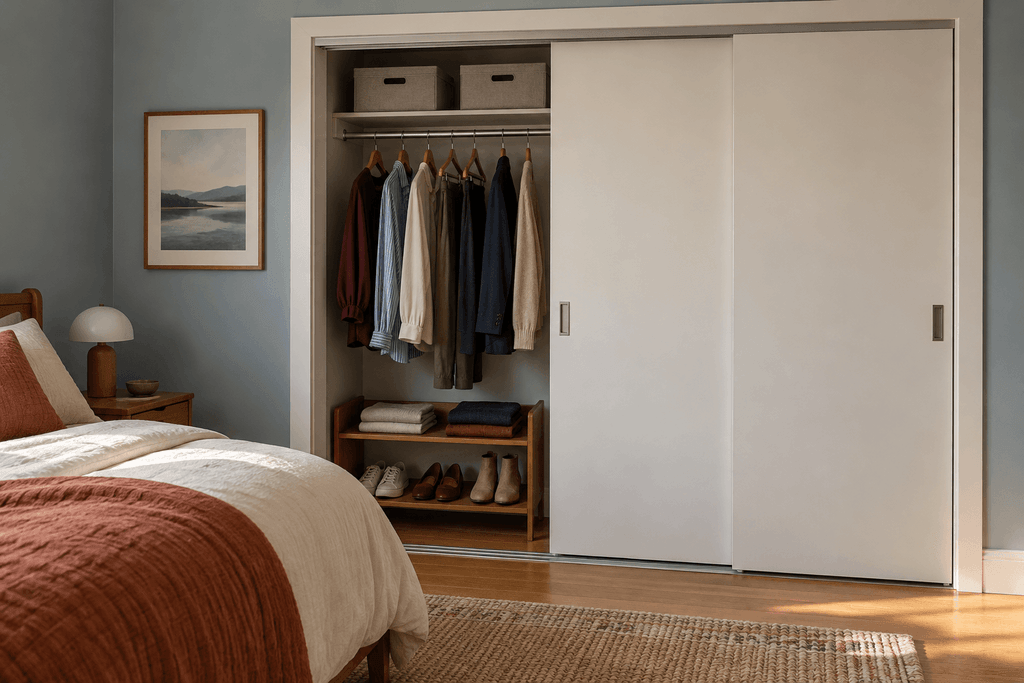
This guide explains how to organize a small closet with sliding doors by checking the door positions first, then arranging hanging clothes, folded items, shoes, and containers around them.
It focuses on bypass doors: panels that slide past one another on separate tracks. Pocket doors and other sliding systems can expose the closet differently, so check how your own doors operate before applying a layout.
Start With the Item That Is Hardest to Get Out
Before emptying the whole closet, identify one recurring problem.
Perhaps you cannot open the underwear drawer fully. Your work shoes sit behind a panel. Or getting a sweater means moving a hanging organizer and then sliding the doors again.
Repeat that task slowly and watch what gets in the way:
- Does a door panel cover part of the item?
- Does the closet frame narrow the opening?
- Are hanging clothes blocking your hand?
- Does the container fit on the shelf but struggle to come out?
- Is bedroom furniture stopping a drawer or basket from extending?
This tells you whether you need to move something, change the storage method, or address a problem outside the closet.
If the drawer opens through the doors but hits the bed, a different closet organizer may not solve it. Start with the surrounding room arrangement using these small bedroom organization fixes.
Measure the Openings With the Doors in Place
Measuring only the empty interior misses the main constraint. Slide the panels fully to one side and measure the clear opening. Then slide them the other way and repeat. Check for handles, stops, the frame, and recessed side walls that affect access.
Record these measurements before shopping:
- Interior width: The space available inside the closet.
- Clear opening in each door position: The unobstructed opening you can actually use.
- Usable depth: The distance available without an organizer or its contents entering the moving doors’ path.
- Shelf clearance: The space above a container, including room to grip and lift it.
- Pull-out space: The path a drawer or basket needs inside the closet and out into the bedroom.
Measure at the height where the organizer will sit. A clear opening beside the hanging rail does not automatically tell you whether a floor-level drawer will clear the track and frame.
Take a photograph with the doors shifted left, then another with them shifted right. These are useful references when comparing possible positions.
Do not assume that half the closet’s interior width equals the usable opening. The frame, panel overlap, and hardware can change what is accessible.
Why a Drawer Can Fit but Still Fail
A drawer needs more than enough floor space for its cabinet. Its moving front must clear the opening, and it needs room to extend.
ClosetMaid’s planning guidance specifically calls for adequate drawer clearance in closets with sliding doors.
A Worked Example: The Cabinet Fits, but the Drawer Is Blocked
The following measurements describe a hypothetical closet, not a tested installation.
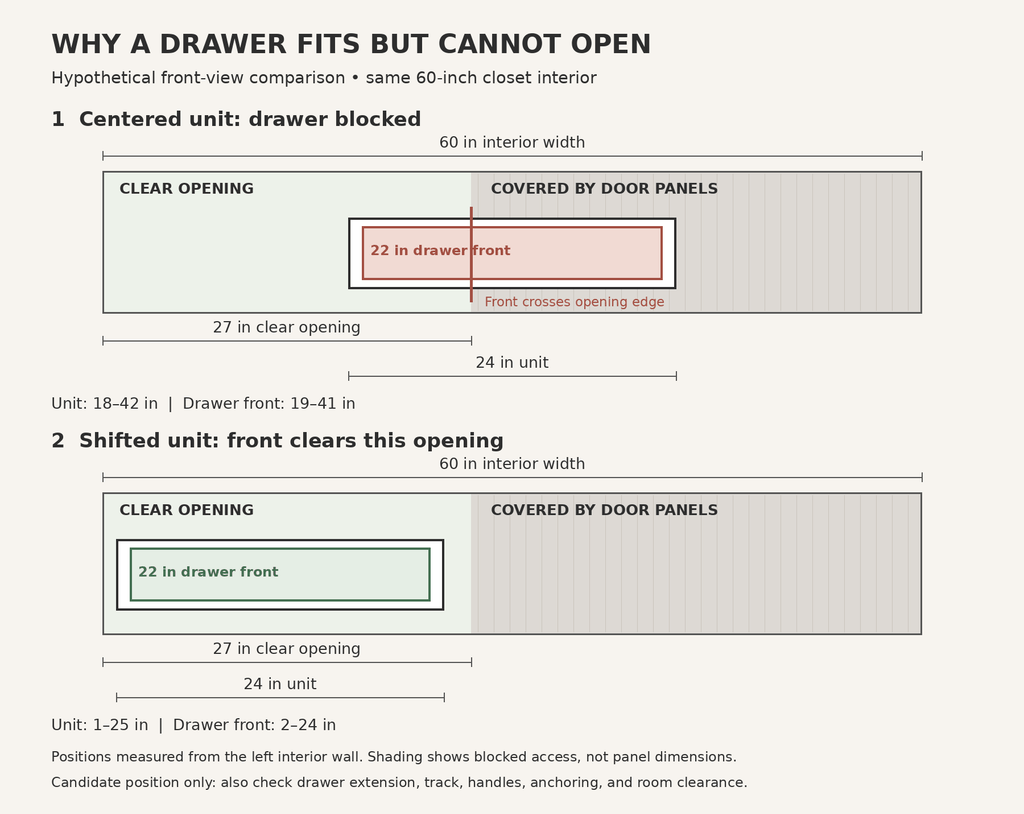
Imagine a closet with:
- A 60-inch-wide interior.
- A 27-inch clear opening at the left when the panels are shifted right.
- A 24-inch-wide drawer unit centered inside the closet.
Measured from the left interior wall, the centered unit occupies the space from 18 to 42 inches. Suppose its moving drawer front occupies the space from 19 to 41 inches.
The opening exposes the space from 0 to 27 inches.
That means part of the drawer front remains behind the door panel. The cabinet fits inside the closet, but the drawer cannot pull straight out without interference.
Moving the unit left could resolve that particular obstruction. For example, a unit occupying the space from 1 to 25 inches would sit within the hypothetical opening.
However, that is only a candidate position. You would still need to check the actual drawer front, handles, track, installation requirements, and space in front of the closet.
The useful question is: does the opening expose the entire moving part?
Test the Proposed Position Before Buying
Use a cardboard outline to represent the organizer’s width and depth. Position it where the unit would sit, then move the doors through their normal range.
For a drawer, also mark the manufacturer’s stated extension distance into the room. Check whether you can stand beside or in front of it and reach the contents.
A cardboard outline can help reject a poor position. It cannot confirm stability, load capacity, anchoring, or the operation of the actual product.
Group Clothes Around How You Get Dressed
A visually balanced closet is not necessarily convenient.
If your work tops are on one side, work pants on the other, and daily shoes behind the first panel, choosing an outfit may require repeated door changes.
Try grouping the items you commonly use together behind the same opening:
- Everyday tops and pants.
- The shoes you wear most often.
- A regular belt or bag.
- Small folded items in a reachable compartment.
Keep less frequently used clothing in the other section when that suits your wardrobe.
This does not mean one side must hold everything. The aim is to reduce unnecessary switching during a normal dressing routine.
For a shared closet, separate sides may still be more practical. Each person can arrange their frequently used items within their own accessible section.
Choose Hanging Space According to Your Clothes
A second hanging level can help when much of your wardrobe consists of short garments. It can also make a closet worse if it removes the space needed for dresses, coats, or longer clothing.
Before adding another rod, hang a few representative garments in the proposed arrangement. Check that:
- Upper garments clear the lower rod and clothing.
- Lower garments clear shoes or storage beneath them.
- Both levels remain reachable through the door opening.
- Clothing stays clear of the moving panels.
- The supporting system is suitable for the added load.
Preserve a full-height section if your clothes require it.
A hanging shelf organizer also consumes rail width. Compare it with the clothes it would displace before deciding that it adds useful capacity.
Place Folded Storage Where Your Hands Can Reach It
Folded storage does not have to mean a drawer tower.
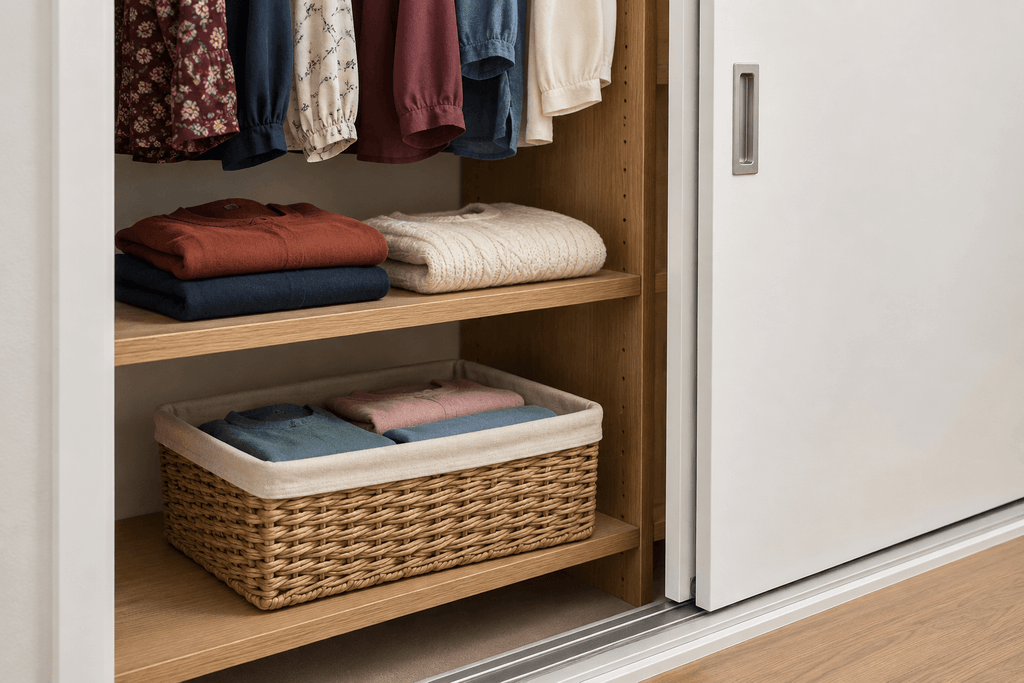
An existing shelf, a suitable hanging compartment, or a small open shelf unit may work better when a door prevents drawers from operating.
Choose based on the task:
For everyday folded clothes: You should be able to identify and remove an item without disturbing several unrelated stacks.
For a removable basket: Check that you can grip it and bring it through the opening with its contents inside.
For occasional clothing: A container in a less convenient position may be acceptable if retrieval is manageable when needed.
Avoid treating the center of the closet as the automatic location for a shelving tower. With some bypass-door arrangements, that position is awkward to access. Let your measured openings determine placement.
A narrow organizer in a reachable position can be more useful than a larger one that holds more but is difficult to operate.
Keep Shoes Clear of Both Clothing and the Door Track
The floor beneath short hanging clothes can hold shoes, provided the garments, shelves, and doors have enough clearance.
Start with the pairs you wear regularly. Place them where you can retrieve them through a normal opening without pushing clothing aside.
Before adding a shoe rack, check:
- Its depth with shoes on it, not just the empty frame.
- Whether the shoes extend into the panels’ path.
- Whether longer garments fall onto the upper tier.
- Whether you can reach the back row.
- Whether the rack interferes with access to another section.
A rack that fits beneath the rail may still force you to move it whenever you need a suitcase or basket behind it.
Keep the door track clear. Storage should not depend on placing objects where the panels need to travel.
Give Upper Shelves Containers You Can Remove
A large container may use the shelf’s depth well while making retrieval awkward.
Before filling it, test whether you can lift it clear of the shelf and bring it through the opening. Include the lid, handles, and any protruding edges in the check.
If a container spans an area that neither door position fully exposes, you may have to rotate it to remove it. That might be manageable for a light, occasional-use container. It is a poor assumption for something heavy or frequently accessed.
Use a size and filled weight you can handle safely. Where a step stool is necessary, account for a stable place to use it in front of the closet.
Label the side that faces the opening. A label hidden behind a panel provides little help.
Be Careful With Storage Attached to Sliding Doors
Over-the-door hooks and pocket organizers designed for hinged doors are not automatically suitable for bypass doors.
The panels pass close to each other. Added hooks, pockets, handles, or hanging items may catch between them or interfere with movement.
Before attaching anything, check compatibility with the door system and move the panels through their full travel.
A stationary interior wall may offer a better location for a lightweight accessory, provided the item stays clear of the panels and the fixing method suits the surface and load.
For renters, removable storage still needs a sound supporting structure. Freestanding furniture may require anchoring, and rod-hung organizers depend on the existing rail and brackets.
Keep a Small Repeat-Wear Section From Taking Over
If worn-but-not-dirty clothing regularly lands on a bedroom chair, the closet may need a convenient place for that category.
Use a limited section of the existing rail for suitable hanging garments, or a supported folded space for clothing that should not hang.
Position it where returning an item is straightforward. A space hidden behind several obstacles is unlikely to compete with the convenience of the chair.
Keep this section separate enough to identify what has already been worn. It should also leave room for clean clothes.
For garment support and the chair-and-hamper problem, see where to put worn-but-not-dirty clothes in a small bedroom.
Test the Arrangement With One Complete Outfit
Before filling every remaining gap, run through a normal dressing task.
- Retrieve a top, bottoms, underwear, and shoes.
- Notice which door movements are necessary.
- Check whether anything needs to be moved merely to reach something else.
- Return each item to its place.
- Close the doors and check for caught fabric or contact with storage.
Some door movement is unavoidable with bypass doors. What matters is whether the arrangement creates unnecessary work.
If one frequently used item causes the difficulty, move that category first. You may not need to reorganize the entire closet.
Only consider removing or replacing the doors after checking whether an interior change would solve the problem. In a rental, door alterations also require checking the lease and obtaining permission where required.
Before You Buy a Closet Organizer
Before buying, make sure you know exactly what you are storing, which door opening it sits behind, and how you will reach it without moving other items.
Then confirm that the doors still travel freely, the contents remain accessible, and the installation follows the product’s instructions.
That check helps distinguish an organizer that merely fits from one that makes your closet easier to use.