Where to Hang Clothes for Steaming in a Small Apartment
Disclosure
This post may contain affiliate links. If you purchase through these links, I may earn a small commission at no extra cost to you. As an Amazon Associate I earn from qualifying purchases.
A handheld steamer takes up little storage space. Finding somewhere to hang a dress while you use it can be harder.
A wardrobe handle might hold the hanger, but leave the hem on the floor. An over-door hook might provide enough height while putting the garment directly against a surface that could be damaged by steam.
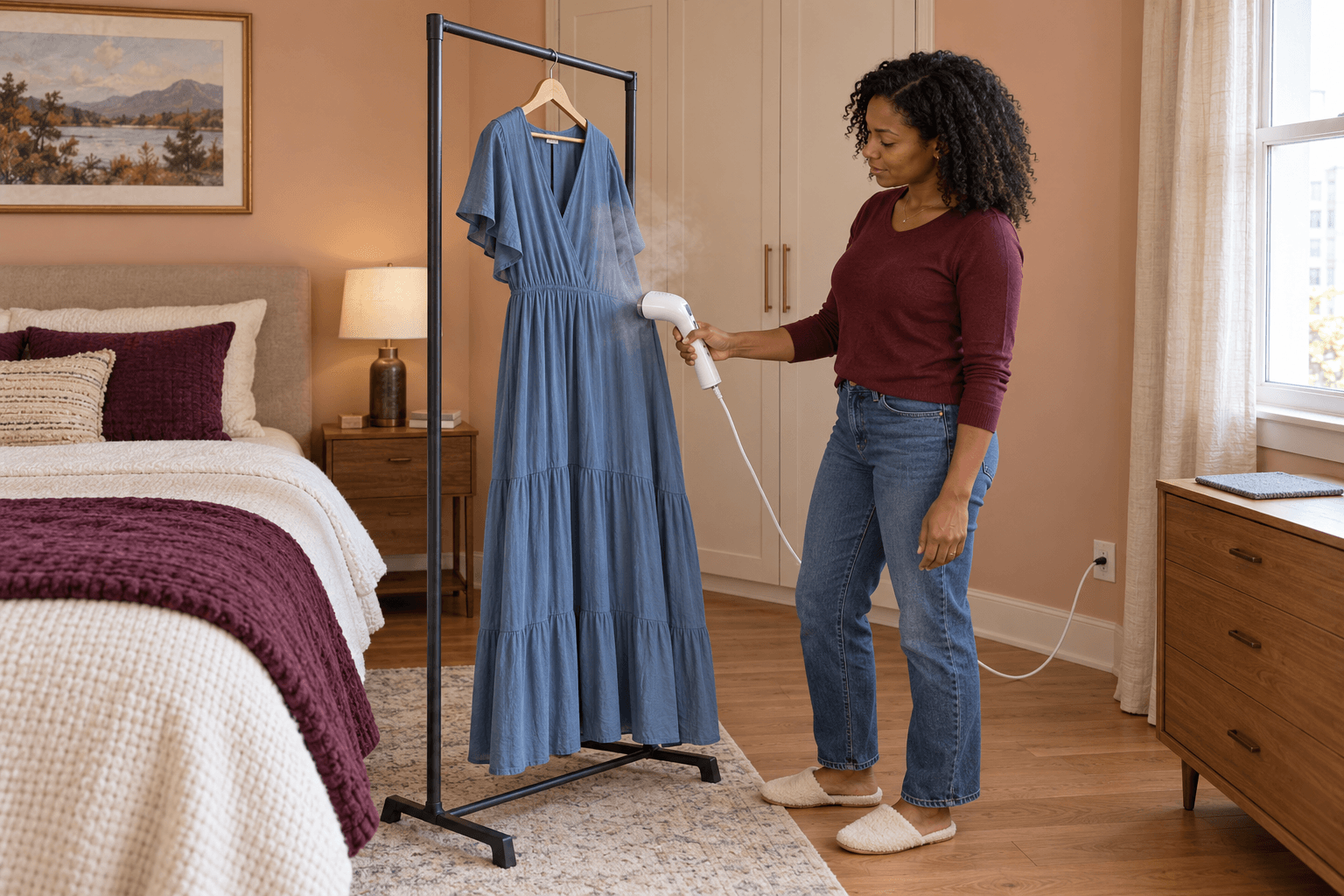
The best place to hang clothes when steaming is a stable support that lets the garment hang at a usable height, with suitable clearance around it and safe access to an outlet. That may be a rack you already own, an appropriate door-mounted setup or a compact steaming stand.
Before heating the appliance, check the hanging spot with the actual garment. A location that works for a blouse may be frustrating for a long dress.
Start With The Garment, Not The Hook
Put the garment on a suitable hanger and hold it at the proposed hanging point while the steamer is unplugged.
Check five things:
- Support: Can the hanging point securely hold the hanger and garment without slipping or moving?
- Height: Does the hem clear the floor without folding the garment?
- Working room: Can you reach the front, back and lower sections without stretching or repeatedly crouching?
- Surroundings: Where will steam go beyond the fabric?
- Power and resting space: Can the cord reach safely, and is there an appropriate place to set the appliance down?
A hook is only one part of the setup. You also need room to stand, turn the hanger and put the steamer down according to its instructions.
Check the garment’s care label and the appliance manual before proceeding. Don’t steam clothing while someone is wearing it, or place a bare hand behind the area being steamed.
A Wardrobe Handle Can Work But Height Is The Catch
I’ve used a handle on my closed wardrobe door to hold a hanger while steaming clothes. It worked, and I didn’t initially think of it as awkward.
Longer dresses were less convenient. The handle wasn’t high enough to let them hang fully clear of the floor, so I had to fold the garment in two or let it trail while bending down to reach the lower sections.
That experience highlights an easy detail to miss: a hanging point can hold the garment without being high enough to steam it comfortably.
Check The Handle And The Surface Separately
A wardrobe handle is designed for opening a door, not necessarily for supporting a loaded hanger while you work on the fabric. Its shape, fixings and position all matter.
Don’t use a loose handle, a hanger that keeps slipping or a door that moves whenever you touch the garment.
The surface behind the clothing also needs attention. In my arrangement, the garment rested against the closed door. That describes what I did; it does not establish that every wardrobe finish can tolerate repeated steam exposure.
Keep in mind that steam can damage or discolor certain wall, door and furniture finishes.
If your clothing presses against a finish whose suitability you cannot establish, choose another arrangement rather than assuming the fabric will protect it.
Don’t Solve A Low Hanging Point By Letting Dresses Drag
A higher support is usually a more practical answer than repeatedly lifting and folding a long garment.
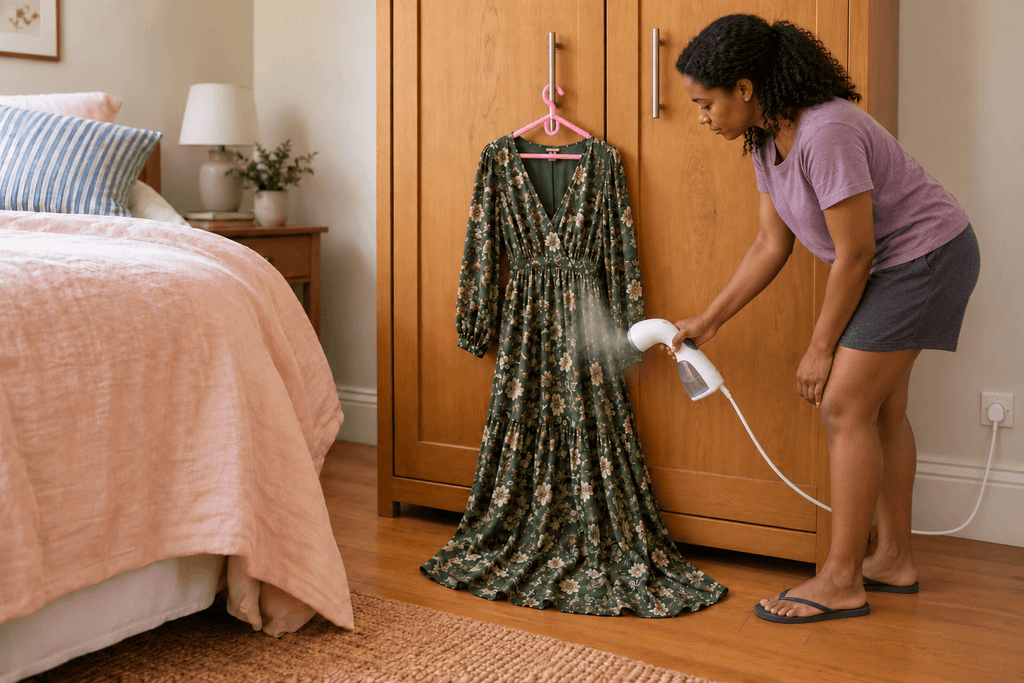
Trailing fabric can pick up dust, while folded sections make it harder to reach the whole garment consistently. Before buying anything, measure the drop from the proposed support to the floor with the hanger included.
If long dresses are what you steam most often, choose the setup around them not around your shortest shirt.
Use A Garment Rack If You Already Have One
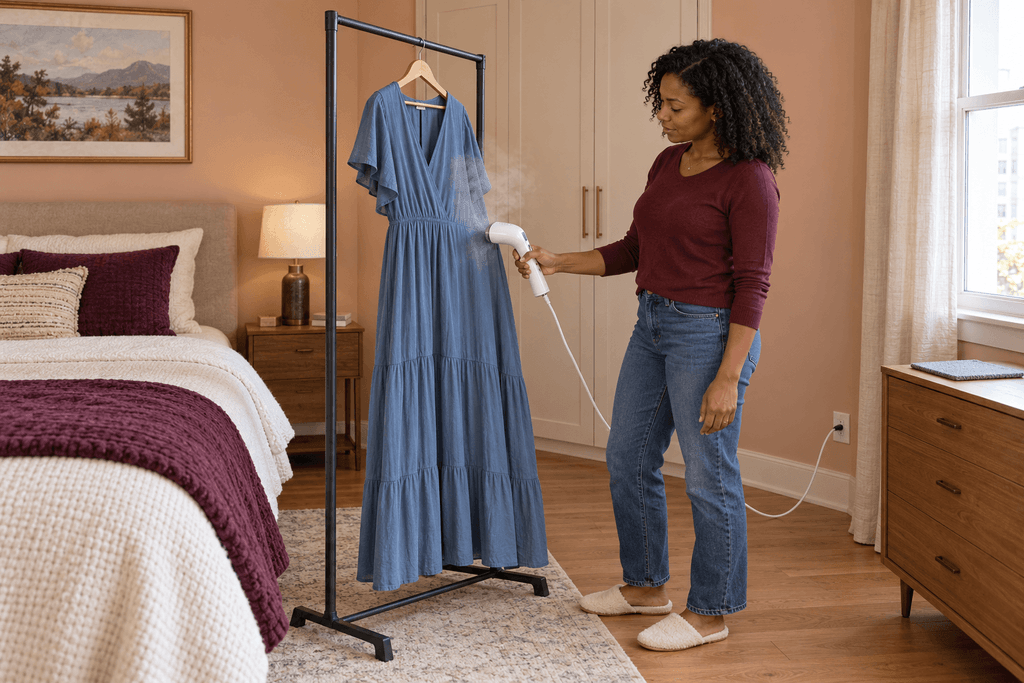
An existing freestanding clothing rack is worth assessing before adding another hook or buying a separate stand.
It can let the garment hang away from a door or wall, and some racks provide enough height for longer clothing.
However, a full rack is not automatically a usable steaming station.
Move neighboring clothes out of the working area. Check that the rack remains stable when you turn the hanger or lightly handle the garment, following the appliance’s technique instructions.
For a wheeled rack, use its wheel locks where provided. Don’t use a rack that rolls or rocks while you work.
Keep the garment you are steaming separate from the clothes you are storing. The aim is to create working clearance, not steam one item inside a tightly packed row.
Also consider where the rack sits. A convenient hanging rail beside the bed may leave too little room for your body, the appliance and its cord. The room’s main walking route should remain usable.
An Over-Door Setup Needs More Than A Strong Hook
A suitable over-door hook can provide a higher hanging point without using floor space. But check the complete arrangement before relying on it.
The hook should fit the door properly, support the intended load and hold the hanger securely. Its fit should not damage the door or interfere with normal closing.
Arrange the door so it cannot unexpectedly swing toward you while you are working. In a shared home, let others know the space is in use.
Then check the garment’s position. A higher hook may solve the dragging problem while leaving a blouse or dress pressed flat against the door.
When A Purpose-Made Steaming Backing Helps
A door-mounted steaming backing is a different product from an ordinary hook. It is designed to provide a working surface behind the garment.
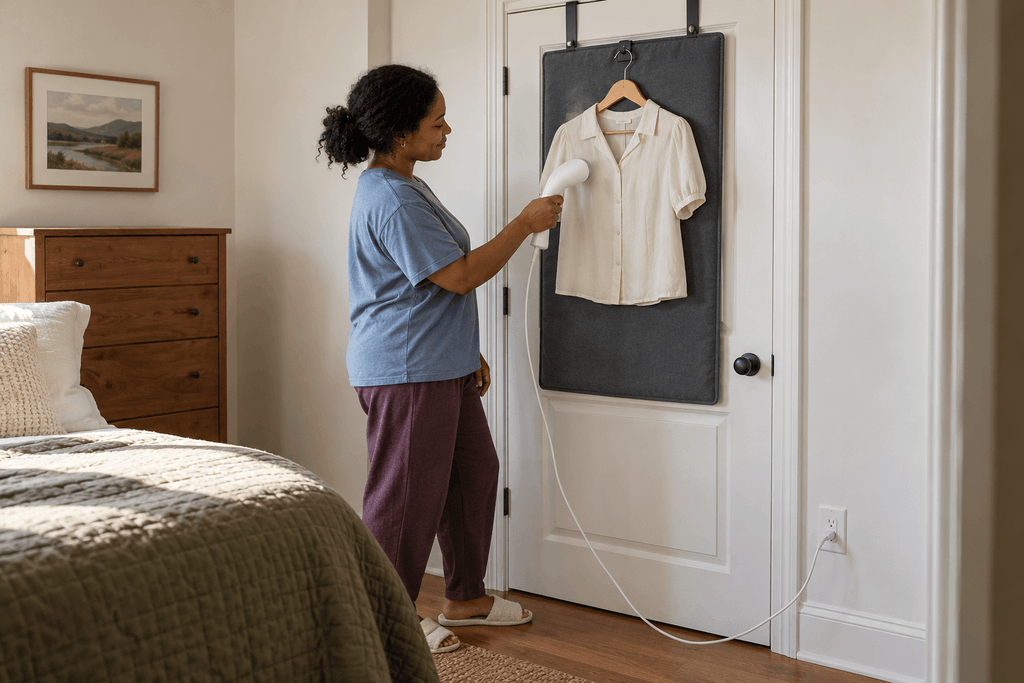
Before choosing one, check:
- The door thickness and mounting requirements.
- The supported garment weight.
- The backing’s dimensions.
- Whether the garment remains within the protected area.
- The manufacturer’s instructions for compatible surfaces and use.
For example, Brabantia specifies both door-fit dimensions and a defined backing size for its door steaming blanket. Those measurements illustrate why “fits over a door” is not enough information on its own.
A long dress may extend below a short backing. Sleeves may also fall beyond its edges.
A towel hung behind a garment does not automatically make the door suitable for steaming. Use equipment designed for the task and follow its instructions; don’t assume any extra layer provides equivalent protection.
A Closet Rod Works Only If There Is Room To Work
A closet rod may offer a secure hanging point, but the surrounding storage can make it awkward to use.
A garment hanging deep inside the closet may be difficult to turn, too close to other clothing or positioned above shoes and folded items.
Before switching on the steamer, check whether you can:
- Separate the garment from neighboring clothes.
- Reach its lower sections.
- Turn the hanger without catching another item.
- Keep steam away from unsuitable shelves, finishes and stored belongings.
- Work without pulling the power cord across the closet opening.
Don’t pack clothes tightly to one side and assume the resulting narrow gap is enough.
If the closet cannot provide a clear working area, use it for storage and steam elsewhere. You can apply the same access-first thinking from organizing a small bedroom: a location needs to work during the activity, not simply hold the equipment afterward.
Don’t Choose The Bathroom Just Because It Has A Rail
A shower rod or bathroom hook may look like an obvious place to hang clothing. That doesn’t make every bathroom an appropriate place to operate an electrical steamer.
A shower-curtain rod may move under load. The garment may touch wet surfaces, and a small bathroom may offer no suitable place for the appliance or cord.
Follow your appliance’s restrictions on use near water. Don’t use it in a shower or bath, on wet flooring or where it could fall into water.
Even where a dry bathroom arrangement is permitted, check the support, nearby finishes, outlet location and available working space. Don’t stretch a cord across a doorway to make an otherwise unsuitable location work.
A bedroom setup may be more practical than adding steam and equipment to an already cramped bathroom.
When A Compact Steaming Stand Is Worth The Space
A separate stand can make sense when you steam frequently and none of your existing hanging points provides adequate height or clearance.
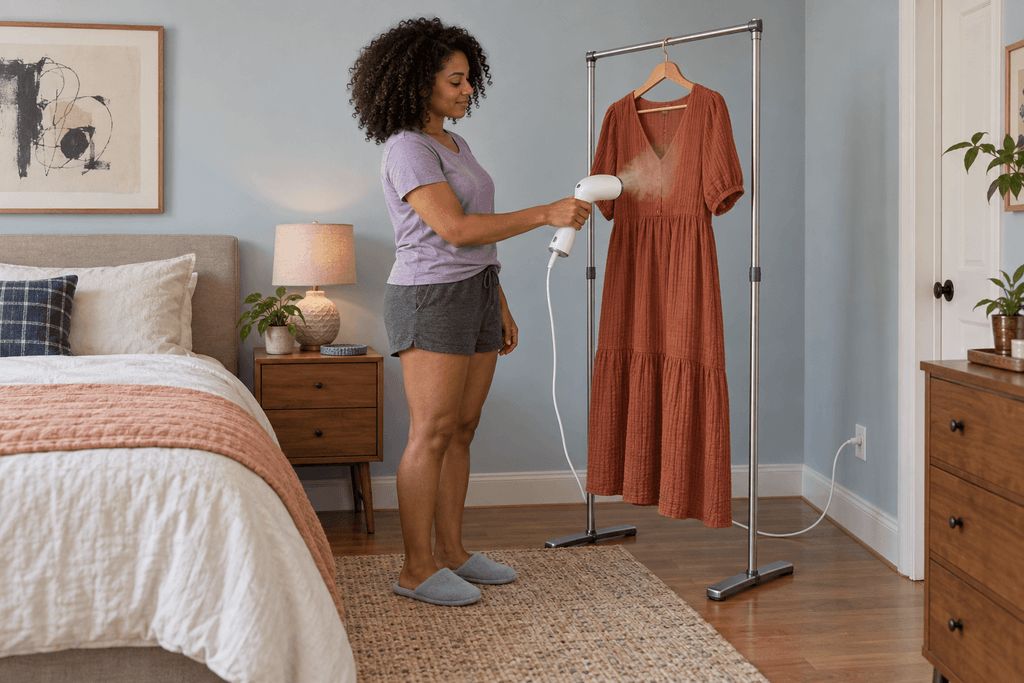
It is less worthwhile if it becomes another object you struggle to store.
Before buying, compare the stand’s:
- Maximum usable hanging height.
- Open base dimensions.
- Stability and stated load capacity.
- Folded dimensions.
- Space required around a hanging garment.
Check how the height is measured. The top of the stand, the hanging hook and the bottom of the garment are different points.
Mark the base footprint on the floor and test where you would stand. A narrow base in a product photograph does not show the entire working area.
Then identify its storage location. If the only place is behind a door that already holds bags or clothing, check whether the door can still open properly.
The stand should solve the hanging problem without making everyday room access worse.
Plan Somewhere To Put The Steamer Down
It is easy to focus on the garment and forget the appliance.
You may need to pause to turn a hanger, reposition a sleeve or check a care label. Decide where the steamer will rest before it heats up.
Use the resting position and surface specified in its manual. Don’t assume every handheld steamer can safely stand upright, lie on its side or sit on an ordinary dresser.
Keep the cord away from the hot head and out of the route where someone walks. If the setup requires stretching the cord tight, relocate the working area rather than improvising an extension arrangement.
If No Hanging Spot Works, Check Whether Your Steamer Supports Flat Use
Some handheld steamers are designed for both vertical and horizontal operation. Others are not.
Philips, for example, explicitly lists vertical and horizontal steaming for certain Steam&Go models. That feature should not be assumed for another appliance simply because it is handheld.
If your model permits horizontal use, follow its instructions for the supporting surface, protective equipment and appliance position.
Laying a garment on a bed does not automatically create a suitable steaming surface. Nor does horizontal capability mean that every table finish can tolerate the heat and moisture involved.
If your appliance requires upright use and no appropriate hanging arrangement exists, change the location or equipment. Tilting it beyond its intended operating position is not a substitute.
Let Clothes Dry Before Returning Them To Storage
After steaming, give the garment somewhere to hang until any residual dampness has cleared. Avoid immediately compressing it between other clothes.
That means the best steaming location also needs a practical finishing step. If you must dismantle the setup immediately to open a door, consider where the garment will go next.
Switch off and unplug the appliance, then follow its instructions for cooling, emptying and storage. Don’t put it away while hot.
Keep the hanger, any backing and the cooled appliance near each other if space allows.
Choose The Spot That Fits Your Longest Regular Garment
Before settling on a location, test it with the longest item you routinely steam.
Can it hang without dragging? Can you reach the bottom without repeatedly bending? Can you turn it, put the appliance down and finish without wetting nearby belongings?
My wardrobe handle provided a convenient place for a hanger, but longer dresses exposed its limits. That is important to understand: somewhere to hang clothes is not necessarily somewhere to steam them comfortably.
Choose the support, height and surrounding space together. A simple arrangement that works for your actual clothes is more useful than a compact appliance with nowhere suitable to use it.