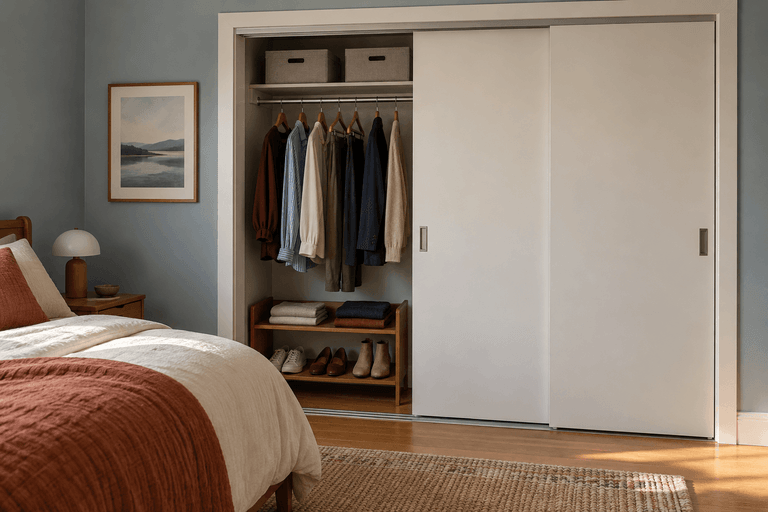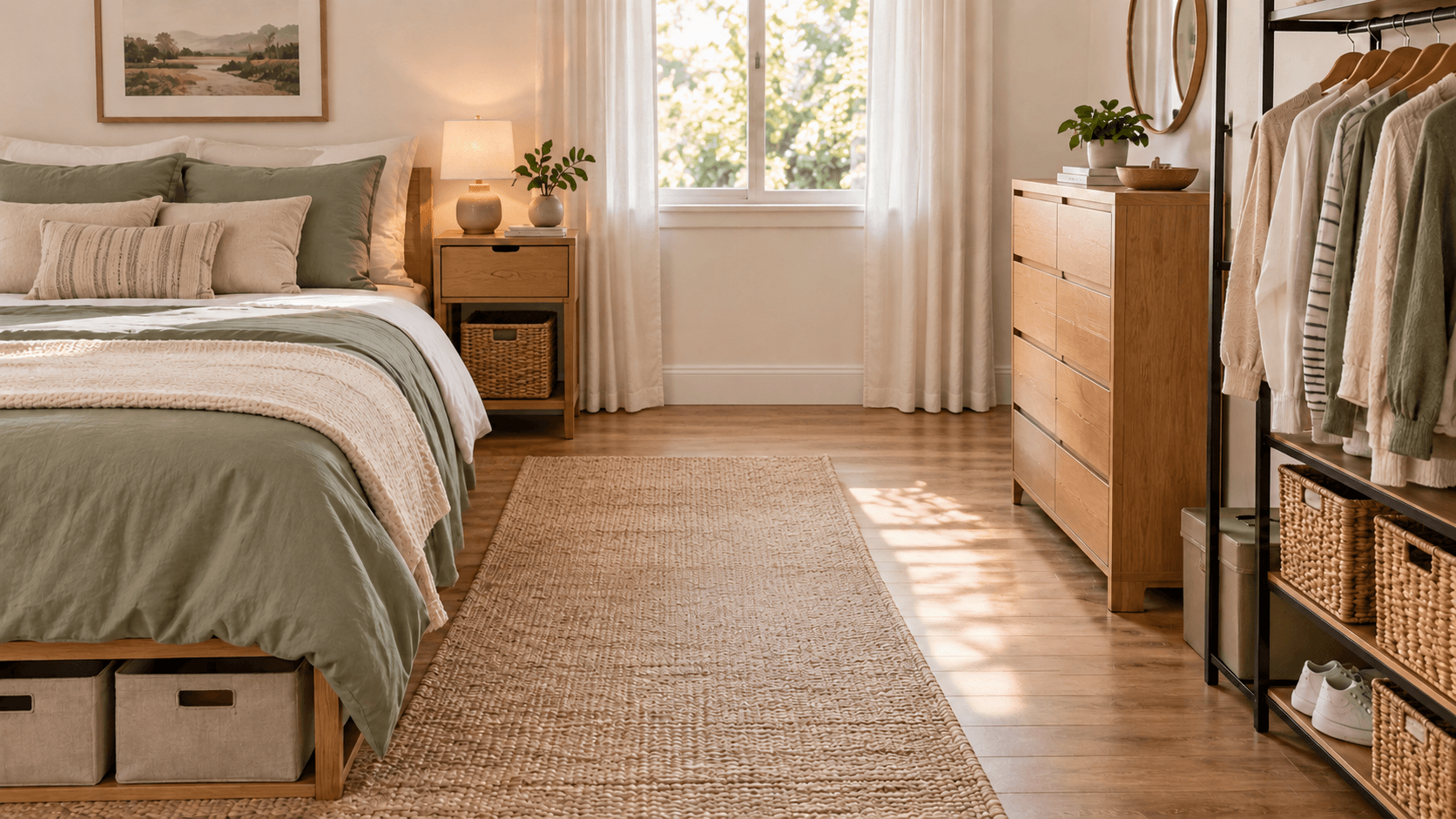
How to Organize a Small Bedroom: 11 Practical Fixes for Everyday Clutter
Disclosure
This post may contain affiliate links. If you purchase through these links, I may earn a small commission at no extra cost to you. As an Amazon Associate I earn from qualifying purchases.
Organizing a small bedroom can feel productive while you are doing it.
You buy baskets, divide the drawers, move the furniture and find containers for everything that was previously sitting out. For a few days, the room looks better.
Then the clothes return to the chair. The nightstand fills up again. The new baskets become places to hide miscellaneous objects, and you still have to move three things whenever you need the one stored behind them.
The problem is not necessarily that you organized badly.
It may be that you started organizing before identifying what was making the room difficult to use.
A small bedroom does not have enough spare space to support complicated systems, unnecessary furniture or storage that is inconvenient to access. Every solution has to work with your actual habits, not the version of your routine you imagine having after the room is perfectly organized.
The following checks will help you identify why clutter returns, make existing storage easier to use, and decide whether another organizer would actually help.
1. Organizing Clutter Is Not the Same as Reducing It
It is possible to arrange clutter beautifully.
You can place it in matching containers, label every basket and line everything up neatly on a shelf. The room may look more controlled, but you still own the same number of things and they still require the same amount of space.
This is why some bedroom organization projects feel successful for a week and then slowly collapse. Nothing was removed, relocated or reconsidered. It was simply packed into a more attractive configuration.
Before buying organizers, separate the room’s contents into four broad groups:
- Things you use regularly
- Things you use occasionally
- Things that belong somewhere else
- Things you no longer need or genuinely want
You do not have to become a minimalist. You do need to stop asking one small room to store objects that do not support how you currently live.
Pay particular attention to duplicates, empty packaging, clothes waiting indefinitely for repair, products you tried and disliked, old paperwork and decorative objects you no longer notice.
The goal is not to reach an arbitrary number of belongings. It is to make sure the room is not working harder than necessary to store them.
2. More Organizers Can Create More Clutter
An organizer is useful only when it solves a clearly defined problem.
A drawer divider can stop socks from spreading through an entire drawer. A narrow hamper can prevent laundry from collecting on the floor. A basket can keep a category of small items together.
But adding containers without deciding what each one is for creates another layer of clutter.
The containers occupy space. They create additional edges and surfaces. Open bins expose their contents. Deep baskets allow unrelated objects to disappear underneath one another. Small organizers can multiply until the room contains more storage products than useful storage.
Ask yourself one question before buying: what specific items will this hold, and does that spot make them easy to grab and put away?
If you cannot name the belongings, the location and the routine, you probably do not need the organizer yet.
This does not mean storage products are a bad investment. It means they should be purchased after the problem has been diagnosed. If the problem is genuinely insufficient enclosed storage, these storage cabinets for small spaces can add useful capacity. They will not, however, decide what deserves to be stored inside them.
3. You Need to Identify Which Problem You Actually Have
A bedroom can look disorganized for several different reasons, and each one requires a different response.
You have too many belongings for the available space
No arrangement will create unlimited capacity. Some things will need to leave the bedroom, move into deeper storage or be released.
You have enough storage, but it is badly configured
The closet rail may be packed while the space above it remains empty. A deep dresser drawer may contain one loose layer of clothing. The back of the door may be unused while bags collect on the floor.
In this case, reorganizing the existing capacity may solve more than adding another piece of furniture.
The storage is difficult to access
Belongings have assigned homes, but reaching or returning them involves opening several lids, moving other objects, or using a location that is uncomfortable for you.
Check the sequence rather than judging the appearance. If putting away one shirt requires removing a box, opening a drawer, and shifting another pile, simplify that route before adding more capacity.
The room is being asked to perform too many functions
A small bedroom may also be an office, dressing area, workout space, laundry zone and general storage room. Without clear boundaries, the objects associated with every activity remain visible at once.
Do not prescribe storage until you know which of these problems you are solving. Otherwise, you can spend money fixing the wrong one.
4. Frequently Used Things Deserve the Easiest Storage
Not every storage location has equal value.
The easiest location depends on your room and how you move. A reachable drawer may suit everyday clothes, but a smoothly operating under-bed drawer can also work if you can open it comfortably. A high shelf may be suitable for occasional supplies while being impractical for something you need each morning.
Judge accessibility by whether you can retrieve and return the item comfortably not by the storage category alone.
Give the easiest locations to the things you use most often.
Everyday clothes should not sit behind formalwear. Daily skin-care products should not share prime drawer space with unopened backups. The bag you carry regularly should not be underneath three bags you use twice a year.
A simple hierarchy works well:
- Prime storage: Things used daily or several times a week
- Secondary storage: Things used occasionally but still regularly
- Deep storage: Seasonal, sentimental or rarely needed belongings
This is particularly useful for clothing. If you love most of your wardrobe and do not want to remove it, Too Many Clothes but Love Them All? How to Make a Small Closet Work explains how to prioritize access without treating every rarely worn garment as something that must be discarded.
The most accessible part of the bedroom should reflect the life you live most days not the exceptions.
5. Every Item Needs a Realistic Return Location
The hardest part of organizing is not placing everything neatly once. It is making the correct action easy enough to repeat when you are tired, busy or in a hurry.
If you’re like me and worn clothes routinely land on a chair, ask why.
Perhaps they are not clean enough to return to the closet but not dirty enough for the hamper. They need a hook, short hanging rail or designated basket, not another promise that you will stop using the chair. Our guide to where to put worn-but-not-dirty clothes in a small bedroom explains how to choose between storage options.
If jewelry remains on the dresser, the jewelry box may be too far away or too complicated to open. If shoes collect beside the door, their official home may not be near the place where you remove them. If chargers cover the nightstand, there may be nowhere for the cables to go while remaining connected.
Watch where objects naturally accumulate. Those piles are information. They show you where the room’s current system conflicts with your routine.
A good return location should be:
- Close to where the item is used or removed
- Easy to open or access
- Large enough for the category without being overfilled
- Specific enough that you know what belongs there
- Simple enough to use without rearranging other things
The less effort required to put something away, the more likely the system is to survive ordinary life.
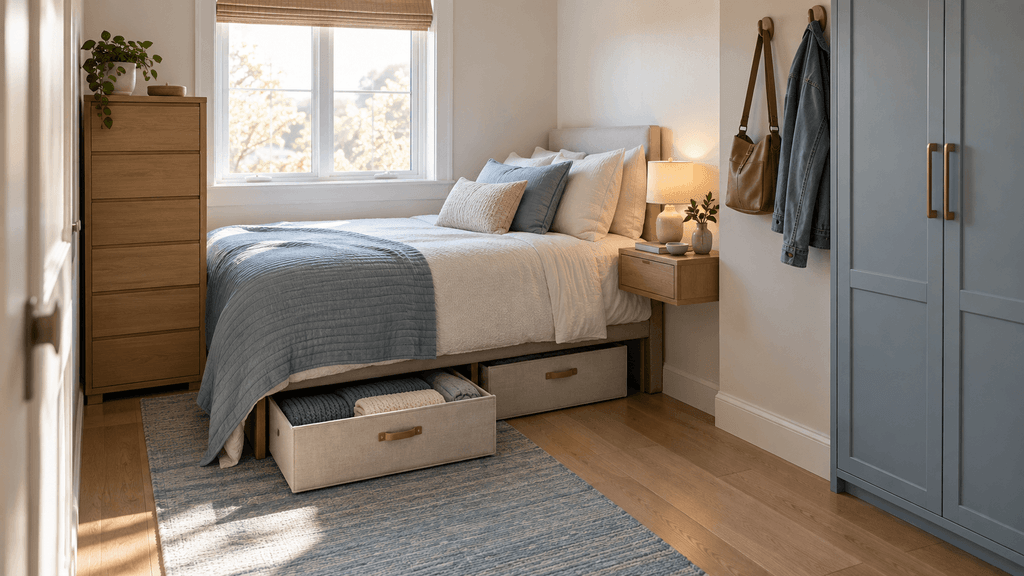
6. Hidden Storage Can Still Be Bad Storage
Closed doors and drawers reduce visual clutter, but they do not automatically create organization.
A drawer packed so tightly that it cannot open properly is not functional storage. Neither is a cabinet containing unrelated objects stacked behind one another or an under-bed container you have to drag into the hallway to reach.
Hidden storage works when its contents remain visible enough to understand and accessible enough to use.
Avoid filling every container to maximum capacity. A little unused room makes it easier to remove one item without disturbing everything around it.
Keep broad categories together, but do not make them so broad that they become meaningless. A basket labeled “miscellaneous” is usually a delayed decision rather than a system.
Clear containers can help with deep or infrequently accessed storage because you can identify the contents without opening each box. Opaque baskets are better when the container remains visible and you want a calmer appearance, but labels may be necessary.
True organization isn’t about hiding your stuff out of sight. It’s about knowing where things are and retrieving them without causing a new mess.
7. Match Storage Access to How Often You Need It
Under-bed storage, high shelves, and the space above a wardrobe can add capacity, but they don’t all require the same effort to use.
A lidded box behind another container is very different from a drawer that opens smoothly beside the bed. The drawer may suit everyday clothing; the obstructed box is better reserved for belongings you need less often.
Before assigning a category, try its normal retrieval and return:
- Can you open the storage fully?
- Can you reach the item comfortably?
- Must you move unrelated belongings first?
- Can you put it back without rebuilding a stack?
Use less convenient locations for suitable occasional belongings, such as seasonal clothes, spare bedding, or travel supplies. Keep frequently used items in places that work comfortably for you.
Follow individual storage requirements too. Medicines, for example, should be stored according to their instructions and household access needs not simply wherever they are easiest to reach.
You don’t need to fill every deep-storage space. Leaving part of it unused may be preferable to creating a daily routine that requires repeated lifting, kneeling, or moving furniture.
8. Use Empty Space Before Adding More Furniture
When a room lacks storage, the immediate response is often another dresser, cabinet or shelf unit.
That may add capacity, but it also consumes floor space, reduces visible floor and can narrow the walking route around the bed.
Before introducing another large piece, look at the space the room already has but is not using well:
- The area under the bed
- The wall above a desk or dresser
- The back of the bedroom or closet door
- The space above a wardrobe
- The lower half of a closet used only for short hanging clothes
- Empty corners that can hold genuinely narrow vertical storage
Vertical and hidden storage can recover capacity without making the center of the room harder to navigate.
But do not cover every wall simply because it is empty. Too much visible shelving can make a small bedroom feel busier, particularly when it holds many unrelated objects.
If the closet is the main problem, 7 Products That Fixed My Tiny Closet and Doubled My Storage shows how to use the rail, upper shelf, door and vertical gaps before replacing the entire system.
Add furniture only after you have established that the bedroom genuinely lacks capacity not merely that its current capacity is poorly used.
9. Protect the Walking Space
Storage capacity is not the only measurement that matters in a small bedroom. You also need to move through it.
A deep dresser may hold more clothing, but if its drawers open into the main walkway, using it will be annoying every day. A storage bench at the foot of the bed may look useful until it leaves an awkward squeeze between the bed and the wall. An extra cabinet can make the room technically more organized while making it physically harder to live in.
Walk your normal routes:
- From the door to the bed
- From the bed to the closet
- From the closet to the mirror or dresser
- From the bedroom to the bathroom
Notice where you turn sideways, bump furniture, step over bags or cannot fully open a door or drawer.
Those obstructions are not small inconveniences to accept after organizing. They are evidence that the layout is not working.
If the room is long or particularly restricted, How to Arrange Furniture in a Small Narrow Bedroom explains how to protect the main walking route while still fitting necessary storage.
An organized bedroom should be easier to move through, not simply better at holding things.
10. Visible Storage Needs Editing
Open shelves and clothing racks are sometimes unavoidable, especially in bedrooms without adequate closets.
The mistake is treating every visible surface as maximum-capacity storage.
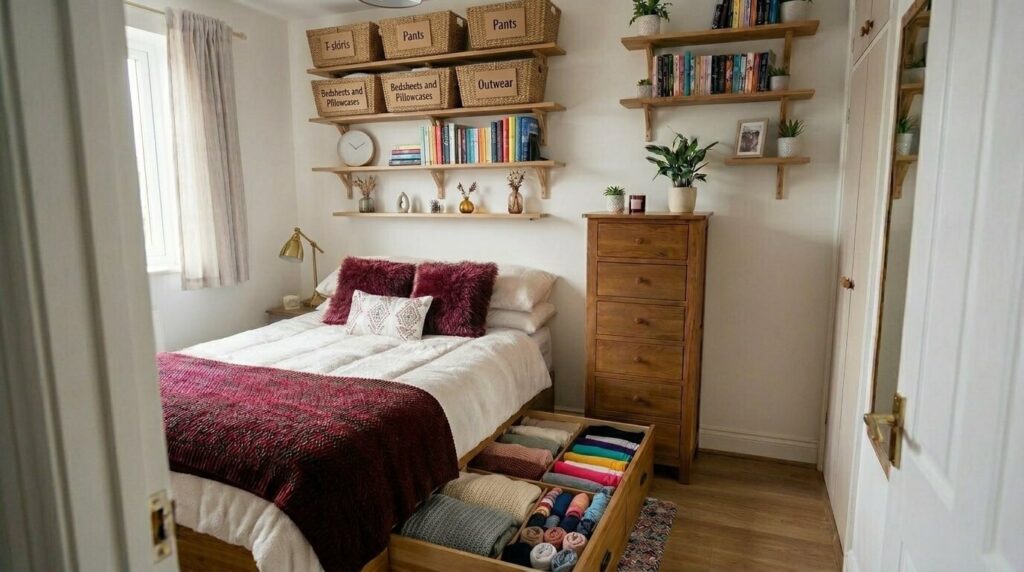
When dozens of unrelated objects remain visible, the eye processes every color, label, shape and edge. The room can be clean and still look unsettled.
Make visible storage more intentional:
- Group small belongings inside matching or coordinated containers
- Keep categories together instead of spreading them across several surfaces
- Leave some space between displayed objects
- Use matching hangers on exposed clothing rails
- Limit the number of colors visible in product packaging
- Reserve eye-level shelves for the items you want to see
- Move unattractive backups and rarely used objects into closed storage
You do not need to hide everything.
A stack of books, one tray of daily products and a few attractive objects can look deliberate. Twenty unrelated belongings across the same surface usually will not.
This is also why buying another open shelving unit can backfire. It adds capacity, but it also adds more belongings to the room’s visual field.
11. The System Needs a Reset Routine
No bedroom remains perfectly organized without maintenance. That does not mean the system failed. It means objects move when the room is used.
The practical solution is a short reset that returns the room to its working state before disorder becomes a larger project.
A nightly reset might include:
- Putting laundry into the hamper
- Returning worn-but-not-dirty clothes to their designated hook or basket
- Clearing cups and dishes
- Returning cosmetics and accessories to their storage
- Putting chargers back in position
- Clearing the main walking path
A weekly reset can handle the tasks that take slightly longer:
- Returning misplaced items to other rooms
- Emptying the trash
- Changing bedding
- Clearing the nightstand and dresser
- Reviewing the chair, floor and other clutter magnets
- Putting away clean laundry
The reset should take minutes, not require reorganizing the entire bedroom.
If it repeatedly takes much longer, the storage system is probably too complicated, too full or too far from the places where belongings naturally accumulate.
This routine also helps the bedroom transition away from daytime responsibilities. For more on visual clutter and the end-of-day atmosphere, see Why Your Bedroom Doesn’t Feel Relaxing.
How to Organize a Small Bedroom in the Right Order
If the room currently feels overwhelming, do not empty every drawer onto the bed at once.
Work through it in this order.
Step 1: Clear the floor and walking path
Remove trash, dishes and objects that belong in other rooms. Put obvious laundry into the hamper.
This creates enough physical space to continue without moving piles from one obstruction to another.
Step 2: Clear one visible surface
Start with the nightstand or dresser, not both.
Remove everything, clean the surface and return only the items that genuinely need to stay there. Give the remaining objects proper homes before moving on.
Step 3: Sort by category
Bring together similar belongings so you can see the true quantity.
It is difficult to decide whether you need another organizer for hair products when some are on the dresser, some are in the bathroom and others are inside three different drawers.
Step 4: Assign storage according to frequency
Put everyday items in prime locations. Move occasional and seasonal belongings into secondary or deep storage.
Step 5: Fix the places where clutter repeatedly forms
Address the chair, bedside floor, dresser corner or other location that repeatedly collects belongings. Give those objects a realistic nearby home.
Step 6: Add storage only where a gap remains
Once everything has been sorted and assigned, you can see whether the room genuinely needs another hamper, drawer unit, cabinet or closet accessory.
If clothing capacity remains the problem, a dresser under 30 inches wide may add storage without demanding a long section of wall. If laundry keeps collecting in a narrow gap or on the floor, one of these slim laundry hampers for small spaces may solve that specific failure point.
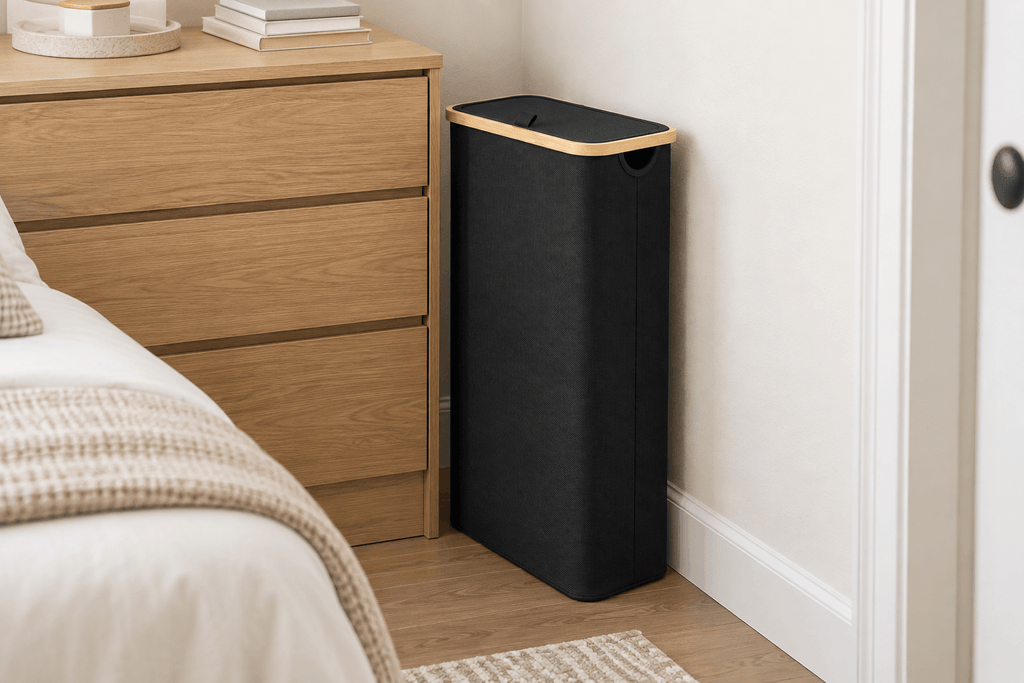
Do not buy both simply because they are designed for small spaces. Buy only the piece that solves the problem still remaining after the room has been edited.
Step 7: Follow One Recurring Pile Through Your Routine
Choose the pile that returns most often: clothes on the chair, products on the dresser, or belongings beside the bed. Follow that category through your next few normal uses.
Notice where the item comes from, where you use or remove it, and what happens when you try to put it away. Record the specific obstacle. “The room gets messy” is less useful than “I have to move the makeup pouch before I can open the drawer.”
Change one part of that sequence, then try again. You might bring the return location closer, separate two categories, remove an unnecessary lid, or keep suitable hangers ready.
For example, suppose hair accessories collect beside your mirror even though they have a box inside the closet. Try an existing shallow compartment near the mirror before buying a larger box. If that location gets used and stays manageable, the problem may have been placement rather than capacity.
This is an illustrative example, not a setup I’ve personally tested. Use the same observation process with your own recurring pile.
Check that the change leaves nearby drawers, doors, and walking space usable. Keep it if it improves the routine; adjust it if it simply moves the obstruction elsewhere.
Frequently Asked Questions
How do I start organizing a small bedroom when I feel overwhelmed?
Start with the floor and the main walking route. Remove trash, dishes, laundry and anything that belongs in another room. Then clear one visible surface completely. Finishing one defined area creates working space and is more manageable than pulling the entire room apart at once.
Should I declutter before buying organizers?
Yes. You need to know what you are keeping, how much space it requires and where you use it before choosing a container. Otherwise, you may buy organizers that are the wrong size or create storage for belongings that should not remain in the bedroom.
How can I organize a small bedroom without a closet?
Divide clothing between hanging, folded and deep storage. Use a compact clothing rack or wall-mounted rail for garments that need to hang, a narrow dresser for folded clothing and under-bed containers for seasonal items. Keep the exposed rail edited because overcrowded open clothing storage can make the room look busier.
How do I keep my bedroom organized every day?
Make the return locations easier than leaving things out. Keep the hamper where you undress, provide a place for worn-but-not-dirty clothing and store frequently used items close to where they are used. Finish the day with a short reset rather than waiting until the room requires another full organization project.
What should I do if I do not have enough storage?
First confirm that the problem is genuinely insufficient capacity rather than inaccessible or poorly configured storage. Then use under-bed space, closet height, door backs and unused wall space before adding another large piece of furniture. If those areas are already working efficiently, a narrow dresser or enclosed vertical cabinet may be justified.
Why does my bedroom become messy again so quickly?
The most common reasons are overfilled storage, inconvenient return locations, belongings without defined homes and a system that requires too many steps. Watch where the same piles return. Instead of blaming yourself for not maintaining the room, redesign the storage around what those piles reveal about your habits.
The Goal Is Not a Perfect Bedroom
An organized small bedroom is not one in which every drawer looks styled for a photograph.
It is one where you can find what you need, move through the room comfortably and put belongings away without turning the process into another task.
You may still have a basket that is not perfectly arranged. A few objects may remain visible. The room will occasionally need resetting.
That is normal.
The important difference is that disorder has somewhere to go and the system does not collapse the moment you become busy.
Before buying another container, ask what problem it will solve. Before adding another piece of furniture, ask what it will do to the walking space. Before hiding a pile, ask why it formed there.
The best small-bedroom organization system is rarely the one with the most products. It is the one that makes the room easiest to use tomorrow.