Where To Put A Wet Bath Mat Between Showers In A Small Bathroom
Disclosure
This post may contain affiliate links. If you purchase through these links, I may earn a small commission at no extra cost to you. As an Amazon Associate I earn from qualifying purchases.
A bath mat needs a place to dry as well as a place to sit. In a small bathroom, those are often different locations.
Leaving it on the floor may keep it underfoot while its underside remains damp. Hanging it beside the towels may crowd the only rail. Putting it over the shower screen can interfere with the door or use a fixture that was never intended to support it.
Where to put a wet bath mat depends on its construction, care instructions and the space available for drying. For a flexible mat that permits hanging, a suitable rail or rack may work. A backed rug or rigid stone mat may need a different approach.
Start with the mat you own before buying another bathroom organizer.
Check Which Kind Of Mat You Have
“Bath mat” can mean a towel-like cotton textile, a thick tufted rug, a memory-foam mat with backing or a rigid absorbent board. These do not necessarily tolerate the same folding, hanging or heat.
Check the label or manufacturer’s instructions for:
- Whether air drying, flat drying or tumble drying is permitted.
- Any restrictions on folding, heat or direct sunlight.
- Care of the backing or separate pad.
- When the mat and floor must be dry before use.
Do not assume a rubber-look backing rules out every dryer, or that a cotton surface means the whole mat can tolerate heat. Follow the instructions for the complete product.
For example, Gorilla Grip’s chenille bath-rug instructions permit low-temperature tumble drying and require a dry underside and suitable dry floor for use. That is guidance for that product, not a rule for every backed rug.
If the label is missing, try identifying the model before applying heat or suspending it from clips that might damage it.
Choose A Drying Position, Not Just Somewhere To Put It
The useful location lets the mat dry without blocking another part of the bathroom.
For a flexible mat whose instructions permit draping, spread it over a suitable support rather than bunching it into a small bundle. Keep it separate from damp towels and avoid pressing it against a wet wall.
Look at the space beneath it too. Does moisture drip onto a walkway, wooden cabinet or a floor surface that should stay dry? Does the hanging mat cover the toilet-paper holder or prevent a drawer from opening?
A tidy-looking position is not enough. A mat tucked behind a door can remain crowded against the wall; a compact rack can occupy the exact floor area you need to enter the shower.
Check the drying arrangement with the mat hanging, not just with the empty rack in place.
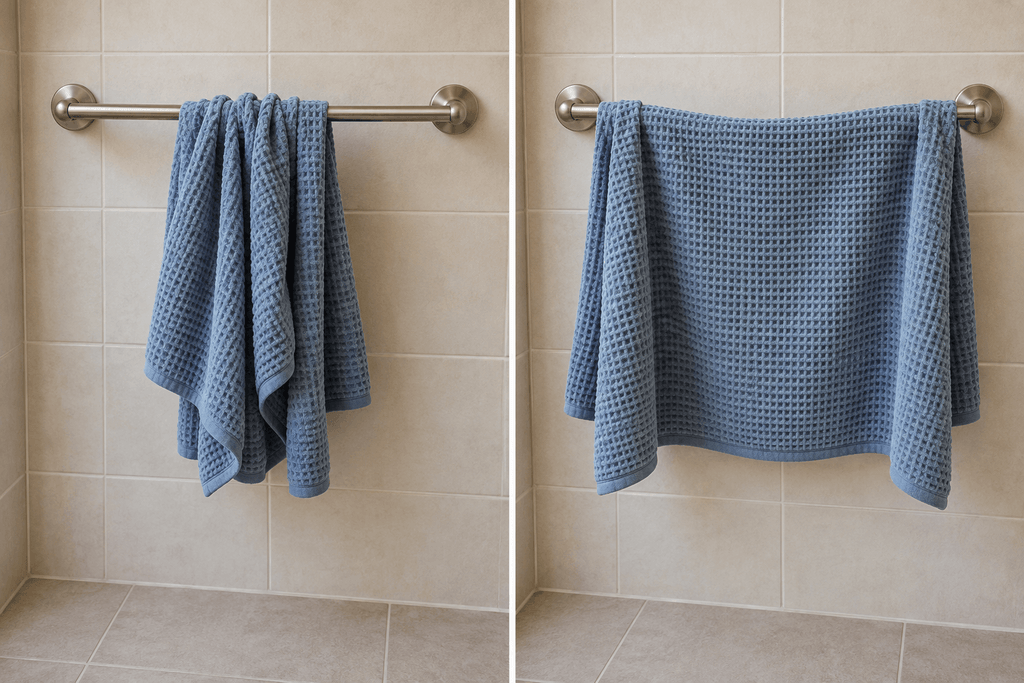
When You Have A Suitable Towel Bar Or Drying Rail
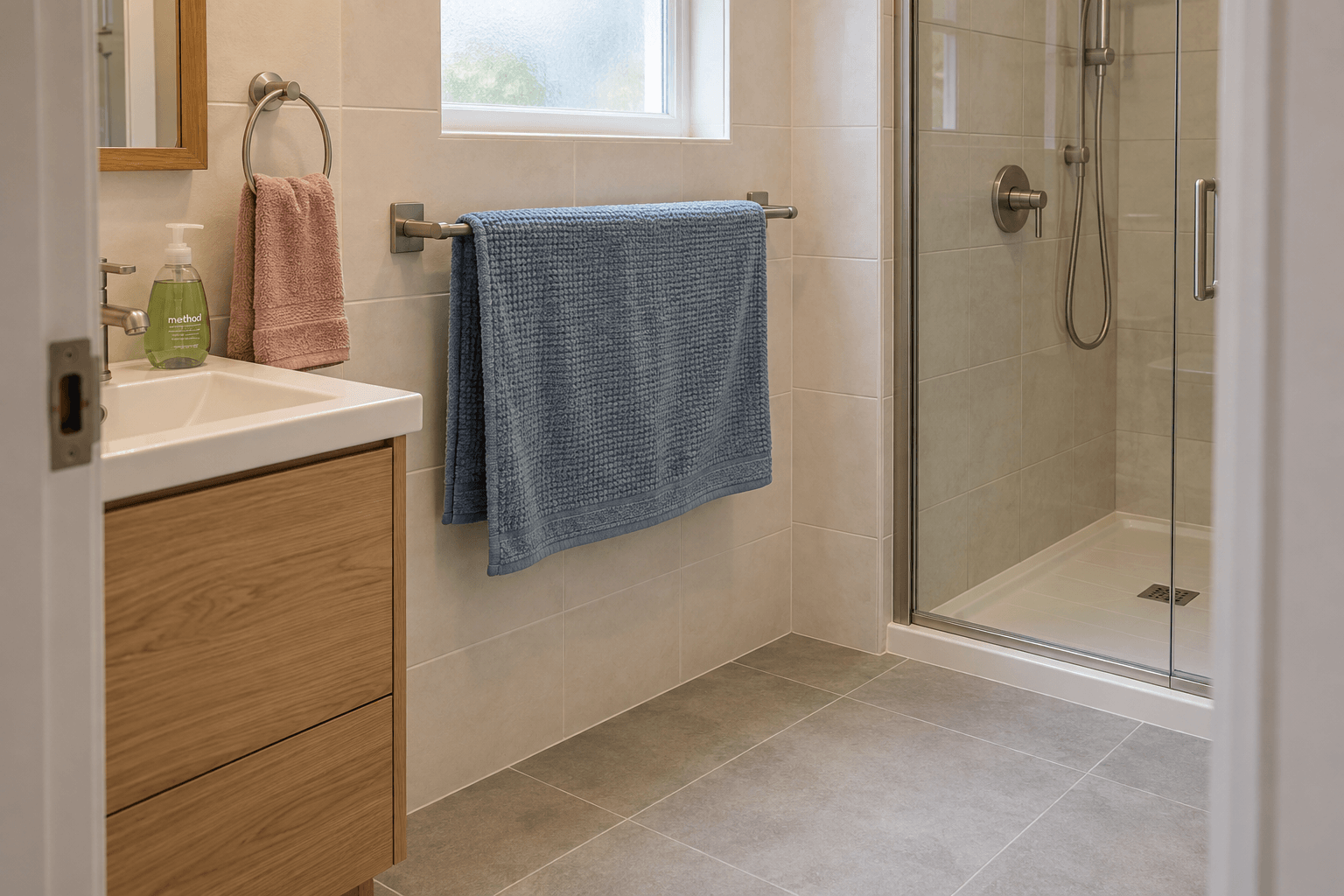
An existing rail may be the simplest option for a mat that can be draped, provided the rail is appropriate for that use and the wet load.
Check its usable width and mounting. A bar that accommodates a hand towel is not automatically suitable for a heavy wet rug. Do not infer a load capacity from how substantial the hardware looks.
If the mat fits, spread it along the rail without folding it repeatedly to squeeze into a narrow section. Where practical, avoid leaving its two hanging sides pressed tightly together.
Give the mat its own space. Covering it with a bath towel or draping it over towels already on the bar creates overlapping wet layers.
A deep, heavy rug may be awkward to lift onto a high rail even if the hardware can support it. Choose a position you can reach comfortably without standing on the toilet, tub edge or another fixture.
When There Is No Bathtub Or Spare Rail
A small bathroom with a shower stall may offer no obvious place to hang a mat. Consider these arrangements in order of what the room can actually accommodate.
An Appropriate Over-Door Rack
An over-door rack can avoid using floor space, but check more than whether its hooks fit the top of the door.
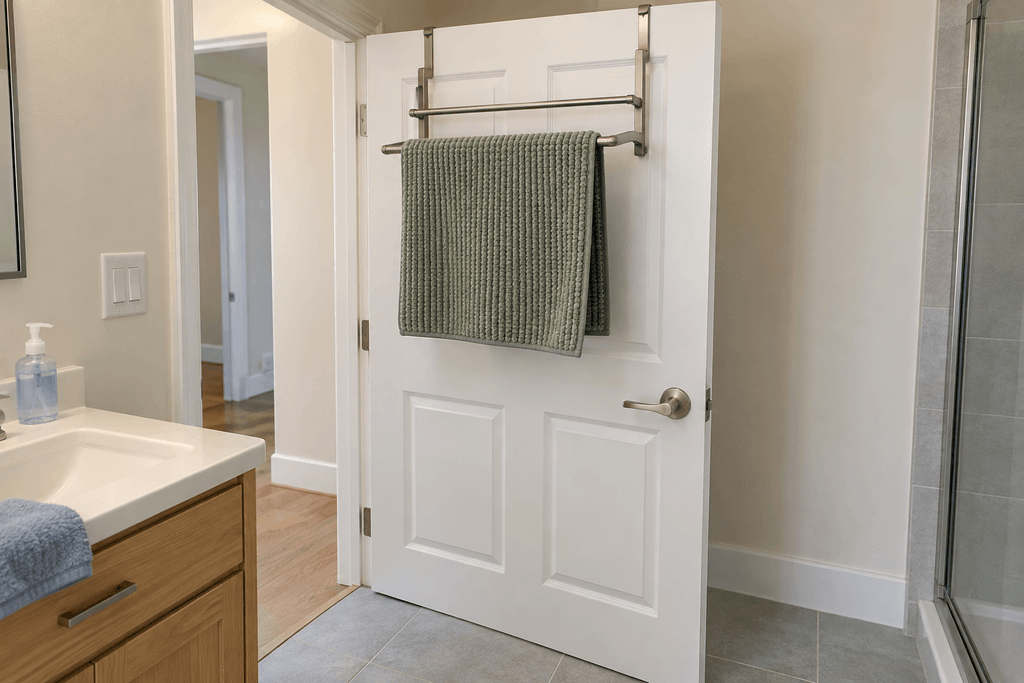
Confirm the product’s mounting requirements, permitted load and compatibility with the door. Then check the loaded arrangement:
- Can the door close normally?
- Can it open fully without the rack or mat hitting the wall?
- Does the mat hang clear of the handle and floor?
- Is it separated from other wet textiles?
- Can you remove and replace it without awkward reaching?
The thickness of the mat can matter as much as the empty rack’s projection. Avoid forcing the door shut over unsuitable hooks.
A Compact Freestanding Rack
A small rack may work where mounting is restricted, provided it is stable and leaves the bathroom usable.
Measure its open footprint and account for the hanging mat. A folded rack’s dimensions do not describe the space needed while drying.
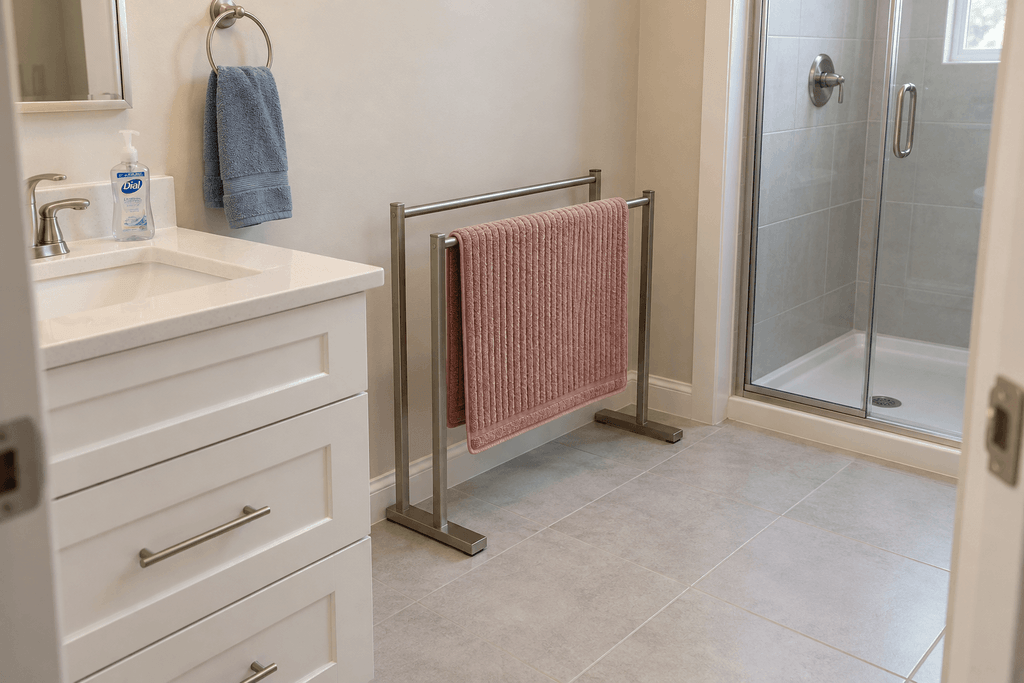
Place it outside the walking route, door swing and shower entrance. If the only possible position blocks the room, a freestanding rack has not solved the space problem.
A suitable drying location elsewhere may be more practical. Carry the mat without dripping along the route, and protect the surface beneath it as required. Do not drape it over upholstered furniture simply because that room has more space.
A Permitted Wall-Mounted Rail
A dedicated rail may suit a bathroom with an unused wall section. Check that the hanging mat will clear fixtures and leave enough room to move.
Renters should confirm permission and use hardware suitable for the wall and intended wet load. An adhesive fitting is not automatically compatible with a textured, painted or tiled surface; follow its exact instructions.
Choose a support for the mat you need to dry, rather than choosing a small hook and forcing the mat onto it.
Can You Use The Tub Edge, Shower Screen Or Curtain Rod?
These are possible locations to assess, not interchangeable drying supports.
The Tub Edge
For a mat that allows draping, a suitable tub edge may provide a temporary position. Check that the mat does not obstruct anyone entering or using the tub, become caught in the enclosure or sit in ongoing spray.
The surface beneath it matters. A wide damp contact area is different from a narrow rail with space around the fabric. Check the underside rather than assuming the visible surface tells you the whole mat is dry.
The Shower Screen Or Door
Do not assume a glass panel, door handle or towel bar can carry a wet mat. Follow the enclosure and accessory manufacturers’ limits.
A compatible purpose-made accessory may offer a drying position, but the door still needs to move normally. Keep fabric clear of hinges, seals and the entrance.
Do not add improvised clamps to glass or use the top edge as a support without confirming suitability.
The Shower Curtain Rod
A shower curtain rod supports the load and installation conditions it was designed for. A wet mat adds weight, and a tension rod can be displaced if used beyond those conditions.
Use it only if the rod and mat instructions permit the arrangement. Otherwise, choose a different support rather than treating the rod as a spare drying rail.
When The Mat Is Backed Or Rigid
A flexible surface does not necessarily mean the mat can be folded sharply, clipped by a corner or left hanging from a narrow point. Backing, seams and foam layers may have their own care requirements.
If flat drying is specified, use an appropriate supported position with airflow rather than improvising a hanging method. If tumble drying is permitted, use the specified setting and follow the appliance instructions.
Rigid absorbent mats need separate consideration. They cannot be draped over a towel bar like a cotton mat.
Some brands call for adequate airflow and complete drying between uses. They advise propping the product against a wall when overly saturated. Check a brand’s guidance separately.
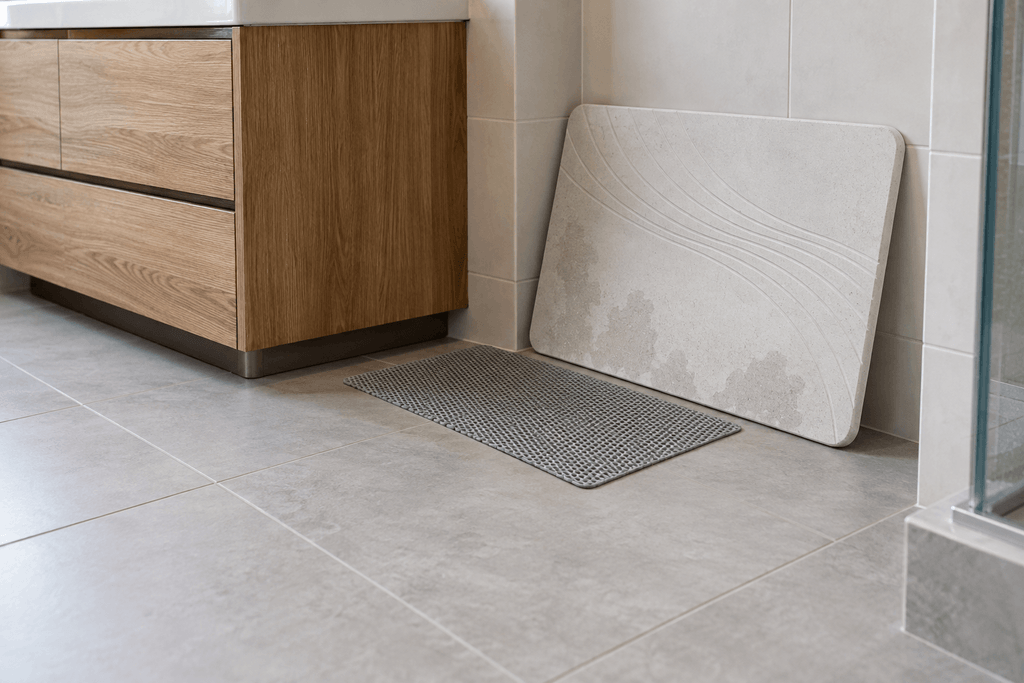
If an upright drying position is permitted, choose a stable location outside the walking route where the mat will not fall or be knocked over. Do not suspend a rigid mat from ordinary towel hooks.
When Several People Shower Close Together
A mat may be wetted again before it has had time to dry, especially in a shared bathroom.
Give the drying arrangement enough capacity for the routine. If you use a spare, the first mat still needs its own drying position; swapping mats and piling the damp one in a basket only relocates the problem.
A smaller or lighter mat that meets the placement requirements may be easier to handle and dry than a large plush rug. That does not establish a drying time: material, water exposure and room conditions still matter.
Where practical, reduce water reaching the mat by drying yourself before leaving the bathing area while standing securely. Avoid balancing on one foot to dry the other.
Put a replacement mat down only under the floor conditions its instructions require. If the floor beneath the first mat is wet, deal with that before covering it again.
If The Mat Still Stays Damp
Check what is happening before buying a product labeled “quick dry.”
Is the mat receiving spray after you hang it? Are its layers pressed together? Is the backing still damp even though the pile feels drier? Is the room’s ventilation working as intended?
Use the bathroom’s existing ventilation according to its instructions and address a faulty fan or persistent moisture problem separately. Moving the mat cannot compensate for every room condition.
Also distinguish normal moisture from bathing from a leak or repeated puddling. A mat should not be used to conceal an unresolved water problem.
If the care instructions permit machine drying, that may be an option. Do not speed things up with an unspecified heater, heated rail or hotter dryer setting.
Drying also does not replace cleaning. Follow the mat’s washing and maintenance instructions, particularly when dirt or product residue has accumulated.
Return It To A Clean, Dry, Usable Position
Before returning the mat, check the conditions required by its manufacturer, including the underside, backing or separate pad and the floor beneath.
Spread it flat, keep its edges clear of doors and fixtures, and address shifting or curling before treating the arrangement as finished.
If its floor position is the problem, our guide to bath mat placement in a small bathroom covers shower exits, pedestal sinks, door conflicts and shared walkways.
A workable drying routine has three parts: a method suitable for the mat, a support suitable for the load and a location that leaves the room usable. You do not need a collection of new organizers just an arrangement that works after the shower as well as during it.